22 May 2024

What does the mental health services landscape in South Western Sydney look like today – and how will we meet the expected increase in demand over the next decade? 

That was the focus of South Western Sydney Primary Health Network’s (SWSPHN) Mental Health Needs Assessment undertaken with insights from health professionals and community members throughout the region. The results, released earlier this year, revealed a range of key challenges and priorities both today and into the future to meet the mental health needs of our community. 

Participants at one of our Local Health Forums last year which focused on mental health.

They included: engaging with community leaders to convey key messages; increasing advertising; and improving targeted training for primary health care providers. 

Participants with professional or lived experience were approached by SWSPHN during a six-month consultation process.  

The objectives were: to understand mental health service projections; define vulnerable groups under-serviced by the Medicare Better Access initiative; understand the barriers and enablers to accessing mental health services; identify workforce experience and skills gaps; and identify opportunities to improve mental health services across South Western Sydney. 

Methods for information gathering included Local Health Forums (87 attendees), online surveys (completed by 62 community members and 27 mental health professionals) and structured interviews with 19 mental health professionals from the region. 

An extensive review of literature, health data and SWSPHN commissioned provider activity was undertaken to complete the report. 

Focus areas of the local health forums included barriers and challenges, opportunities for access, service navigation, care coordination, co-morbidity support and key priorities. 

For mental health professionals, the focus was on: underserviced groups; access barriers; care coordination; workforce experience and skills gaps; service provision barriers and perceptions of SWSPHN commissioned services. 

In 2023-24, Campbelltown had the highest predicted prevalence of mental illness compared to other areas (mild 8 per cent, moderate 5 per cent and severe 2.6 per cent respectively). 

The needs assessment identified several opportunities for mental health system improvement in South Western Sydney. Key priorities included: 

  • Priority 1: Enhancing community engagement and knowledge of mental health services by engaging with community leaders to convey key messages; increasing advertising and promotional material; and improving HealthPathways targeted training for primary care providers. 
  • Priority 2: Developing the mental health workforce capacity by upskilling GPs in key areas; establishing a SWSPHN-led webinar series to support primary care workers; and building capacity in the mental health workforce to improve accessibility.  
  • Priority 3: Improving care coordination and discharge planning by implementing an effective system; facilitating multi-disciplinary case conferences with GPs and mental health providers; and establishing inter-agency meetings to improve service awareness. 
  • Priority 4: Enhancing funding to improve accessibility to services such as early intervention and prevention programs in schools; increased services to support those experiencing a traumatic event; and improved service provider collaboration to support patient connection to services. 
  • Priority 5: Improving the SWSPHN mental health intake process and increasing follow-ups for vulnerable patients. 
Download the report
18 March 2024

The Department of Health and Aged Care’s Health Design Lab is inviting you and your staff to provide input on LGBTIQA+ healthcare.

The research aims to gain a deeper understanding of primary healthcare for lesbian, gay, bisexual, trans, intersex, queer and/or questioning, A-sexual and other diverse genders and sexualities (LGBTIQA+) people.

The design lab will be talking to primary care providers and practice staff across Australia, including South Western Sydney.

How to participate:

When and where: The Health Design Lab will be in Sydney between 2 and 13 April. If you have availability at a different time, please advise the design lab via email at Design.Lab@Health.gov.au.

Who: The design lab wants to talk with GPs, primary care nurses, pharmacists, allied health professionals (eg physiotherapists or psychologists), Aboriginal and Torres Strait Islander health workers, and health support staff who interact with patients (eg reception staff).

What: Taking part will include a one-hour interview (per person) at a time convenient for you and your practice. The design lab understands your time is valuable, so they have time slots both within and outside of regular business hours.

Reimbursement: Each participant* will be emailed directly with a $200 gift voucher as reimbursement for their valuable time.

*Please note, the design lab is unable to provide reimbursements to government employees if they participate in an interview during work hours.

To participate or support the project:

  1. Share: Please forward this email to your staff or any other health practitioners who may be interested to let them know about the project.
  2. Reply: If you would like to participate, please reply to this email with your preferred date/s and time/s for an interview.

Project resources

Research overview

Participant information sheet

Participant consent form

If you or any staff members have any questions, please reach out via email at Design.Lab@Health.gov.au or call the project lead, Drew Thomas, on 0422 652 093.

29 January 2024

The Federal Government is undertaking a wide-ranging review to investigate how to more equitably distribute doctors and other health workers around the country.

The Working Better for Medicare Review will look at how current policies and programs can be strengthened to make it easier to see a doctor, nurse or other health worker in the outer suburbs of our major cities and in regional, rural and remote Australia.

Primary healthcare providers are encouraged to provide input, via a survey/written submission.

Visit the government’s webpage to find out more

The review is looking at Medicare’s role in locating the workforce, as well as the three main policy levers used to distribute the workforce:

  • Modified Monash Model,
  • District of Workforce Shortage, and
  • Distribution Priority Area

The review will identify ways to improve health access by building a more stable, motivated and properly located workforce.


29 January 2024

SWSPHN is facilitating a co-design focusing on the health needs of people who are homeless or marginally housed.

The aim of the project is to:

  • Define the characteristics of the homeless population in South Western Sydney
  • Better understand the health needs and risk factors of the homeless population in South Western Sydney
  • Identify the barriers and enablers in accessing healthcare services
  • Identify opportunities to improve health outcomes
  • Identify key priorities for service funding in South Western Sydney

We are seeking input from GPs and practice nurses working in South Western Sydney.

Through structured interviews, GPs and practice nurses are invited to share their experiences providing care to people who are homeless or marginally housed.

Interviews will be approximately 30 minutes long.

GPs and practice nurses will be remunerated for their participation.

If you were interested, please contact SWSPHN Integration and HealthPathways Coordinator Kira Chamberlain at kira.chamberlain@swsphn.com.au.

23 January 2024

The Department of Health and Aged Care is working to understand the perspectives of health professionals regarding navigation, referral to, and uptake of mental health services and treatments, especially for patients with milder symptoms.

It is particularly interested in understanding the barriers and enablers encountered when supporting patients with lower acuity mental health needs and connecting them with appropriate services.

The department has commissioned Liquid Interactive to conduct research to understand the opportunities to improve the experiences of GPs and practice staff across Rural, Remote and Metropolitan Areas (RRMA) of Australia in supporting people with a range of mental health needs.

Download factsheet

Health professionals interested in participating in the research can nominate via this online expression of interest form or through the link included in the above factsheet.

The expression of interest form will be open until Friday, 26 January 2024.

21 November 2023

Practices are invited to participate in the Wearables Integrated Technology to support healthy behaviours in people with type 2 diabetes (WEAR-IT) study.

The study will begin in early 2024 and seeks to test integrating feedback from wearable devices to improve dietary and exercise behaviours within a diabetes self-management plan. Wearable devices will measure blood glucose, blood pressure, and physical activity.

Participating practices will receive:

  • $1,000 for recruiting eligible patients for the trial
  • $200 gift voucher for the practice champion, nominated by the practice team, who will be the main contact point of the study

General practices allocated to the INTERVENTION arm of the trial will receive:

  • Payment of up to $2,500 to cover practice nurse time for administering the intervention (target of 13 patients)
  • $200 shopping voucher for each staff member participating in online training
  • $100 shopping voucher for each staff member who participates in interviews

GPs and practice nurses can also claim CPD hours for their involvement in the study.

All patients will receive $20 reimbursement to attend pathology tests and $10 for completing study questionnaires.

Patients from intervention practices will receive free wearables: transdermal blood glucose monitor (Freestyle Libre 2 starter pack plus 2 additional sensors), blood pressure monitor (iHealth wireless BP monitor) and a physical activity monitor (eg Xiaomi Smartband).

Register your interest

17 November 2023

The Australian Commission on Safety and Quality in Health Care is inviting comments on the draft Chronic Obstructive Pulmonary Disease (COPD) Clinical Care Standard.

Comments are sought from healthcare professionals, peak healthcare and consumer organisations, consumers and any other interested parties.

The clinical care standard includes a set of indicators to support healthcare providers and local health services to monitor how well they implement the care described in the clinical care standard.

Submit comments

Consultation closes 18 December.

26 October 2023

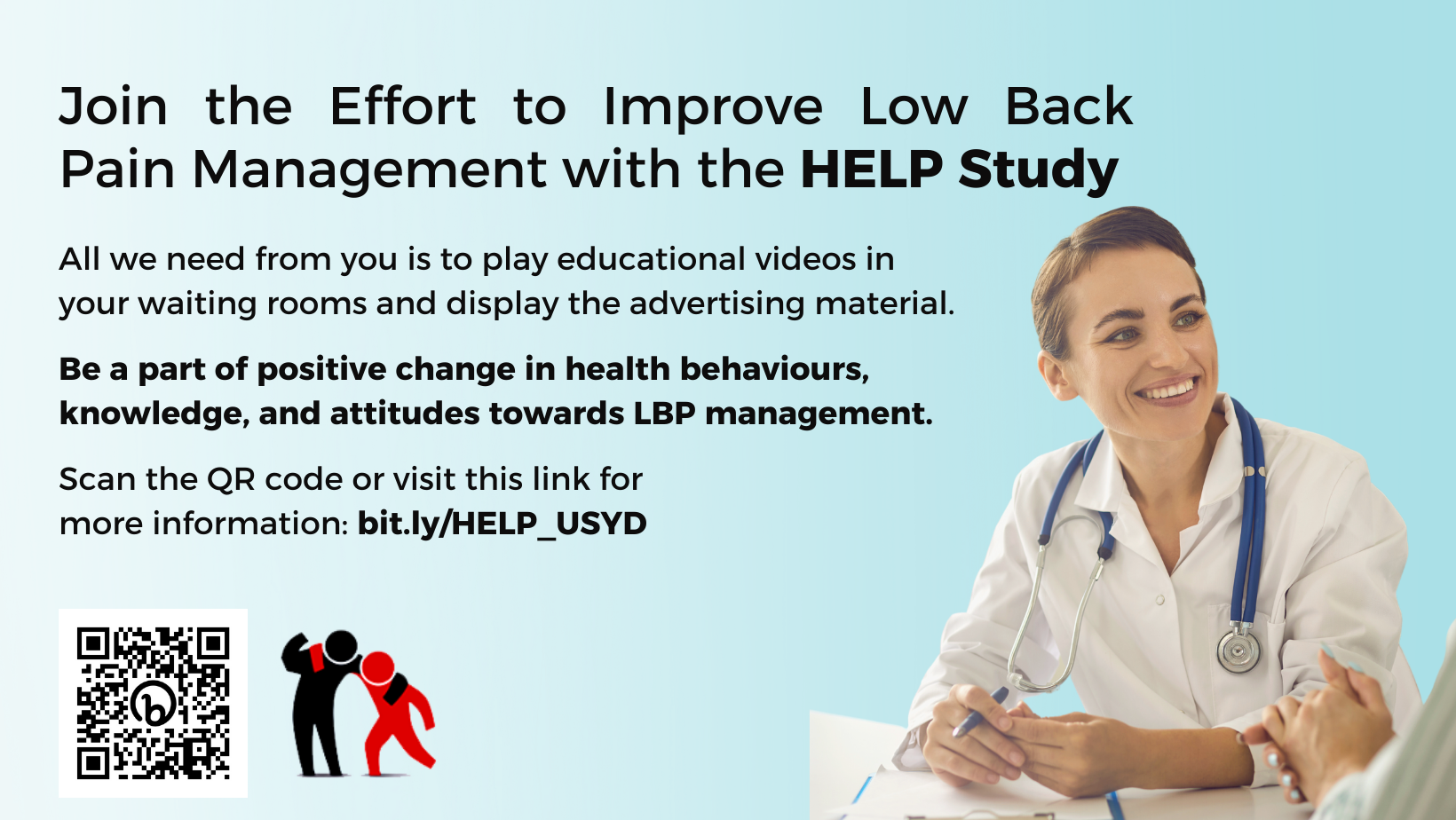
The University of Sydney’s HEalth literacy in Low back Pain (HELP) study is evaluating the effectiveness of a media-led intervention in the management of low back pain (LBP).

The study aims to explore a creative approach to enhance public awareness of LBP management while assessing beliefs and attitudes about LBP.

Researchers are recruiting 45 GP clinics to participate in the study.

Your practice’s involvement would include:

  • Displaying the study advertising materials in practice waiting rooms
  • Ensuring waiting room TVs are switched on and are displaying Tonic Media Network material

At the end of the study, the research team will provide key study findings which can be used by GPs for their CPD accreditation points.

Find out more Download the flyer
21 September 2023

Primary carers in South Western Sydney are invited to participate in the Patient Reported Indicator Surveys (PaRIS), an international project led by the OECD to improve patient-centred healthcare.

The survey assesses how patients with chronic conditions experience healthcare in different countries, especially in primary care settings.

PaRIS uses two types of measurements:

  • Patient-Reported Experience Measures (PREMS) to evaluate practical aspects of care
  • Patient-Reported Outcome Measures (PROMS) to assess how patients perceive the results of their care

Australia is one of more than 20 countries participating, with the survey led by the Australian Commission on Safety and Quality in Health Care on behalf of the Australian Government Department of Health and Aged Care, and supported by ORIMA Research.

The initiative is crucial because it fills an important information gap in primary healthcare.

It helps us understand factors like healthcare access, waiting times, quality of life, pain, physical health and mental wellbeing.

The results will aid local, national and international efforts to improve healthcare delivery.

Ultimately, Australia aims to integrate patient-reported measures into routine clinical care to guide policy makers, empower healthcare providers, and, most importantly, give patients a say in shaping their future healthcare experiences.

The PaRIS Health Survey is open to all general practices and Aboriginal Community Controlled Health Organisations which:

  • are accredited against the RACGP Standards and
  • have an electronic health records system

Find more information:

Patient-Reported Indicator Survey (PaRIS) | Australian Commission on Safety and Quality in Health Care

Register:

PaRIS – Practice Portal

21 September 2023

The University of Sydney and University of Wollongong are seeking 30 general practice nurses to participate in the validation of a new data collection method involving a cloud-based electronic interface called OCEAN (Occasions of Care Explained and Analysed).

Find out more / register