14 September 2023
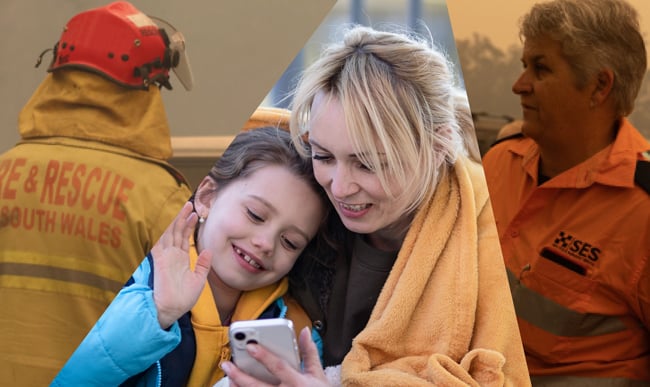
SWSPHN’s Disaster Management team will be sharing information about the importance of healthcare during a disaster or emergency, at the Wollondilly Emergency Services Expo on Saturday, 23 September.
The event will be held from 10am to 2pm at Victoria Park, Picton.
Representatives from the NSW Rural Fire Service, Fire & Rescue NSW, NSW SES, NSW Ambulance and the NSW Police Force will also attend the expo.
Our Disaster Management team will be holding a stall to provide community members with information about how to best prepare their health for a disaster.
They will also be distributing a flyer highlighting the five simple steps to follow to ensure your health and wellbeing can be prioritised during disaster.
The flyer, which provides practical advice about preparing your health for disaster as well as information about access to services, will also be available at:
- Emergency Ready Day, Sunday, 24 September, 11am to 3pm, Koshigaya Park, Campbelltown
- Community Links Wellbeing Festival of Fun, Sunday, 26 November, 10am to 2pm, Bargo Sports Ground
During an emergency, PHNs are the first points of contact on primary healthcare coordination and service availability, as part of the overall coordinated health response.
Health outcomes for our community can be greatly improved and enhanced when we prepare and respond to emergencies together.
17 August 2023
Fussy eating can lead to stressful and prolonged mealtimes, delayed oro-motor skills, and poor health outcomes including nutrient deficiencies (eg iron), slow growth and constipation.
Early intervention is required when fussy eating is caused by sensory sensitivities with food textures, or when it leads to highly restricted diets (less than 15 to 20 different foods) or challenging behaviours at mealtimes.
Children may require referral to speech pathology and/or occupational therapy.
When and how to refer
Mealtime strategies
- Set up routines – Serve food at the same time and in the same place each day.
- Create an engaging mealtime environment – Remove distractions (eg screens, toys) and share meals together as a family to model positive mealtime behaviours like trying new foods.
- Encourage food exploration and play – Participate together in food preparation and play games with food like sorting by colour or texture, or building houses.
Start Them Right: A parent’s guide to eating for under 5s
This article was written by members of the ‘Stronger Seeds, Taller Trees’ project which includes professionals from a number of government and non-government organisations in South Western Sydney. The group aims to support GPs working with families to navigate and access timely services when they have a concern about a child’s development.
07 August 2023
State-wide Referral Criteria (SRC) are clinical decision-support tools which give health professionals the referral criteria they need to refer their patients to public specialist outpatient services across NSW.
SRC helps people who need to see a health professional in a NSW public specialist outpatient service be referred and prioritised in a safe and timely way.
They support patients and the health professionals looking after them to make a referral and assist NSW public specialist outpatient services with screening and triaging these referrals.
Please visit the NSW Health website for more information.
07 August 2023
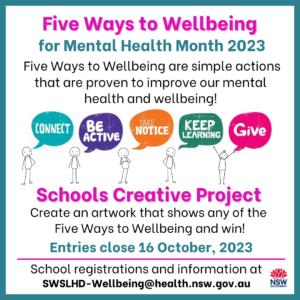
In recognition of Mental Health month this October, SWS Local Health District will be hosting a creative project competition for school-aged children in South Western Sydney.
Students are asked to create an artwork which highlights ones or more of the Five Ways to Wellbeing:
- Connect
- Be Active
- Take Notice
- Keep Learning
- Give
The winning artwork will be displayed online to promote Mental health month and raise awareness of the Five Ways to Wellbeing.
Entries open Monday, 10 August 2023 and close Monday, 16 October 2023 —Term 4, Week 2
Five Ways Schools Creative Project 2023 – entry information
20 July 2023
Some children have difficulty processing and responding to information from their senses.
This includes sight, sound, taste, touch, smell, proprioception (body awareness) and vestibular (movement) input.
Signs of sensitivities:
- Seeking sensations (touching, smelling or licking textures, closely watching moving objects, difficulty sitting still)
- Over-reacting to sensations (becoming upset when touched, easily distracted by noise/light, picky with food textures and smells)
- Under-responding to sensations (appearing to ‘tune out’, low response to sound/touch, poor pain perception)
Download:
Sensory seeking versus sensory sensitive
When to refer:
Refer to an occupational therapist when a child’s sensory sensitivities interfere with everyday routines or engagement in learning. Early referral is key in improving functional, social and academic outcomes.
Download:
Early intervention – where and how to refer
Further information about sensory sensitivities
This article was written by members of the ‘Stronger Seeds, Taller Trees’ project which includes professionals from a number of government and non-government organisations in South Western Sydney. The group aims to support GPs working with families to navigate and access timely services when they have a concern about a child’s development.
19 July 2023
SWSPHN has teamed with Western Sydney University (WSU) and Wests Tigers to support an initiative to improve girls’ health and wellbeing through sport.
Beyond the 80 (BT80) is a family-based healthy lifestyle intervention for girls aged 7 to 11 years and their families in South Western Sydney.
The program will harness the popularity of the Wests Tigers National Rugby League club and use rugby league to engage families to promote health and well-being and address health priorities in the region.
Through participation, spectatorship and community engagement, sport has the potential to improve health outcomes, empower individuals and unite communities.
BT80 will be launched in September, initially as a feasibility study (phase 1), and involve about 30 families or 120 participants.
It will be delivered over 10 weeks and will include weekly education and physical activity sessions at Campbelltown Sports Stadium.
Education sessions will be delivered to girls and adult family members and will focus on building healthy family routines around key lifestyle behaviours, including: physical activity/sedentary behaviour, healthy eating, mental health and sleep.
Data will be collected on a range of health and wellbeing outcomes before and after taking part in the program. Based on findings from phase 1, the program will be optimised and delivered to a larger sample in the pilot trial (phase 2, 2024-25), before being rolled out on a large scale in phase 3.
SWSPHN, WSU and Wests Tigers share a vision to improve health and wellbeing in South Western Sydney.
29 June 2023

SWSPHN is funding a children’s health program aimed at educating and empowering children in South Western Sydney to make better food and sleep choices.
Schools in the region are invited to submit expressions of interest to access a full scholarship with The Root Cause Children’s Health Program (CHP) for 12 months, starting in term four this year.
Applications must be lodged by Friday, 18 August.
The Root Cause is a partnership where entire primary school communities are educated and encouraged to learn and build a positive relationship with food and sleep. Through the program, parents, teachers and children learn about healthy eating and waste.
Five South Western Sydney schools will have an opportunity to participate in the program, which incorporates in-person workshops for students, parents and staff, plus a range of classroom resources, professional development, and an online portal for families to use from home.
Research shows the amount and quality of food eaten by a child has a direct impact on health and well-being, learning, behaviour, resilience and academic results.
This is the first time SWSPHN has linked up with CHP.
During the last decade, The Root Cause has educated more than 59,000 children, parents and teachers from almost 260 schools across Australia.
Apply now
26 June 2023
Transition to school has an impact on a child’s educational trajectory.
A successful transition to school requires social, emotional, communication, and motor skills.
COVID-19 has impacted opportunities for children to develop their ‘ready for school’ skills, as many children could not attend early learning or playgroup.
GPs can help by supporting families to:
Did you find this article helpful? YES / NO
Additional resources:
Children with disability have the right to go to school alongside their peers: Reimagine Australia Ready, Set, School! resource
Starting School (NSW DoE)
PlaygroupsNSW
Find your local school
Transition to School Resource
Crunch and Sip
Conversations for Collaboration
09 June 2023
More imperative than ever, early mental health assessments and support for children and young people should be provided to prevent unnecessary long-term impacts.
Many families visit their GP frequently, and these consultations present the ideal opportunity for early intervention.
As a result of COVID-19, many GPs have become pressed for time, however, GP’s skills and knowledge are crucial in supporting children’s mental health, especially infants and toddlers.
Australia’s Emerging Minds provides an evidence-informed guide created specifically for GPs.
This article includes links to brief videoclips, podcasts and e-learning courses on conducting child mental health assessments.
Early intervention and referral by GPs can prevent progression of a mental health condition, critically contributing to children’s future wellbeing.
Southwest Sydney Paediatric Clinics
Referral
Infant Child Adolescent Mental Health Service (ICAMHS)
Phone: 9827 8011/8717 1700
Referral
Phone: 9780 2777
Referral
Phone: 4621 5000
Referral
SWSPHN STAR4Kids Providers (3 to 12 years)
- Camden, Wollondilly and Wingecarribee: AT Full Potential Psychology
Phone: 4655 1694
- Liverpool: Mission Australia
Phone: 9732 6500
- Bankstown/Fairfield: ProActive Psychology
Phone: 9796 3925/9727 7752
- Campbelltown: Sparrow Centre for Children
Phone: 0417 469 800
Referral
Family Mental Health Support Services
- Liverpool: Mission Australia – Happy Healthy Minds
Phone: 9732 6500
- Fairfield: Woodville Alliance
Phone: 9724 3807
- Bankstown: Break Thru People Solutions
Phone: 8700 1400
- Campbelltown: The Benevolent Society
Phone: 4633 3777
Referral
This article was written by members of the ‘Stronger Seeds, Taller Trees’ project which includes professionals from a number of government and non-government organisations in South Western Sydney. The group aims to support GPs working with families to navigate and access timely services when they have a concern about a child’s development.