02 October 2020

Perinatal Anxiety and Depression Australia (PANDA) is inviting health professionals working in, or passionate about supporting peoples’ mental health and well-being to become a PANDA Clinical Champion.

Clinical Champions are health professionals, researchers and clinical leaders who may or may not have their own lived experience of perinatal mental illness, who are interested in helping PANDA shape the service system that provides care to the families who need it.

Through Clinical Champions, PANDA is offering health professionals an opportunity to broaden their impact and help to build a community of passionate clinical leaders who work in or interact with the field of perinatal mental health. Clinical Champions may be asked to consult on a range of issues, from public health to service design and professional development.

To find out more or you can register here

30 September 2020

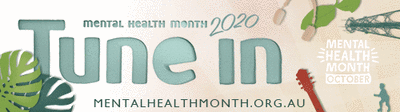
October is Mental Health Month – an opportunity to think about our mental health and wellbeing, and to gain a better understanding of the importance of good mental health in our everyday lives.

This year’s theme is ‘Tune In’ which focuses on the importance of being present, being aware of what’s happening within you and in the world around you.  

Tuning in has been shown to help build self-awareness, help make effective choices, reduce the impact of worry and build positive connections. Tuning into communities and the impact of mental health stigma can help ensure that people who need support have safe places to talk about their experiences and reach out.


Find out more about the mental health services we fund

Find out more about mental health support available in response to COVID-19

Find out more about mental health support available to those impacted by last summer’s bushfires

Find out more about Mental Health Month


You’re invited to our Online Mental Health Summit in October

People with a lived experience, carers and service providers are invited to South Western Sydney Recovery College’s Online Mental Health Summit during Mental Health Month in October. SWSPHN, MDS and One Door Mental Health are funding the summit which will provide access to a variety of online support and learning activities for mental health recovery and wellness.

Download the summit timetable


To keep informed:

www.swsrecoverycollege.com.au

www.facebook.com/swsrecoverycollege

swsrecoverycollege@mdservices.com.au

4621 8400

14 September 2020

A community-designed screening model which aimed to increase detection of and reduce harm from gambling has been successfully piloted in the Fairfield local government area (LGA), where residents lose an alarming $1.4 million on poker machines each day – more than any other LGA in NSW.

As we near GambleAware week, 19 to 25 October – an annual campaign to increase awareness of the impacts of gambling and harm from gambling in NSW – the Fairfield City Health Alliance is finalising its report on the development of the tool through the Gambling Harm Screening and Referral Project. It is hoped the screening model developed for Fairfield will be rolled-out across NSW to detect and support those experiencing harm from their gambling behaviour and those experiencing harm as a result of someone else’s gambling.

The alliance is a unique collaboration between the three levels of government – South Western Sydney Primary Health Network (SWSPHN), South Western Sydney Local Health District (SWSLHD) and Fairfield City Council.

The 18-month project brought together more than 100 participants from across the region, including GPs, community workers, psychologists and consumers, with the aim of designing and piloting a screening tool to equip GPs and community workers to identify harm from gambling and assist patients access appropriate support services. Ten community service workers and two GPs successfully piloted the screening tool with their patients.

Read more about the Gambling Harm Screening and Referral Project

GambleAware week, 19 to 25 October, is an annual initiative of the Office of Responsible Gambling to increase awareness of gambling and gambling related harm. It aims to increase the community’s understanding of risky gambling behaviour, encourage gamblers and their loved ones to recognise when gambling may place them at risk of harm and provides information on practical ways to keep their gambling under control.

08 September 2020

South Western Sydney Primary Health Network (SWSPHN) will implement Embrace, a framework for engaging multicultural communities in mental health support, following the announcement of our successful Expression of Interest (EOI).

The Embrace Project is run by Mental Health Australia and delivered in partnership with the Federation of Ethnic Communities’ Council of Australia, and the National Ethnic Disability Alliance.

During the next year, the SWSPHN Embrace Advisory Committee, along with key stakeholders, will develop activities to improve how we engage with Culturally and Linguistically Diverse (CALD) communities in South Western Sydney. This may include how our services are promoted, co-designed, commissioned and evaluated.

As key stakeholders and partners of SWSPHN, we encourage you to implement the framework within your own organisation. In addition, we hope your organisations will participate in consultations and feedback opportunities.


What is the Embrace Project?

The Embrace Project builds on the achievements of previous national projects and aims to promote an equitable mental health system and improved mental health and wellbeing for Australia’s multicultural populations.

The project provides a coordinated approach to meeting the unique needs and challenges faced by people from CALD backgrounds. This includes providing a platform to increase national networking and collaboration opportunities for mental health practitioners working with people from CALD backgrounds.

Crucially, the project works to improve the cultural responsiveness of mainstream mental health services to meet the needs of the diverse Australian population. This is being achieved through further development and implementation of the Framework for Mental Health in Multicultural Australia.


What is the framework?

The Framework for Mental Health in Multicultural Australia is a free, nationally available, online resource which has been mapped against national standards to help you meet your existing requirements. It has been developed to support Australian mental health services, practitioners, Primary Health Networks and others to work effectively in a multicultural context.

The framework consists of a tailored set of modules and self-reflection tools, which allow organisations and practitioners to evaluate and enhance their cultural responsiveness. Registered users build on their strengths and address areas for improvement in a self-paced way, with free access to a range of support and resources to inform both professional and service development.

To find out more go to www.embracementalhealth.org.au, email Mental Health Australia on multicultural@mhaustralia.org or call on 6285 3100.

01 September 2020

Fact | Residents of Fairfield LGA lose $1.4 million to poker machines each day, more than any other LGA in NSW.

You’re invited to a webinar on Thursday, 17 September, 10.30am to 11.30am, to learn more about the outcomes of our Screening for Gambling Harm pilot project which aims to combat these alarming statistics.

The project is a collaboration between SWSPHN, South Western Sydney Local Health District and Fairfield City Council. It aims to equip GPs and community workers with the resources and tools to identify and assist patients access support services.

Join the FREE webinar on MS Teams to hear from our Gambling Project Officer.


01 September 2020

In NSW, 7.2 per cent of people who gamble are considered to be a moderate-risk or problem gambler according to the Problem Gambling Severity Index (PGSI).

Residents of Fairfield LGA lose $1.4 million to poker machines each day, more than any other LGA in NSW.

These alarming statistics have underpinned our Gambling Harm Screening and Referral Project led by the Fairfield City Health Alliance, a unique collaboration between SWSPHN, the South Western Sydney Local Health District and Fairfield City Council.

During the past 18 months, the project team led the co-design and piloting of a gambling harm screening model in the Fairfield LGA which aimed to:

  • Improve identification of patients experiencing gambling harm
  • Educate GPs and community workers about the issue of gambling harm
  • Increase referrals to support services


Black Dog Institute-led CPD session for GPs, Problem Gambling and Mental Health Online Program for GPs – 23 SeptemberLearn more

Community STaR is hosting a one-off webinar via Zoom to outline the results of the Screening for Gambling Harm pilot – 17 September. Learn more


Why was Fairfield chosen for the pilot project?

In 2019 the Fairfield City Health Alliance proposed the piloting of a community-designed screening tool to equip GPs and community workers with the resources and the tools to identify and assist patients access appropriate support services.

Fairfield LGA was chosen not only because of the prevalence of gambling harm in the city where $1.4 million is lost to poker machines each day, but because people from all walks of life are represented in its diversity of cultures, religions and social backgrounds.


What are the challenges to addressing gambling harm?

One of the greatest challenges to addressing gambling harm is that it is not part of the mainstream health system. Support services, referral and education information is largely provided outside the health system, via a separate stream of funding provided by levies on gambling products in NSW. This unfortunately contributes to a lack of knowledge about gambling harm, screening and referrals to support services particularly in primary care settings.

Unlike other lifestyle questionnaires or assessment tools GPs use to identify issues relating to domestic violence, mental health and alcohol and other drugs, gambling harm screening is not embedded in general practice.


How did the co-design process work?

The co-design process brought together more than 100 participants including GPs, community workers, psychologists and consumers. It included a workshop which attracted 39 stakeholders, an online survey which drew 73 responses, and interviews with 29 participants and two focus groups involving eight healthcare professionals. 


What was developed through the co-design process?

The screening tool itself was chosen and adapted, bringing together the Problem Gambling Severity Index Short Form (PGSI Short Form) – which focuses on the individual engaging in gambling behaviour – and Concerned Others Gambling Screen (COGS) – which focuses on an individual experiencing harm as a result of another person’s gambling. The screening tool steps the practitioner through a series of questions, with responses weighted to produce an indicative screening outcome. Information packs were also provided to every participant with resources on the available support services and how to access them, and training materials including motivational interviewing techniques in the context of gambling.

A model for screening was also developed as part of the co-design process. The model recommends that all patients be screened to reduce stigma, ensuring of course that the screening is done in a safe environment at the beginning of an appointment. Ethics approvals stipulated that only those over the age of 18 may be screened in the pilot.


Who participated in the pilot project?

Healthcare providers in Fairfield LGA were invited to express their interest in implementing the screening model over 13 weeks during May to July. Participants included 10 community workers from a range of organisations and two GPs. More than 140 patients were screened during this period.


How did the pilot pivot in response to COVID-19?

The initial project called for face-to-face screening and, in the case of GPs, having the questions completed in the waiting room. The project moved online, acknowledging that many practitioners were moving to telehealth arrangements in response to the COVID-19 pandemic.


What were the results of the pilot project?

The levels of harm identified were higher than expected, with more than one in four of the 142 people screened experiencing some level of gambling harm across the continuum.

While financial harm was most often talked about given its measurability, individual harms also included relationship breakdown, deceitful behaviour, anxiety, stress, depression and in the most severe cases incarceration for fraud, embezzlement and stealing to support the habit.

Participants were interviewed at the conclusion of the pilot and were very positive about the project saying the screening tool was definitely successful in identifying gambling harm with many surprised at the prevalence of gambling harm in Fairfield LGA.


What happens now?

The project team is compiling a report for the Office of Responsible Gambling with the results and recommendation of the scalability acceptability of the screening tool. The report will go to the department at the end of this month (September). The team is also disseminating information about the screening tool and associated resources to GPs and community organisations.


SWSPHN is funding a Black Dog Institute-led CPD session for GPs, Problem Gambling and Mental Health Online Program for GPs, on Tuesday, 15 September. Unfortunately, this session is now full but an additional session funded by the NSW Ministry of Health has been added on Wednesday, 23 September from 6pm to 8pm. Register now.
 

Community STaR (outreach service of the Centre for Health Equity Training, Research and Evaluation) is also hosting a special one-off webinar via Zoom with Project Manager Nick McGhie presenting the results of the Screening for Gambling Harm pilot on Thursday, 17 September from 10.30am to 11.30am. To find out more and join


For more information about the Gambling Harm Screening and Referral Project, please email Integrated Health Coordinator Nick McGhie on nick.mcghie@swsphn.com.au

14 August 2020

Tenders are now open for organisation to apply to deliver the new South Western Sydney Peer Support Program which aims to support the recovery and wellbeing, health outcomes and social connectedness of people with mild to moderate and severe mental illnesses.

The program will complement clinical services delivered via the SWSPHN-commissioned You in Mind program. Peer workers will collaborate with mental health professionals to further embed person-first, recovery-oriented and trauma-informed approaches in mental health services.

Eligible organisations are invited to apply by 5pm on 7 September.

An information session will be held via Zoom on 18 August at 12pm. The tender information session registration link and supporting documentation is available via TenderLink. Applications will only be accepted through TenderLink.

To register for TenderLink: https://www.tenderlink.com/swsphn/

Tender Code (to search tender): SWSPHN-930641


For more information contact:

Pritika Desai – SWSPHN Mental Health Program Advisor

Pritika.Desai@swsphn.com.au

17 July 2020

Headspace Campbelltown has unveiled a new mural to the wider community following a successful collaboration with local art duo MigsxEze to create an artwork which ensures young people visiting the centre feel safe and welcome.

The mural took six months to develop – including creating and selecting designs – and two full days to complete with headspace Campbelltown’s Youth Reference Group (YRG) members and staff pitching in to help.

The YRG is made up of 12 to 25-year-olds who are passionate about young people and the issues they face in the Macarthur and Wingecarribee regions. The YRG is the voice of young people at the centre and the face of headspace in the community.

The mural is designed to make the centre’s reception/waiting area more youth friendly. Often, walking into headspace (or any service) can be daunting for a young person, whether it’s their first time or not. The mural recognises the courage it takes to seek help.

It was among a number of improvements made to the centre with funding from a Stronger Communities Grant, supported by Macarthur MP, Dr Mike Freelander. A matching commitment from Rotary Ingleburn and Macarthur Sunrise will allow more artwork to be created within the centre.

Find out more about headspace Campbelltown

26 June 2020

The success of SWSPHN’s region-wide service co-design approach to men’s suicide prevention has caught the attention of the Australian Men’s Health Forum.

SWSPHN was one of only four PHNs asked to discuss our ongoing approaches to men’s mental health to the Men’s Health Connected forum, an online summit throughout June.

Our Mental Health Manager Chris Jones was invited to present to the session: How PHNs are working to prevent male suicide and How PHNs are engaging with men. His presentation attracted more than 120 attendees from across Australia.

Chris focused on the key learnings and perspectives from co-design sessions held at Campbelltown and Mittagong in early February which gave local people an opportunity to contribute to the development of local services.

Chris said our co-design sessions not only attracted one of our largest co-design participation rates to date, with more than 80 people attending, but also encouraged new men’s voices and provided a unique platform for the lived experience of male suicide to be featured and supported.

“This co-design approach has since helped to enable SWSPHN to develop an innovative grants approach through which we’ll provide funding to organisations to foster ideas for helping men become more proactive in seeking and securing support to improve their mental health and reduce rates of male suicide,” he said.

15 June 2020

The success of SWSPHN’s region-wide service co-design approach to men’s suicide prevention has caught the attention of the Australian Men’s Health Forum.

SWSPHN was one of only four PHNs asked to discuss our ongoing approaches to men’s mental health to the Men’s Health Connected forum, an online summit throughout June.

Our Mental Health Manager Chris Jones was invited to present to the session: How PHNs are working to prevent male suicide and How PHNs are engaging with men. His presentation attracted more than 120 attendees from across Australia.

Chris focused on the key learnings and perspectives from co-design sessions held at Campbelltown and Mittagong in early February which gave local people an opportunity to contribute to the development of local services.

Chris said our co-design sessions not only attracted one of our largest co-design participation rates to date, with more than 80 people attending, but also encouraged new men’s voices and provided a unique platform for the lived experience of male suicide to be featured and supported.

“This co-design approach has since helped to enable SWSPHN to develop an innovative grants approach through which we’ll provide funding to organisations to foster ideas for helping men become more proactive in seeking and securing support to improve their mental health and reduce rates of male suicide,” he said.