10 January 2023
Three GP-led Respiratory Clinics (GPRCs) will continue to operate across South Western Sydney until Tuesday, 28 February.
The clinics at Fairfield, Campbelltown and Mittagong have been testing patients for COVID-19 since May 2020. The clinics began delivering vaccinations in March 2021.
Last month, the Australian Government announced a new GPRC Panel (GPRCP) model will be implemented for activation during health emergencies to ensure sufficient surge capacity is in place to respond to future COVID-19 waves or any other respiratory health emergency.
Under the new panel arrangement, up to 150 existing, accredited GP clinics across Australia will be held in reserve to be activated as needed.
The government is in the process of recruiting practices.
The GPRCPs will begin operating in March this year.
19 December 2022
Picton’s GP Respiratory Clinic (GPRC) will close on Saturday, 31 December.
The Department of Health and Aged Care (DHAC) has extended the contracts of South Western Sydney’s remaining three GPRC’s – at Fairfield, Campbelltown and Mittagong – until Tuesday, 28 February 2023 when the current operational model will end.
13 December
The Australian Government has provided the following important update for general practice about GP Respiratory Clinics following yesterday’s launch of the National COVID-19 Health Management Plan for 2023.
Key points:
- Up to 76 GPRCs will continue to operate until 28 February 2023 but some will close
- From March 2023, a new GPRC Panel model will be implemented for activation during health emergencies
- Clinics interested in participating in the GPRC Panel model should register directly on AusTender to receive notifications
In a continuing scale down of the GP Respiratory Clinic (GPRC) program, the government has approved an operational extension for up to 76 clinics until 28 February 2023. However, this also means some clinics will close at the end of December.
This will be the final operational extension of GP Respiratory Clinics under the current operational model, with the program ending on 28 February 2023.
From March 2023, a new GPRC Panel model will be implemented for activation during health emergencies.
Existing accredited general practices will be selected for the GPRC Panel through an approach to market which will be released on AusTender in January and may include existing GPRCs if they are able to meet the relevant criteria.
The DHAC will provide more advice to potential GPRC Panel participants shortly but for now, any interested clinic should register directly on AusTender to receive notifications.
Current GPRCs which will be extended, will be offered Deeds of Variation in the coming days and will need to decide if they wish to continue given changes to the contract, which include:
- Cessation of funding for functions including in-reach on 31 December 2022
- Cessation of access to PPE and RATs from the Commonwealth
GPRCs not being offered extensions will also be notified shortly. A final list of operational GPRCs will be provided once variations are executed.
Access the GPRC clinic finder
13 December 2022
As of Sunday, 1 January 2023, changes to PCR testing for COVID-19 will come into effect.
PCR tests will remain free for everyone who needs them.
People at high risk of COVID-19 can access tests free through state testing sites and GP-led Respiratory Clinics without a GP referral.
This includes: older Australians; First Nations people; people with disability; people from culturally and linguistically diverse communities; people living in remote communities; people with complex underlying health conditions; and the immunocompromised.
Those considered low risk, can get a bulk billed PCR test from a private pathologist with a referral from a GP or nurse practitioner.
The Federal Government has developed a factsheet outlining the changes.
Download the factsheet
13 December 2022
The Australian Government has provided the following important update for general practice about PPE following yesterday’s launch of the National COVID-19 Health Management Plan for 2023.
Key points:
- The distribution of PPE through Living with COVID funding will cease on 31 December 2022
- Healthcare providers should lodge final orders by COB on Wednesday, 14 December 2022
- Hand sanitiser will not be provided as part of a PPE order as stock has depleted
All Living with COVID (LWC) measures scheduled to cease on 31 December 2022 have been reviewed.
As part of this review, the government has confirmed the distribution of PPE through the Living with COVID funding will cease on 31 December 2022. There will be no further extensions. The Department of Health and Aged Care’s (DHAC) contract with DHL for the distribution of PPE ceases on 31 December 2022 and no deliveries will be made after this date.
Due to the Christmas holidays and lead time for processing of orders, the last day for submission of orders to the department from PHNs is COB 15 December 2022. Therefore, general practices should lodge final orders by COB 14 December 2022 to allow one day for collation and submission by SWSPHN.
Please note the following:
- Practices should be ordering under ‘Living with COVID’ provision (excluding pharmacies and allied health)
- Practices are no longer obligated to order full LWC Bundles and are able to order specific PPE which is required by the practitioner
- If ordered, hand sanitiser will not be provided as stock has depleted
- The limit of up to 10 pulse oximeters per practice has been lifted. Eligible practices can order additional pulse oximeters
Some PPE distribution measures will continue, including support for Residential Aged Care Homes and Aboriginal Community Controlled Health Services. More information about these measures will be provided by the end of December.
15 November 2022
In March, St Vincents Hospital opened a Post-Acute and Long COVID Clinic. This clinic services multiple areas including South Western Sydney.
Referrals can be made by any out of area GP/Allied health clinician if there are no clinics available in the patient’s area. Strict referral criteria are outlined in the link below under the Long COVID Outpatients Clinic tab.
Allied health and GPs can also request a clinician to clinician contact for guidance and resources, by emailing the referral line and stating clinician to clinician contact request.
Referral Line: svhs.longcovid@svha.org.au
Referral Criteria and Clinic Information: www.svhs.org.au/patients-visitors/covid-19
17 October 2022

With the current levels of transmission in the community decreasing, and improvements in the number of hospitalisations and staff furloughing, NSW Health has advised that public hospitals and services have moved to Yellow Alert Level in line with the COVID-19 Infection Prevention and Control Manual (see pages 87 to 91).
With the move to the risk level of Yellow, mask-wearing is now focused on clinical settings and public spaces as follows:
- staff will be required to wear a mask in all publicly accessible spaces and in clinical areas
- staff who work in non-clinical areas (areas where patients and visitors do not routinely have access to) will no longer be required to routinely wear masks in those work settings
- visitors will be required to wear a surgical mask at all times while in the facility
In general practice, the RACGP strongly encourages practices to continue mask use for the practice team, patients and visitors, and practices can make it a condition of entry to the practice to wear a mask. Download the Patient Alert Posters
With mandatory isolation requirements for COVID-19 ending last Friday (14 October), it is important GPs continue to advise COVID-positive patients to stay home and take steps to protect others.
People who test positive for COVID-19 may be infectious for up to 10 days. They are most infectious in the two days before symptoms start and while they have acute symptoms (such as a runny nose, sore throat, fever, cough).
To reduce the risk to others, NSW Health recommends people who test COVID-positive:
- Stay home until their acute symptoms have gone
- Don’t visit people at high risk of severe illness, anyone in hospital or an aged or disability care facility for at least seven days
- Wear a mask when indoors and on public transport, if they must leave their home.
- Avoid large gatherings and indoor crowded places, especially where they will be in contact with groups of people they don’t live with
- Talk to their employer about when you should return to the workplace
- Tell people they live with, or spend a lot of time with, they have COVID-19
- Register their positive rapid antigen test result with Service NSW (online or by calling 13 77 88)
12 October 2022

SWSPHN has identified that people from some vulnerable groups may be vaccine averse due to the association between mRNA COVID vaccines and foetal cells.
In response, we have created an information sheet about Novavax to address this barrier.
It is available in English and the languages of our high-risk, low-vaccinated groups.
The Chaldean, Assyrian, and Arabic groups have lower than 25 per cent third dose vaccination coverage which increases their risk of COVID-related complications.
If you know of people who are vaccine adverse, particularly those in the identified groups above, please share with them this information about how Novavax is different.
19 September 2022
The Department of Health and Aged Care has provided the following information about changes to the onboarding process for the COVID-19 vaccine program, for new sites and existing sites interested in new vaccine types, following the addition of Moderna Bivalent for those 18 years and over (Blue/Green) to the program.
Please note:
Changes to onboarding process
- Moving forward, all ongoing vaccine types will be offered to new sites entering the program, with the provision to offboard after eight weeks of inaction.
- Onboarding allocations will be changed to minimum allocations.
- Onboarding of new practices or existing practices for new vaccine types will be actioned fortnightly from this week.
- Last week, only existing practices newly interested in Pfizer 12 years and over, Pfizer five to 11 years and Novavax were onboarded. Sites wanting Moderna will be onboarded this week with a Moderna Bivalent for those 18 years and over (Blue/Green)
Vaccine Allocations
- With the move from mass vaccinations to a more opportunistic model, allocation increases will be paused while demand is reassessed.
Vaccine Waste Management Emails
- The department will no longer send out Vaccine Waste Management emails.
- Enhancements have been made to COVID Vaccine Administrative System (CVAS) to include wastage controls. From now on when a site attempts to place a new order, CVAS will perform wastage control checks. If it is determined the site meets the metrics for wastage controls, the site will be required to provide a reason for requesting further stock and the order will require approval from the Taskforce. This is similar to the current approval process in CVAS for sites holding excess stock.
Consumables
- Work is underway to identify primary care sites which have been over ordering consumables, in comparison to their vaccine orders. Similar to the Vaccine Waste Management emails, PHNs will be provided with a list of identified sites to have communications sent to them about excess consumable ordering.
Moderna Bivalent
- As advised in the Provider Bulletin dated 13 September 2022, all sites participating in the vaccine program will be onboarded in tranches for Moderna Bivalent Original/Omicron vaccine (Moderna Bivalent for those 18 years and over (Blue/Green)).
- All sites will receive an ongoing allocation of 100 doses of Moderna Bivalent for those 18 years and over (Blue/Green).
- If sites do not complete the site declaration and place an order within eight weeks, they will be deactivated for Moderna Bivalent in CVAS.
- Sites will be able to onboard again in the future via the standing EOI process through PHNs.
VCF
- Due to complaints from the public, a review has been completed of Vaccine Clinic Finder (VCF) and sites no longer active for AstraZeneca have been inactivated. Further reviews will be conducted for the other vaccine types. Please update your details using VFC Connect so accurate data is showing on VCF for the public.
- If a site has not already registered for VCF Connect, please refer to the registration email you received from this email address: PCDVCF@health.gov.au. This was sent to the contact nominated on the CVAS and is the person in your organisation who will have signed the declaration forms for your service to participate in the vaccine rollout and place orders for COVID-19 vaccines in CVAS.
14 September 2022
South Western Sydney has two groups who are at high risk of experiencing severe COVID-19 related symptoms and have low vaccination rates – our culturally and linguistically diverse communities and those with chronic conditions.
COVID vaccines reduce the risk of hospitalisations, severe symptoms, and long COVID.
Therefore, there is a significant opportunity to improve health outcomes for our vulnerable populations through improving access to and uptake of COVID-19 vaccines. 1
Please continue to encourage your patients to get vaccinated.
The facts:
COVID-19 and ethnic groups
People born overseas are two times more likely to die from COVID-19 than people born in Australia.2 Those with a country of birth in the Middle East have the highest age-standardised death rate at 44.8 deaths per 100,000 people.2 This statistic is almost twice the next highest age-standardised death rate (24.9 for North African individuals).2
This statistic is particularly significant to South Western Sydney as 43 per cent of our population was born overseas3, with eight per cent of the population self-reporting as Middle Eastern.4
Furthermore, these groups are disadvantaged as they have lower vaccine coverage.
For example, Chaldean, Assyrian, and Arabic groups have lower than 25 per cent three-dose vaccination coverage for those 16 years and above, and in the five-to-11 years categories.6 This increases their risk of COVID-related complications.
COVID-19 and chronic conditions
Another high-risk group for COVID-19-related mortality is people with pre-existing chronic conditions.2
Pre-existing chronic conditions increase the risk of COVID-19 complications.1 Therefore, the risk of death. A person with a pre-existing chronic condition is more than twice as likely to die from COVID-19 (74.9 per cent).2
This risk is significant as 50 per cent of individuals in South Western Sydney live with a chronic disease3, which increases their risk of COVID-related complications.
- About Australia’s COVID-19 vaccine rollout | Australian Government Department of Health and Aged Care
- COVID-19 Mortality in Australia: Deaths registered until 31 May 2022 | Australian Bureau of Statistics (abs.gov.au)
- SWS Our Health in brief.pdf (nsw.gov.au)
- csv (sharepoint.com)
- Health of our region – South Western Sydney PHN (swsphn.com.au)
- SWSPHN CALD MADIPAIR data
17 August 2022
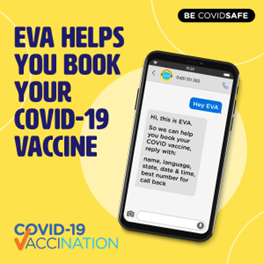
Easy Vaccine Access (EVA) is an Australian Government call-back service to help people find a COVID vaccine provider.
Message ‘Hey EVA’ to 0481 611 382
If you need help making a COVID-19 vaccine booking, send an SMS with ‘Hey EVA’ to 0481 611 382.
When you message EVA you will receive a reply asking for your:
- name
- preferred language
- preferred date and time
- best number for a call back.
A trained operator from the National Coronavirus Helpline will call you at the scheduled time to help book your COVID-19 vaccination. EVA is available between 7am to 10pm, seven days a week.
Through EVA you can receive information and advice about COVID-19 vaccines and get help with:
- choosing your preferred callback date and time
- locating an appropriate vaccine appointment
- locating a walk in vaccination clinic
- completing the COVID-19 vaccine booking during the call
- accessing an interpreter.
Find out more
Read these COVID-19 Booster FAQs for advice on keeping you and your family safe.
COVID-19 hasn’t gone away
Visit the Australian Department of Health and Aged Care website for more information.
Health and Aged Care website


