24 June 2025

Being a parent is the most important job a person can have. But it can also be isolating for parents, particularly when extended family might not be nearby.  

It’s important for parents to know they can reach out to local services when they need some help or advice.    

Evidence-based parenting programs have been shown to support family functioning and the wellbeing of children, particularly when delivered by trained professionals.   

Many parenting programs aim to help parents improve their relationship with their child and enhance emotional and behavioural outcomes.  

There is substantial evidence of the effectiveness of parenting programs in providing favourable outcomes for parents (improved confidence as a parent, stronger parent-child attachment, more effective and safe strategies for guiding children’s behaviour) and children (improved age-appropriate behaviour and social skills).  

In South Western Sydney, some not-for-profit family support services are funded by the NSW or Australian Government to provide parenting programs at no cost. 

Parenting program providers in SW Sydney 2025

Read the full report on effective approaches for young children

Did you find this article helpful? Yes/No


10 June 2025

While medical care options for trans children are unnecessary until puberty, families seek advice from GPs for young children. Parents seek a GP who listens, affirms the child rather than dismissing concerns, is respectful, kind and willing to learn.

Some children are clear about being trans from the age of three, while others do not feel like either boys or girls (non-binary), and others are exploring gender.

Children thrive when they can express their preferred gender through clothing, people use their preferred pronouns, and sometimes they choose a different name.

Parents can benefit from the support of other parents to navigate healthcare, legal documentation and education settings. GPs can provide letters of support.

Article provided by Dr Cris Townley

Resources

Support for parents

Support for Trans, Gender Diverse and Non-Binary Children and their Families

Why is family support important

Supporting trans and gender diverse children in early education environments

Westmead gender clinic

The Royal Children’s Hospital Melbourne, Australian Standards of Care and Treatment Guidelines

RACGP special interest group

Working with adult trans and gender diverse people

E-Learning Module: Trans Primary Care – AusPATH

03 June 2025

The South Western Sydney LHD Public Health Unit has asked that the following information be provided about measles and childhood vaccination rates in South Western Sydney.

Measles warning for South Western Sydney

  • there has been a recent surge of imported measles infections in Australia in 2025
  • genotyping of these infections shows the majority of these infections were acquired in the Middle East where several outbreaks are ongoing
  • a surge in travel to the Middle East is expected for the upcoming Hajj in Saudia Arabia (4 to 9 June)
  • be vigilant for signs and symptoms of measles in returning travellers and pilgrims
  • other infectious diseases to consider in those returning from the Middle East include: meningococcal disease, MERS and hepatitis A
  • contact your local PHU as soon as you suspect a case of measles or have any questions on 1300 066 055

Childhood vaccination rates plummet in South Western Sydney

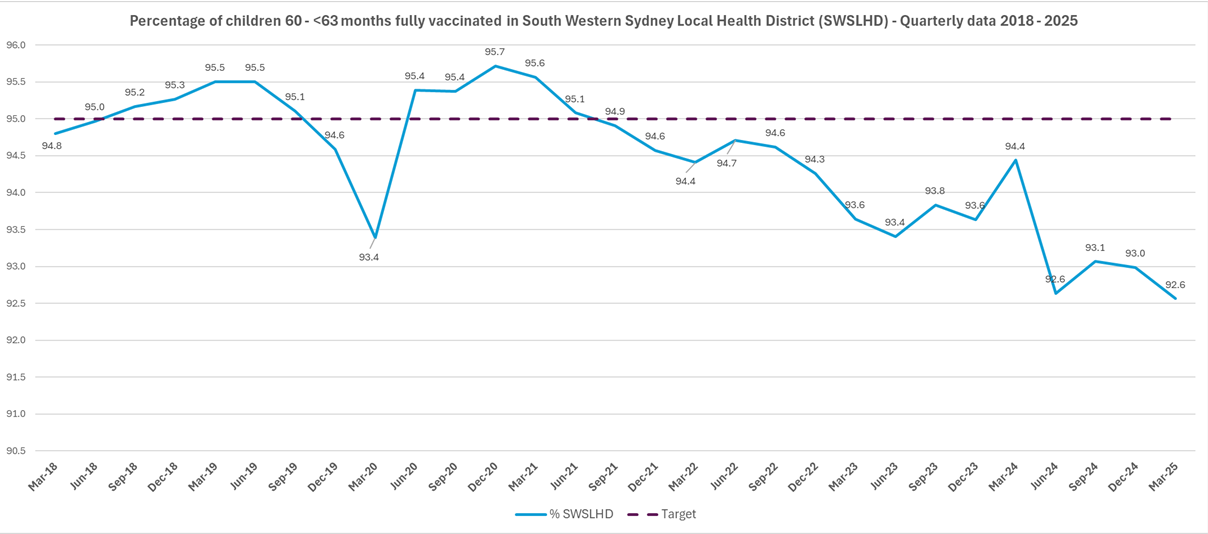
  • childhood vaccination rates have been falling in every LGA in South Western Sydney for the last four years, despite the recommended target being 95 per cent
  • South Western Sydney has some of the lowest childhood vaccination rates in the state
  • the proportion of children who were fully vaccinated for selected age groups in SWSLHD for March 2025 is: 12 to 15 months 89.1 per cent, 24 to 27 months 86.9 per cent and 60 to 63 months 92.6 per cent
  • please contact your local PHU on 1300 066 055 if you need assistance in arranging a catch-up schedule or sedation for a child with special needs
precentage of children monthly fully vaccinated in SWS
Childhood vaccination rates declining in South Western Sydney.
27 May 2025

South Western Sydney welcomes more refugees each year than anywhere else in Australia.

Many arrive after fleeing war, persecution or violence, carrying the impacts of trauma – often compounded by the challenges of resettlement.

Adjusting to life in a new country often involves navigating unfamiliar systems, overcoming language and cultural barriers, and managing ongoing stress. Past or recent experiences may also lead to mistrust of institutions, making it harder to seek help.

Health professionals play a crucial role in supporting refugees and asylum seekers through the settlement process. By using culturally appropriate interpreters, understanding the effects of trauma and providing compassionate, culturally sensitive care, they can rebuild trust and foster long-term healing.

Bulk-billing and reduced-cost care is recommended for refugees and asylum seekers due to their low-income status. However, some may not be eligible for Medicare, which can limit their access to healthcare.

Connecting patients with appropriate referral pathways, ethno-specific organisations and community-based support services is essential to ensure their health and social needs are fully met.

The refugee experience can significantly impact children, leading to issues such as lack of immunisation, malnutrition, inadequate growth and development monitoring and various traumas.

GPs play a crucial role in supporting these children by providing trauma-informed care, ensuring they receive the necessary immunisations, monitoring their growth and development, and addressing nutritional needs. GPs can also work with families and other professionals to ensure children receive comprehensive care tailored to their unique needs.

Here are some useful resources and support services which support refugees and asylum seekers:

Support services in the community

Community Hubs

Legal Aid NSW Refugee Service

Multicultural Disability Advocacy Association of NSW (MDAA)

NSW Multicultural Health Communication Service

NSW Service for the Treatment and Rehabilitation of Torture and Trauma Survivors (STARTTS)

Settlement Services International (SSI)

SWSLHD – NSW Refugee Health Service

Transcultural Mental Health Centre (TMHC)

Translating and Interpreting Service (TIS National)

Health Information and GP Resources

NSW Health Refugee Health Plan

NSW Health Care Interpreting Services

Factsheets for refugees in Australia – Refugee Council of Australia

SWSLHD – NSW Refugee Health Service – Information in other languages

Information for GPs – Gaza_Israel arrivals Oct 24

Service directories

Ask Izzy

Services and information – Refugee Council of Australia

LINCS – Local Information Network for Community Services

13 May 2025

General practice helps prevent domestic and family violence by addressing the root causes before it begins.

GPs play a crucial role by promoting healthy relationships, identifying at-risk individuals and referring them to support services.

This can include addressing root causes, promoting healthy relationships, identifying at-risk individuals and referring to specialised services.

Find out more

  • addressing root causes: change societal norms and behaviours which normalise/excuse violence
  • promoting healthy relationships: educate patients on healthy dynamics, communication and conflict resolution
  • identifying at-risk individuals: recognise risk factors like controlling behaviours, isolation and threats
  • providing safe support: offer a safe space for patients to discuss concerns and provide confidential resources
  • referring to specialised services: know local DFV support services for legal, housing, financial and child protection assistance
  • advocacy and awareness: support prevention initiatives and advocate for policies addressing violence
  • self-care: GPs should prioritise their well-being to prevent burnout when dealing with DFV cases

Useful links:

Primary prevention initiatives

Impact of domestic and family violence on children and young people

Services to support those experiencing violence

Supporting Recovery Brochure 2025– support to heal from domestic and family violence


Did you find this article helpful? Yes/No


For more Stronger Seeds, Taller Trees articles click here: Stronger Seeds, Taller Trees

22 April 2025

The first three years of life are critical for a child’s brain development.

Early Intervention is linked with positive changes in functional gains for children and can positively impact all aspects of development and functioning including mental health, physical, social and cognitive development.

Early identification of developmental concerns and referral to appropriate services is crucial, particularly before children start Kindergarten. It is also important to refer early to account for potential waitlist times.

How to make an early intervention referral

Families may be eligible for support through the NDIS Early Childhood Approach if a child has a disability or there are concerns about their development.

Children aged under six don’t need a formal diagnosis to be referred. The service also supports children up to age eight, connecting families with local supports, guidance and advice tailored to their needs.

EACH is the NDIS Early Childhood Partner for South Western Sydney and can assist with referrals.

Call EACH on 1300 003 224.

Download the Early Intervention Referral Guide (PDF)

More information for GPs and health professionals – NDIS


Did you find this article helpful? Yes/No


For more Stronger Seeds, Taller Trees articles click here: Stronger Seeds, Taller Trees

08 April 2025

Playgroups provide opportunities for children to engage in play, which helps them learn the valuable skills required to have a positive start to school.

Benefits of playgroup include:

  • help develop social skills at the child’s own pace
  • build emotional confidence
  • encourage physical activity
  • support imagination and creativity
  • learn through role-play
  • social connection for parents

Many playgroups are run by experienced early childhood trained staff and provide parents with support and guidance on child development as well as offering a soft entry point to other community support networks.

Many families might not be aware of the benefits of playgroup so GPs can play a vital role in referring families who might have a child with developmental concerns or if the family is socially isolated.

Benefits of attending playgroup

Different types of playgroup

In South Western Sydney there are lists of playgroups for the following local government areas:

Fairfield

Liverpool

Canterbury Bankstown


Did you find this article helpful? Yes/No


For more Stronger Seeds, Taller Trees articles click here: Stronger Seeds, Taller Trees

24 March 2025

Emergency relief can assist families in a cost-of-living crisis and other adverse conditions such as income loss. It can include food, money, housing, healthcare and other support services.

Real life example

Mrs Nawabi, 34, visits her GP because she’s feeling anxious since she lost her job the previous week. She’s a single mother with three young children.

In cases like this, the children’s health and wellbeing may be supported through emergency relief. This support will also help to manage Mrs Nawabi’s anxiety by reducing her stressors.

Where to get help

Low cost meals providers

Find providers offering affordable food options in your area.

Emergency relief provider

DSS portal – service provider– After selecting the state and local government area, choose Financial crisis and material aid – Emergency relief in the programm field.

Ask Izzy directory – A mobile-friendly tool to find nearby support services.

Centrelink assistance

Centrelink support

Advance payment information

NSW Government support

Rebates and vouchers

NSW Cost of Living Hub

No interest loans

Good Shepherd No Interest Loans

Find a local No Interest Loan provider


Visit the Stronger Seed, Taller Tree page to learn what the initiative is about.


Did you find this article helpful? Yes/No


12 December 2024

According to the Australian Institute of Health and Welfare, there are 50 indicators to measure “what matters”. The indicators are then organised into five wellbeing themes, which combine to create an overall “life satisfaction” rating.

One of the themes is “cohesive”, explained as: A society which supports connections with family, friends and the community, values diversity, and promotes belonging and culture.

As we head into the festive and holiday season, there’s no better time to tick off some of those important indicators such as sense of belonging, social connections and time for recreation and social interaction.

We’ve compiled a list – just touching the surface – of activities to do and places to visit over the next month or two. Pack up the kids, grab a few mates … and discover some of the things Western Sydney has to offer.

We guarantee your “life satisfaction” meter will hit the roof.

It’s hot! Of course it is, it’s summer. But there’s plenty of options to cool down, right across the region. If you’ve got younger ones who want to splash, head for a water park. There’s also plenty of local swimming centres and pools to chill in the heat. Keep an eye open for when the new Penrith Beach opens to the public.

The great outdoors. We’re blessed in Sydney to live in suburbia but have so many green spaces and bushland to explore and enjoy. If your budget is a bit on the tight side, you can pack a picnic basket, some games and discover what’s in your suburban backyard. For free! One of our recommendations is the Australian Botanic Garden, at Mount Annan. You can enjoy 416ha of bushland, lawns, lakes and gardens and discover 4,000 native and introduced plants and trees. There’s also plenty of holiday activities, including talks, walks and workshops.

If you want a bit of adventure, we’ve got some things for you to try. There’s obstacle courses, white water rafting, the biggest playground slide in Western Sydney and what’s been described as the biggest indoor inflatable playground in Australia. For the adrenaline junkies, there is an indoor skydiving centre in Penrith. There are challenges for all sizes and levels of risk-takers We dare you!

Visiting a museum, art gallery or historic property should always be a family consideration. It’s important to introduce children to culture, learning and history – and it’s an ideal way to initiate discussion, thinking and appreciation. There’s an awesome selection of places to visit in the region.

There’s nothing which creates as much joy as interacting with animals. A visit to see animals is food for the soul. And, of course, we’re fortunate to have so many opportunities within driving distance.

When you’ve exhausted this list or ticked off a few more places to visit and things to do, we have a couple more suggestions. Breathe deeply … and take in the vastness of our ancient land. National and state parks and conservation areas are on our doorstep, with an array of amazing attractions to stimulate our senses.

This list is by no means exhaustive. The Georges and Nepean rivers meander through our region, our local playgrounds are endless as are our sporting facilities and public places to gather, chat or enjoy a barbecue. There are heritage sites and houses to visit, public artworks to admire and shopping centres to get our retail fix. We can take in a movie, enjoy a concert or just kick back and admire the views.

These holidays, your level of adventure – or relaxation – will only be limited by your imagination.

CAPTION: Mount Jellore Lookout at Mount Gibraltar Reserve, Bowral. 

13 November 2024

As the cost of living continues to increase, it can be difficult to make the family budget stretch. This includes healthy meals for growing children.

Across South Western Sydney, some organisations provide cost of living help, such as low cost or free meals to those in need. Other organisations also offer support with paying bills and household basics such as blankets.

Families and individuals on low incomes can also access No Interest Loans (NILs) which enables low-income earners and Health Care Card holders to borrow up to $2,000 for expenses such as car repairs or registration, education expenses such as school fees and laptops, medical and dental expenses or essential purchases such as white goods and household items

NILs do not require a credit check; however, clients must demonstrate their capacity to repay the loan by having a source of income. Those experiencing domestic and family violence can borrow up to $3,000.


Cost of living support resources:

For more information about NILs, visit goodshep.org.au/nils

Find a local provider

Low cost and free meals directories


Other useful websites:

NSW Government Cost of Living Hub

Services Australia Advance Payment

Emergency relief providers

Services NSW – concessions and rebates


Read more about Stronger Seeds, Taller Trees


These articles are written by members of the ‘Stronger Seeds, Taller Trees’ project which includes professionals from a number of government and non-government organisations in South Western Sydney. The group aims to support GPs working with families to navigate and access timely services when they have a concern about a child’s development.


Did you find this article helpful? Yes/No