
September | 2026
A QI approach to menopause care
18 October is World Menopause Day
Hot flushes, irregular periods and night sweats are the most common symptoms of menopause; however, menopause can present in many ways and symptoms can vary considerably between individuals.
Sleep disturbance, fatigue, mood changes, brain fog, headaches, joint and muscle aches, vaginal and urinary symptoms, and changes in libido can all occur during the menopausal transition.
Recognising the broader range of symptoms can help to ensure menopause is considered when women present with symptoms which may appear unrelated. It also provides an important opportunity for earlier assessment, support and appropriate management.
Don’t wait for your patients to raise menopause – start the conversation.
Routine health assessment, education and primary prevention provide valuable opportunities to start a conversation about menopause and midlife health.
A simple question such as “Have you noticed any changes you think may be related to perimenopause or menopause?” can open the door to further assessment and shared decision-making.
It’s important to know not every symptom in midlife is caused by menopause. A holistic assessment is needed to help identify the patient’s individual concerns, consider other possible causes of symptoms and support shared decision-making around treatment and ongoing health needs.
General practice remains the key place for assessment, education, symptom management and follow up.
SWSPHN funds the Women’s Health Centre Southern Highlands which provides perimenopause and menopause care and support.
For individuals with severe or complex menopause symptoms, the South Western Sydney Local Health District Specialist Menopause Service provides multidisciplinary specialist support and accepts referrals from GPs, specialist and women’s health practitioners.
HealthPathways can be used as a referral portal for both these services.
In May this year the Australian Government launched the National Menopause and Perimenopause campaign to improve access to reliable information and increase support for women aged 35 years and over going through this life stage.
The campaign website includes a dedicated page for health professionals with a number of resources, a poster for display in practices to encourage symptom discussion, brochures for patients discussing common symptoms and management options available and a symptom checklist which can be used by patients to help identify symptoms and generate discussions with their GP.
Many of these resources have also been translated into several other languages. Resources have also been developed which are dedicated to supporting First Nations women.
By making menopause a more visible part of routine primary care, general practices can help women better understand their symptoms, access early and appropriate evidence-based care and address important longer-term health considerations.
Recognising menopause starts with understanding its presentation can be much more than hot flushes.
World Menopause Day 2026 – International Menopause Society
QI case study: how are we currently identifying and supporting patients experiencing perimenopause and menopause?
The opportunity
A general practice in South Western Sydney identified an opportunity to improve how perimenopause and menopause were identified, discussed and managed.
Menopause was often addressed opportunistically, with inconsistent documentation and follow-up. Some patients were hesitant to raise concerns because of limited awareness or previous healthcare experiences, while clinician confidence in discussing symptoms and management options varied.
Before commencing the quality improvement (QI) activity, clinicians undertook additional education to strengthen their knowledge and support evidence-based conversations with patients.
What did they do?
Rather than trying to change everything at once, the practice adopted a tiered approach to improving menopause care. While their overall goal was to improve the identification, assessment and management of all patients experiencing perimenopause and menopause, they began with a smaller, clearly defined patient cohort.
The first tier focused on patients who already had a coded diagnosis of menopause or perimenopause and were not prescribed Menopausal Hormonal Therapy (MHT) in the practice’s clinical system. This provided an achievable starting point to review current care, initiate conversations about symptoms and management, and identify opportunities to improve assessment and follow-up.
Once these processes were established, the practice planned to broaden its approach to the next tier — patients who may be experiencing perimenopause or menopause but had not yet been identified or coded. This would enable the practice to move from improving care for known patients towards more proactive identification and support across its broader patient population.
As a Tier 3 practice in the Quality Improvement in Primary Care (QIPC) program, the practice worked with their SWSPHN Quality Improvement Officer to develop SMART goals and test these changes using a Plan-Do-Study-Act (PDSA) approach.
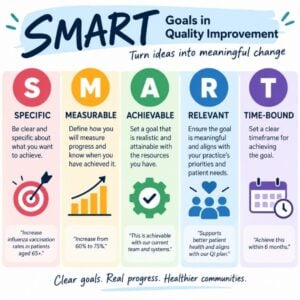
- identified a small target patient cohort – patients with coded diagnosis of menopause or perimenopause and not prescribed MHT
- improved clinical coding of diagnoses and documentation
- introduced prompts, templates and trusted patient resources
- built clinician confidence through education and team discussions
- incorporated menopause conversations into preventative health activities where appropriate
regularly reviewed progress and refined their approach - What barriers did they face?
Through the QI activity, the practice identified not all patients within the targeted patient cohort required or wanted MHT. Some patients were not experiencing symptoms, while others preferred to explore alternative management options.
Upon reviewing the data from POLAR, it was also highlighted some patients had been incorrectly coded as experiencing menopause or perimenopause, reinforcing the importance of accurate clinical coding and individualised assessment.
Other challenges included varying levels of clinician confidence and patient awareness of menopause, as well as limited consultation time to explore symptoms, assessment and management options.
How did they overcome them?
By improving clinician confidence in menopause assessment and management, GPs were better equipped to have collaborative, informed discussions with patients about treatment and management options which reflected their individual needs, preferences and circumstances.
The practice used the Model for Improvement (MFI) Template as the foundation for a PDSA approach, allowing the team to set clear improvement goals, test changes on a small scale and compare baseline and current data. This helped the practice monitor progress, assess the impact of changes and identify opportunities for ongoing improvement.
Could your practice try this?
Choose one measurable improvement, test it with a small patient cohort, review the results and build on what works.
Small, measurable changes can help build a more consistent approach to menopause care while strengthening preventive and person-centred care.
Sample Editable MFI – Menopause Management

POLAR in practice
POLAR can support your quality improvement activities in general practice. The below walkthrough demonstrates how POLAR can be utilised to identify patients who may be eligible for a menopause assessment.
POLAR Walkthrough
20260827POLARWalkthroughMenopauseAssessmentEligibilityV2.0.pdf
Tips and Tricks
Correct documentation: POLAR extracts data from the practice’s clinical information software. For POLAR to obtain precise and reliable data, every item should be documented correctly in the patient’s file.
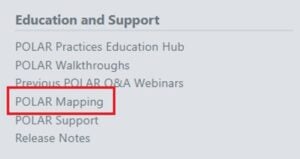
To assist clinicians and practice staff, data mapping is available via the Help menu within the POLAR report or via the POLAR mapping tab on the POLAR landing page.

20240321ClinicalSoftwareGuideCodingBPV2.0.pdf
20240321ClinicalSoftwareGuideCodingMDV2.0.pdf
Private bookmark function:
The POLAR private bookmark function allows individual users to save searches created with specific filters for future reference and comparison.
Private bookmark walkthrough: 20260831POLARWalkthroughPrivateBookmarkV3.0pdf
How can POLAR Husky potentially benefit your practice?
POLAR Husky provides daily insights into potential revenue and MBS item billing opportunities with PRODA integration and live data updates which refresh every five minutes. Currently Outcome Health is offering 12-month licences to eligible practices in South Western Sydney. Want to know more? Reach out to your PAO/PSO or CQI Officer.

POLAR Pop Quiz:
True or false? You can share a POLAR Bookmark.
True or false? The WALRUS tool prompts you about missing data, clinical prompts, PIP-QI or MBS items for the patient on-screen, in your clinical software.
True or false? WALRUS is a free resource for any practice using POLAR.
Ask the CQI Team
Do you have a QI question you would like our team to answer?
Email cqisupport@swsphn.com.au or contact your SWSPHN QI Officer.
Q) Does marking a patient file “inactive” reduce our Practice Incentive Payment?
A) A common misconception is making patients “inactive” may impact the Standardised Whole Patient Equivalent (SWPE) and reduce practice payments.
However, SWPE is based on MBS item numbers processed by Medicare, not on whether a patient record is marked as active or inactive within your practice data.
Practice Incentives Program payments – Health professionals – Services Australia

POLAR Pop Quiz answers:
False. However, you can document the pathway in a document to share with your colleagues.
20260831POLARWalkthroughPrivateBookmarkV3.0pdf
True. WALRUS supports better patient data, saves time and helps maximise appropriate practice revenue.
True. WALRUS is FREE. POLAR-Walrus-for-quick-patient-insights.pdf
Resources:
- Perimenopause and menopause symptom checklist
- Languages – Jean Hailes
- Menopause: Symptoms, Causes And Management | Jean Hailes
- SWSLHD – Primary & Community Health
- Menopause Information & Support | Australasian Menopause Society
- Everyone experiences perimenopause and menopause differently | Menopause and Perimenopause | Australian Government Department of Health, Disability and Ageing
- World Menopause Day 2026 – International Menopause Society