01 September 2022

The Cancer Institute NSW has provided the following update on cancer screening for primary healthcare providers.
New language translations available for ’What is Cancer Screening?’ brochure
The ‘What is Cancer Screening?’ resource, has now been translated into 15 more languages by Multicultural Health Communication Service. This brings the total languages available to 37, with an additional version produced specifically for Aboriginal communities. The new translations are available in Bengali, Burmese, Hazaragi, Indonesian, Kurdish Kurmanji, Lao, Nepali, Swahili, Tongan, Urdu, Dinka, Bosnian, Filipino, Hindi and Ukrainian.
Find out more
Resources for cervical screening self-collection
There are a range of resources available for cervical screening self-collection including explainer and instructional videos, information sheets, visual guides and quick reference guides. Resources are available for:
- general audiences
- Aboriginal and Torres Strait Islander peoples
- culturally and linguistically diverse people
- healthcare providers
Find out more
Supporting patients through cancer treatment
While patients are under the care of a cancer specialist, there is still a significant role for primary healthcare providers. The Cancer Institute has a range of resources for primary healthcare providers such as Cancer treatment side effects: A guide for Aboriginal Health Workers. eviQ has a range of fact sheets with information to assist general practitioners in supporting patients.
Find out more
Cancer Institute NSW Innovations in Cancer Control Grants 2022 Round – now open
The Cancer Institute NSW is pleased to call for applications for its Innovations in Cancer Control Grants 2022 Round.
Applications for the grants must be in line with the one of the following priority areas:
- Investigating Clinical Variation and Addressing Unwarranted Clinical Variation
- Optimal Care Pathways
Find out more
19 July 2022
What is Head and Neck Cancer and why is it different?
Head and Neck Cancer (HNC) is not just one type of cancer. It includes more than 10 different cancers which can affect a person’s mouth, tongue, throat, salivary glands, skin or voice box.
The treatment for HNC can be brutal as it affects a person’s identity unlike any other cancer. It can leave a person unable to speak, with devastating facial disfigurements and take away basic abilities that we take for granted like eating, breathing, speaking, drinking and swallowing.
On the eve of Head and Neck Cancer Day – Wednesday, 27 July – let’s look at the facts:
- There has been a 34 per cent increase in Head and Neck Cancer in the last 10 years
- Aboriginal and Torres Strait Islander peoples are disproportionately impacted with a 30 per cent gap in survival rates compared to non-Indigenous Australians
- 70 per cent of tonsil and base tongue cancer are caused by the human papillomavirus
- There has been a 385 per cent increase in tongue cancer for otherwise healthy young women
- Men are three times more likely than women to be diagnosed
Head and Neck Cancer Australia is the only Australian charity dedicated to providing education and support to people living with HNC. It is a unique collaboration of patients, family members, carers and clinicians working to educate, support and reduce the cancer burden in some of the most disenfranchised cancer patients.
Learn more about Head and Neck Cancer
19 July 2022
About 800 women are diagnosed with cervical cancer in Australia each year, and about 80 per cent of these cases occur in women who have never screened or were not up-to-date with their screening.
Having regular screening tests is the best way to protect yourself.
Anyone eligible for a Cervical Screening Test under the National Cervical Screening Program now has the choice of screening either through self-collection of a vaginal sample using a simple swab or clinician-collection of a sample from the cervix using a speculum.
If you decide collecting your own sample is the best option for you, your healthcare provider will give you a swab and instructions on how to collect your sample. A self-collected sample is taken from the vagina (not the cervix). All you need to do is insert a swab a few centimetres into your vagina and rotate it for 20 to 30 seconds.
The sample can be taken in a private place within a healthcare clinic.
You should get a Cervical Screening Test every five years if you:
- are aged between 25 and 74
- have had any type of sexual contact (with any person, even of the same sex)
- are a woman / person with a cervix
Find out more about self-collection for the Cervical Screening Test
07 July 2022
Bowel cancer is Australia’s second biggest cancer killer, but if detected early, more than 90 per cent of cases can be successfully treated.
Unfortunately, only 43.5 per cent of all eligible people aged 50 to 74 complete the bowel cancer screening kits sent to them every two years. If the participation rate could be increased to 60 per cent, 84,000 lives could be saved over the next 20 years.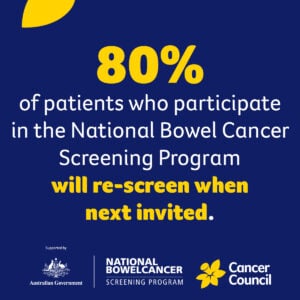
Cancer Council Australia, in partnership with the Australian Government, has launched the Get2it national bowel cancer screening campaign to increase participation in the National Bowel Cancer Screening Program.
The campaign will likely result in a greater number of enquiries to general practices about bowel cancer and screening. This presents an important opportunity for GPs and primary healthcare providers to endorse the program and support their patients’ participation.
GPs are vital in identifying patients who have never screened or are not up-to-date with their screening.
Research undertaken in 2021 by the Centre for Behavioural Research in Cancer identified three types of people who are not participating in bowel screening: refusers, intenders and the FOBT naïve.
Each face specific barriers to participation and GPs and primary healthcare providers are critical in responding to these challenges.
Once people choose to screen, 80 per cent will screen again when next invited.
Cancer Council has produced a GP resource which can be used to identify the best approach to support these reluctant or hesitant screeners in choosing to screen, thereby contributing to improving screening program participation rates.
Download the GP resource to support reluctant and hesitant screeners
Find information for health professionals about bowel cancer screening
29 June 2022
The National Eating Disorders Collaboration’s (NEDC) latest online training is now available, Eating Disorder Core Skills: eLearning for Mental Health Professionals (MH Core Skills). This training has been developed specifically for mental health professionals and is evidence-based, nationally recognised and free to access.
Find out more
ANZAED’s Credentialed Eating Disorder Clinicians – database now live. In November 2021, the Australia and New Zealand Academy for Eating Disorders (ANZAED) and NEDC launched the ANZAED Eating Disorder Credential. The credential aims to help people experiencing eating disorders locate the right treatment at the right time, increasing the chance of positive treatment outcome; and support referrers to easily locate a mental health professional and/or dietitian to provide treatment for people experiencing an eating disorder.
Search the database
22 June 2022
A new system to help improve the safe use of high-risk medicines, SafeScript NSW, is now accessible in South Western Sydney.
What is SafeScript NSW?
SafeScript NSW is computer software which provides prescribers (general practitioners, other medical specialists and nurse practitioners) and pharmacists with real-time information about a patient’s prescribing and dispensing history for certain high-risk medicines. These are known as monitored medicines and include opioids (eg codeine, morphine or oxycodone) and benzodiazepines (eg alprazolam, diazepam or nitrazepam).
How will SafeScript NSW help make the use of high-risk medicines safer?
Some monitored medicines taken in high doses or when taken with other medicines, can be dangerous, and even cause death. In 2019, there were 1,644 unintentional deaths due to drug overdoses in Australia. There were 429 (26 per cent) deaths due to pharmaceutical opioids and 582 (35 per cent) deaths involving benzodiazepines. SafeScript NSW aims to help reduce harm from monitored medicines and save lives.
How will SafeScript NSW affect what medicines I’ll be prescribed?
SafeScript NSW does not tell a health practitioner what to do or whether a medicine should or should not be prescribed or dispensed. This decision remains with the prescriber and pharmacist as they are best placed to consult with their patient and determine the safest and best option based on their individual health needs.
What is included in the monitored medicines list?
An expert panel was established to advise NSW Health on the medicines that should be monitored in SafeScript NSW.
NSW monitored medicines includes:
|
Category
|
Medicine
|
|
Opioids
|
Including but not limited to buprenorphine, codeine, fentanyl, hydromorphone, methadone, morphine, oxycodone, pethidine, tapentadol, tramadol
|
|
Benzodiazepines (prescribed for anxiety or sleep)
|
Including but not limited to alprazolam, bromazepam, clobazam, clonazepam, diazepam, flunitrazepam, lorazepam, midazolam, nitrazepam, oxazepam, temazepam
|
|
Other sleeping aids
|
zolpidem, zopiclone
|
|
Psychostimulants (prescribed for ADHD and narcolepsy)
|
dexamfetamine, lisdexamfetamine, methylphenidate
|
|
Other
|
ketamine, pregabalin, quetiapine, cannabis based medicines in Schedule 8
All other Schedule 8 medicines (Controlled Drugs) not listed above
|
Where to find more information
Visit SafeScript NSW for more information.


