10 October 2023

SWSPHN has been gathering feedback from general practice staff and residents across South Western Sydney to better understand the workforce challenges faced in primary care, as part of the national Workforce Planning and Prioritisation (WPP) program.  

This feedback has informed the following report, which will be incorporated into a wider national report to be presented to the Department of Health and Aged Care and GP colleges to address immediate and future workforce needs.

Download the report

But the journey continues! General practice staff and community members are invited to further contribute to shaping the future of primary care by providing feedback on how we can improve access to, and the quality of healthcare for everyone in our region.

Take our survey

03 October 2023

The Liver Foundation has developed CPD education to support GPs in helping prevent the rising tide of liver disease.

This education includes:

Metabolic-associated fatty liver disease clinical audit

With Metabolic-associated fatty liver disease (MAFLD) fast becoming the primary cause of liver cancer and adult liver transplant, the Liver Foundation is inviting GPs to participate in the Metabolic-associated fatty liver disease clinical audit, to discover why it is never “just a fatty liver”. This program provides practical tools to diagnose MAFLD, how to assess the risk of advanced fibrosis in patients with MAFLD, and how to manage patients with MAFLD in general practice.

Register here

The rising health threat of liver disease: What GPs can do to prevent premature mortality

Liver disease now affects up to one in three Australian adults. Primary liver cancer (HCC) is the most rapidly rising cause of cancer death. Health promotion, prevention, proactive case-finding, early identification of progressive liver fibrosis and early treatment of liver diseases are essential to prevent premature mortality.  Learn how to identify, manage and support your patients with liver disease.

Register here

26 September 2023

SWSPHN has established a Primary Care Workforce team, recognising the importance of workforce strategy, workforce engagement and workforce development in ensuring general practices across our region are better equipped to deliver quality primary healthcare.

The Primary Care Workforce team is supporting general practices, with a focus on looking for ways to improve access to primary care services through workforce planning, community consultation, commissioning and innovation.

The workforce team is working with all major stakeholders in our region, including public, private and non-government organisations across the health sector, the three tiers of government and alliance members.

This facilitates the collective sharing of evidence, local knowledge and business intelligence by key stakeholders in a bid to counter fragmentation in the health system and assist in developing a strong local healthcare workforce.

The workforce team is also focusing on GP registrars across our region.

We are providing GP registrars with opportunities to engage with their peers and SWSPHN, further develop their skills through Continuing Professional Development (CPD), and fully understand the benefits of practising in South Western Sydney.

Find out more
26 September 2023

Take our survey

Help shape the future of our healthcare workforce and guide the placement of GPs to our areas of greatest need.

Whether you’re a primary care worker or health consumer, we want to hear from people from across South Western Sydney to gain insights into how we can improve access to, and the quality of healthcare for everyone in our region.

Your input via our short survey will help us design educational events and workforce strategies to attract and keep GPs in our region.

Take survey

Thank you for taking the time to help improve our community’s health and wellbeing.

12 September 2023

The Australian Government has increased funding for the Workforce Incentive Program (WIP) – Practice Stream. This aims to help more patients access multidisciplinary team-based care in general practices.

The changes to the WIP – Practice Stream include:

  • increasing the maximum incentive amount from $125,000 to $130,000 per practice, per year before rural loading is applied
  • decreasing Standardised Whole Patient Equivalent (SWPE) for the maximum incentive from 5,000 to 4,000 so more practices can access the maximum payment
  • increasing the payment by up to 30 per cent with the amount based on the practice SWPE, health professional types and average hours worked

Practices do not need to do anything. Services Australia made the updates with the first increased payments which occurred in August 2023.

Find out more

27 July 2023

If you’re looking for a challenging, diverse and highly rewarding medical career, apply now to take the first steps towards becoming a GP.

Second intake applications for the 2024 Australian General Practice Training Program are open from 7 to 29 August 2023.

By choosing to specialise in general practice, you’ll have the opportunity to work across a broad spectrum of medicine, with further training available to develop your knowledge in fields of your interest.

You’ll also make a meaningful difference in your patient’s lives and experience the rewards of providing preventative as well as acute care.

Each year, the Royal Australian College of General PracticRACGP helps thousands of prevocational doctors, medical students and international medical graduates to become a GP.

When you train with the RACGP, you’ll join a collegiate community of lifelong learning, and benefit from high quality education and support throughout your career.

If you, or someone you know, is interested in becoming a GP, express your interest at:

www.racgp.org.au/agpt

21 June 2023

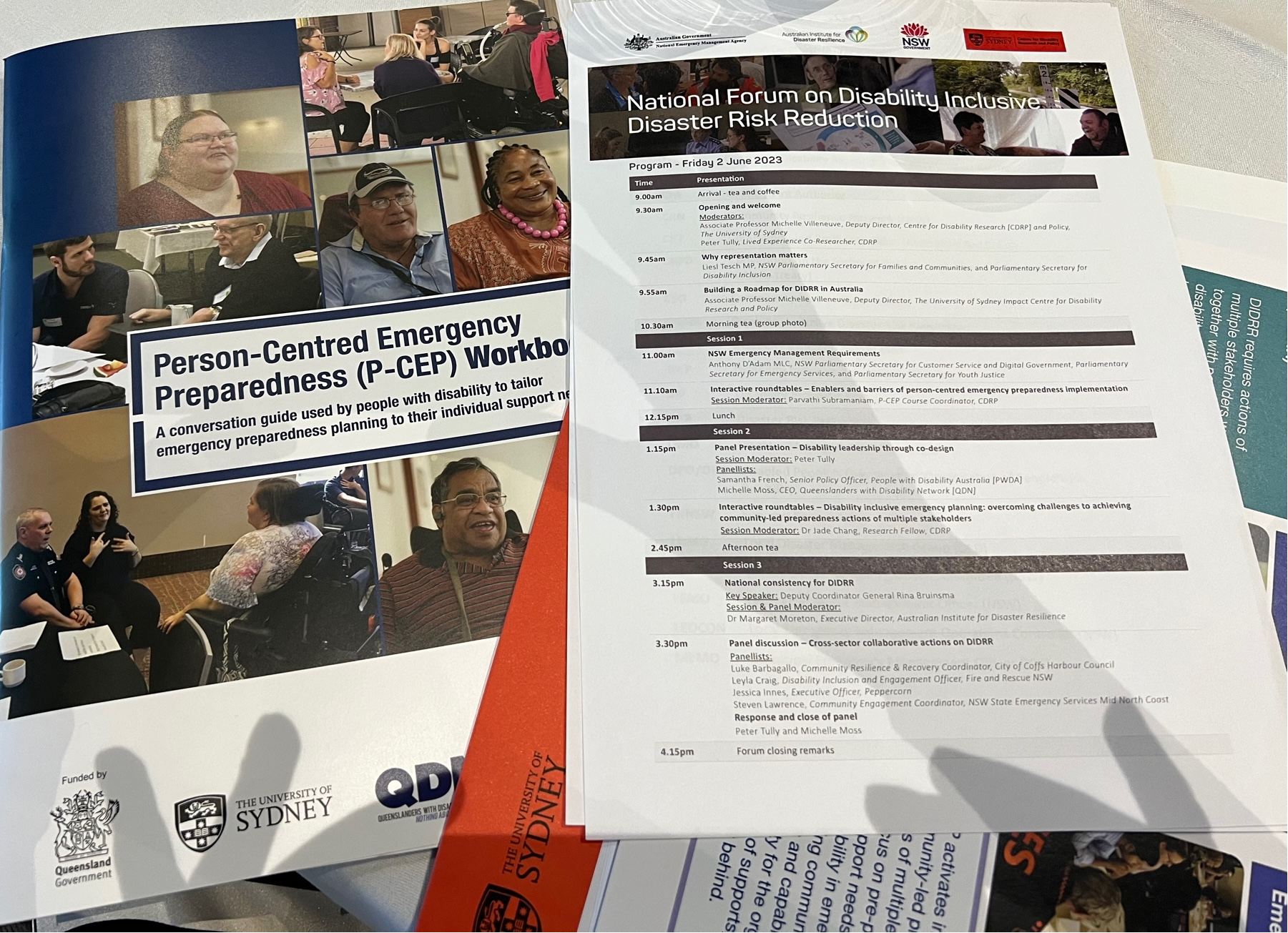
The first disability inclusive disaster preparedness toolkit can now be used by individuals to tailor emergency planning to their unique support needs.

Sydney University’s Disability Inclusive Disaster Risk Reduction research team has co-designed and tested the Person-Centred Emergency Preparedness (P-CEP) with people with disability.

P-CEP enables individuals to self-assess their preparedness, capabilities and support needs, and develop a personal emergency plan for how they will:

  • manage their support needs in emergencies
  • act together with their support network before, during and after a disaster

P-CEP focuses on capabilities not impairments, and removing barriers which increase risk for people with disability and other groups at greater risk in emergencies.

It emphasises the roles of multiple stakeholders in reducing disaster risk, consistent with Australia’s national Emergency Management and Disability Strategies.

Visit P-CEP Resource Package for an introduction and to see P-CEP in action through lived experiences and evidence which shows how the P-CEP works.

P-CEP was on the agenda at the National Forum on Disability Inclusive Disaster Risk Reduction on Friday 2 June.

21 June 2023

TAKE OUR SURVEY


Some South Western Sydney communities are currently – or are predicted to – experience general practice service shortfalls, due to changes in community needs or workforce.

The Commonwealth Government has established GP Workforce Planning and Prioritisation (WPP) Consortiums to provide advice and analysis on workforce need and training capacity across the country.

SWSPHN is gathering information from our community to support this planning, and identify areas in greatest need of GP services.

We’d like to hear from you – our community and general practice staff in South Western Sydney – about the challenges you face in accessing care from your GP.

Please take five minutes to complete this short, anonymous survey and share your experiences

Complete the survey for:

Community General practice

The survey will close on Sunday, 30 July 2023.

26 May 2023

General practice and allied health staff who work in South Western Sydney are invited to take part in this rare and exciting opportunity to upskill or reskill with FREE* training valued up to $7,990 per course as part of a collaboration with SWSPHN, UNE Partnerships and the NSW Government.

Register by 30 June 2023 for free training.


Which courses are available?

We understand that your staff are your greatest asset, which is why we have asked UNE Partnerships to deliver these courses which are focussed on improving our workforce capabilities. As well as world class online learning and personalised support, your team would have the opportunity join regular online webinars and opportunities to interact with their peers across South Western Sydney.

Preview of course details document

Download booklet of course details (PDF  |  3 pages  |  125kb)  


Register your interest to find out more about upskilling and reskilling your workforce:

For Medical Receptionists

BSB30120 Certificate III in Business Administration (Medical)

For Allied Health Assistants

HLT33021 Certificate III in Allied Health Assistance

For Medical Assistants

HLT47715 Certificate IV in Medical Practice Assisting


What about Practice Management?

UNE Partnerships has worked closely with the Australian Association of Practice Management (AAPM) to refine their practice management qualifications for more than 35 years. These benchmark qualifications will help you to lead your team and manage your practice effectively in an increasingly complex healthcare sector.

Register your interest to find out more about developing your practice management skills:

For aspiring practice managers

BSB40520 Certificate IV in Leadership and Management

For new practice managers

BSB50420 Diploma of Leadership and Management

For experienced practice managers

BSB60420 Advanced Diploma of Leadership and Management


Am I eligible?

The NSW Smart and Skilled funding has eligibility criteria which includes:

  • At least 15 years old and no longer at school.
  • Living or working in NSW.
  • An Australian citizen, Australian permanent resident, humanitarian visa holder or New Zealand citizen.

*This training is subsidised by the NSW Government. Eligibility criteria applies.


23 May 2023

GPs and non-GP specialists had the opportunity to network and learn from each other at the inaugural Breaking Down the Silos in South Western Sydney dinner at Rydges Campbelltown on Tuesday, 9 May.

Sydney South West GP Link Chair, Dr Kenneth McCroary, organised the event to encourage the development of broader networking opportunities, provide participants with an opportunity to enhance their capacity and skills, and to breakdown the silos between disparate groups.

The event saw health colleagues introducing themselves to each other over dinner, listening to insightful presentations, and taking part in discussions about the challenges faced by healthcare providers and developing solutions to those challenges.

SWSPHN Acting Chief Executive Officer, Kristen Short, and South Western Sydney Local Health District Acting Chief Executive, Sonia Marshall, gave a well-received presentation on the evening, which provided an overview of the silos within local health services, the impact of silos on patient care and outcomes, and the introduction of strategies to break down silos.

Dr Tim Senior a specialist GP and Dr Andrew McDonald a specialist paediatrician provided an example of GP and non-GP specialists working together at Tharawal Aboriginal Medical Services to improve the health outcomes of Aboriginal and Torres Strait Islander peoples our region.

Special guest Dr Charlotte Hespe, Chair of the NSW Faculty of the Royal Australian College of General Practitioners, and Dr Michael Tam, Deputy Chair of Sydney South West GP Link, also joined a panel discussion of four speakers.

Attendees showed particular interest in discussions relating to information technology, and solutions such as Lumos and iRAD, and communication deficits and plans to improve the collaboration between practitioners locally and across the state to improve health outcomes.

Dr McCroary said it had been amazing the way local healthcare providers came together during the COVID-19 pandemic to protect and support our community to deal with day-to-day changes, particularly during vaccine rollouts and curfew periods.

“A fear I have, though, is that post pandemic these team care community-minded cooperative systems will break down and revert to pre-pandemic health silos,” he said.

“One of the roles of our event was to highlight the importance of breaking down these silos and encourage ongoing cooperation on the ground.”

Dr McCroary welcomed the “incredibly positive” feedback on the event by attendees which included: 

“I felt inspired by all the passionate medical colleagues in the room.”

“Very interesting insight into the structure of primary care in Australia and relationship between general practice and specialist services in Sydney.”

“Excellent topics. Great networking.”

“Let’s keep thinking about systems to encourage patient centred care but also what you can contribute, how you can go out of your way to break the silos and create a collective team.”

“It was great to look at challenges of developing relationships and systems to improve communication.”

If you’re not a member of GP Link already or would like to learn more, visit the Sydney South West GP Link website.