28 July 2022

All inpatient maternity services are now located in Campbelltown Hospital’s Clinical Building (Building A).

Information about accessing the services can be found below.

Birthing Unit A41

Please call prior to arrival on 4634 4099

Between 6am–9pm enter via the main entrance of the building (Level 2), enter the lifts to your left and proceed to Level 4.

The entry to the Birthing unit is near the lifts, use the intercom button 2 to speak with staff for entry.

From 9pm–6am enter via Emergency Department entrance, and you will be escorted to Birthing Unit.

There is limited parking in P1 (outside emergency), otherwise parking P2 or P3 for access to the clinical building.

Antenatal Ward A42

Enter the main entrance of the building (Level 2), enter the lifts to your left and proceed to Level 4.

The entry to the Antenatal ward is near the lifts, use the intercom button 1 to speak with staff for entry.

Visiting Hours: 8am–8pm

Postnatal Ward A52

Enter the main entrance of the building (Level 2), enter the lifts to your left and proceed to Level 5.

The entry to the Postnatal Ward is near the lifts, use the intercom button 1 to speak with staff for entry.

Visiting Hours: 8am–8pm

Special Care Nursery A51

Enter the main entrance of the building (Level 2) enter the lifts to your left and proceed to Level 5.

The entry to the Special Care Nursery is near the lifts, use the intercom button 2 to speak with staff for entry.

Perioperative Unit

For planned Caesarean admissions.

Enter via the main entrance.  Walk straight ahead towards the stairs, enter the lifts to the left of the stairs and go down to Ground level. Exit the lift and turn right.

If you are bringing frozen breastmilk, please go to Postnatal first to store it in the freezer.

Download the flyer

07 July 2022

Bowel cancer is Australia’s second biggest cancer killer, but if detected early, more than 90 per cent of cases can be successfully treated.

Unfortunately, only 43.5 per cent of all eligible people aged 50 to 74 complete the bowel cancer screening kits sent to them every two years. If the participation rate could be increased to 60 per cent, 84,000 lives could be saved over the next 20 years.80% will rescreen -Get2it

Cancer Council Australia, in partnership with the Australian Government, has launched the Get2it national bowel cancer screening campaign to increase participation in the National Bowel Cancer Screening Program.

The campaign will likely result in a greater number of enquiries to general practices about bowel cancer and screening. This presents an important opportunity for GPs and primary healthcare providers to endorse the program and support their patients’ participation.

GPs are vital in identifying patients who have never screened or are not up-to-date with their screening.

Research undertaken in 2021 by the Centre for Behavioural Research in Cancer identified three types of people who are not participating in bowel screening: refusers, intenders and the FOBT naïve.

Each face specific barriers to participation and GPs and primary healthcare providers are critical in responding to these challenges.

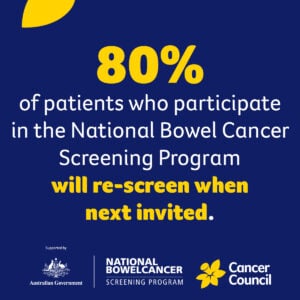
Once people choose to screen, 80 per cent will screen again when next invited.

Cancer Council has produced a GP resource which can be used to identify the best approach to support these reluctant or hesitant screeners in choosing to screen, thereby contributing to improving screening program participation rates.

Download the GP resource to support reluctant and hesitant screeners

Find information for health professionals about bowel cancer screening

25 February 2022

The BreastScreen NSW service is open and is working to minimise delays for women who are due for their two-yearly mammogram.

Please note:

  • Clients will be contacted if there is any change to their appointment.
  • Online bookings are currently open for clients who have been contacted by BreastScreen NSW and issued a booking code.
  • BreastScreen NSW is open for clients who have been screened and are asked to return for additional tests to make a definitive diagnosis.
  • Information is available on BreastScreen NSW’s website and Facebook page.
  • BreastScreen NSW recommends clients who develop breast symptoms contact their doctor or health worker without delay.
  • BreastScreen NSW has implemented a range of COVID-19 safe measures at its clinics and mobile screening vans, to protect women, staff and the wider community.

Please contact BreastScreen NSW on 13 20 50 if you have any questions.

28 January 2022

Cervical cancer is one of the most preventable and curable of all cancers. Having a cervical screening test every five years can reduce the risk of being diagnosed with cervical cancer by up to 96 per cent yet only 50.9 per cent of eligible women in South Western Sydney are screened regularly.

  • Every year about 800 women are diagnosed with cervical cancer and about 250 women die
  • 80 per cent of these women have either never been screened or have had irregular screening


National Cervical Screening Program 

The National Cervical Screening Program reduces illness and death from cervical cancer. Women aged 25 to 74 years of age are invited to have a cervical screening test every five years.

Find more information about the National Cervical Cancer Screening Program on the Department of Health website.


Human papillomavirus (HPV) immunisation service

Vaccination is a safe and effective way to protect you from HPV. The HPV vaccine is often called the ‘cervical cancer vaccine’.


Who is the HPV vaccine recommended for?

  • people aged approximately 12 to 13 years (at school), for free under the National Immunisation Program (NIP)
  • men who have sex with men, if they have not already had a full course of HPV vaccine
  • people over nine years old who have weakened immune systems


High school program

HPV vaccinations are offered to Year 7 students through a school-based program run across South Western Sydney. 


Useful resources

NSW School Vaccination Program 2021

Cervical Screening NSW

Family Planning NSW  

Human papillomavirus (HPV) immunisation service

28 January 2022

Breast Cancer is the most common cancer affecting women with one in eight women in NSW developing breast cancer in their lifetime.

The best time to treat breast cancer is when it is still small. 

This is why breast screening is so important, yet only 46.3 per cent of eligible women in South Western Sydney are participating in regular screening. Having regular mammograms is the best way to find breast cancer early, when treatment is likely to be most successful.


BreastScreen NSW

BreastScreen NSW is a free breast screening service for women aged over 40. The program targets women aged 50 to 74 years, encouraging them to have a screening mammogram every two years. Women aged 40 to 49 and those above 75 are also welcome to have a free mammogram.

BreastScreen NSW provides mammograms at various fixed and mobile locations across South Western Sydney.


Mobile BreastScreen NSW clinics in South Western Sydney in 2021

Download the 2021 BreastScreen NSW mobile schedule for South Western Sydney 


Breastscreen NSW fixed locations in South Western Sydney

  • Bankstown: Ground floor, Civic Tower Building, corner Rickard Road and Jacobs Street, Bankstown 
  • Liverpool (screening): Unit 5, 157-161 George Street, Liverpool 
  • Liverpool (screening and assessment): 102 Bigge Street, Liverpool 
  • Campbelltown: Ground floor, Units 3-5, Mawson Centre, 4 Browne Street, Campbelltown 
  • Bowral: Bowral Street Specialist Centre, Suite 4, 70-72 Bowral Street, Bowral 


Making a booking

To make an appointment call 13 20 50 or for the free telephone interpreter service, call 13 14 50.

Online bookings are available via the BreastScreen NSW website.

Women are also welcome to visit the mobile van or fixed locations to book an appointment and there are also walk-in appointment slots available. Please note these spots are limited. All staff members at the van are female.


Useful resources

BreastScreen NSW  

Cancer Institute NSW

BreastScreen NSW GP resources

22 November 2021

BreastScreen NSW (South Western Sydney) has resumed screening at its permanent screening centres at Bankstown, Bowral, Campbelltown and Liverpool.

The mobile clinic at Cabramatta is also open until 11 February 2022, from 8.45am to 4pm weekdays. Vietnamese, Cantonese and Mandarin-speaking staff are available to provide assistance.

Selected Saturdays will commence at various screening clinics in 2022.


Vaccinations 

It is now mandatory for all NSW Health staff will be vaccinated.

In line with advice from NSW Health, BreastScreen NSW strongly encourages women to be vaccinated against COVID-19, ideally before attending their breast screen appointment.


Safety measures

BreastScreen NSW has in place measures to reduce the risk of COVID-19 transmission, these include:

  • Precautionary questions around health and travel
  • Limiting the number of people in the clinic
  • Practicing social distancing in clinic waiting rooms
  • A minimal contact check-in process
  • The use of personal protective equipment
  • Cleaning of equipment and commonly used services


Appointments

BreastScreen NSW is prioritising clients who had their appointments cancelled during the recent suspension. Clients are asked to wait to be reinvited by BreastScreen NSW before calling 13 20 50 for an appointment.

BreastScreen NSW recommends clients who develop breast symptoms contact their doctor or health worker without delay.

For the most up to date information, visit the BreastScreen NSW website.

15 October 2021

Breast cancer is the most common cancer diagnosed in Australian women.

Breast Cancer Awareness Month in October provides a timely reminder for us all to focus on breast cancer and its impacts.

Take the time this month to find out what you need to know about breast awareness and share this important information with your family, friends and colleagues.

Finding breast cancer early provides the best chance of surviving the disease. You don’t need to be an expert or use a special technique to check your breasts.

Here are some webpages you might find handy:

Breast cancer risk factors

Early detection of breast cancer

Symptoms and diagnosis of breast cancer

Breast cancer treatment

Cancer Australia

Breast Cancer Network Australia

BreastScreen Australia program

Breast cancer in Australia statistics

20 November 2020

Tragically, one woman on average dies in Australia as a result of domestic violence every week.

A number of significant dates are coming up in the next few weeks which shine the spotlight on this alarming figure and call the community to action – to end violence against women and support human rights.

White Ribbon Day

International Day for the Elimination of Violence Against Women

World Human Rights Day

16 Days of Activism

Professional development webinars

SayNo2DV Breakfast

Domestic Violence Service Directory

1800 Respect


Friday, 20 November is White Ribbon Day

White Ribbon Day brings people together – in person and online – to raise awareness and commit to action to prevent men’s violence against women. In workplaces, schools and communities all over Australia, organisers are asking you to stand up, speak out and act to end gendered violence. 

How you can help stop violence against women


Wednesday, 25 November is the International Day for the Elimination of Violence against Women

Violence against women and girls is one of the most widespread, persistent and devastating human rights violations in our world today and remains largely unreported due to the impunity, silence, stigma and shame surrounding it. The United Nations designated November 25 as the International Day for the Elimination of Violence Against Women to raise awareness of these facts.

Campbelltown City Council will hold its annual Driving Out Violence Convoy on Wednesday, 25 November which will travel across the LGA to raise awareness. The convoy starts at West League Club at 9am. This date marks the start of 16 Days of Activism.

To find out more, including the route the convoy will take.

The Driving out Violence Convoy will pass Campbelltown Hospital (Parkside Cres) about 9.20am. Come out and show your support


Thursday, 10 December is World Human Rights Day

Human Rights Day is the day the United Nations adopted, in 1948, the Universal Declaration of Human Rights. The declaration proclaims the rights which everyone is entitled to as a human being – regardless of race, colour, religion, sex, language, political or other opinion, national or social origin, property, birth or other status. Available in more than 500 languages, it is the most translated document in the world.


What are the 16 Days of Activism and why should you care?

Each year, from 25 November to 10 December, the 16 Days of Activism campaign calls for action against one of the world’s most persistent violations of human rights – violence against women.

During the 16 Days of Activism, people around the world unite to raise awareness about gender-based violence, challenge discriminatory attitudes and call for improved laws and services to end violence against women for good.


SWSLHD professional development webinars for healthcare workers

South Western Sydney Local Health District is hosting a series of professional development webinars that will unpack some need-to-know information for building knowledge, skill and application to respond to violence, abuse and neglect.

The webinars start today, White Ribbon Day, and run during the 16 days of Activism, 25 November to 10 December.

To download the calender


SayNo2DV virtual breakfast – 2 December

The Camden/Wollondilly Domestic Violence Committee’s annual SayNo2DV breakfast has been redesigned to ensure it is COVID Safe. You can join the breakfast via Facebook to listen to a compelling interview via video with a survivor of domestic violence. She will talk about her journey and experiences – both good and bad. The breakfast will be held on Wednesday, 2 December from 8.30am to 9.15am.
To find out more
To register

Canterbury Bankstown Domestic Violence Service Directory

If you need help finding local domestic violence support services, visit cbdvsd.com.au

1800RESPECT 10 Year Anniversary

This year’s 16 Days of Activism campaign coincides with the 10th anniversary of the 1800RESPECT service.

The national sexual assault, domestic or family violence telephone service was started in 2010 as part of the National Plan to Reduce Violence against Women and their Children. Under the National Plan, 1800RESPECT is to provide to support to people impacted by violence and abuse, their friends and family, and frontline workers in the sexual assault and domestic violence sectors.

Phone 1800 737 732  24 hours

Chat online 24 hours

Find services in your area

Return to top ^

12 November 2020

South Western Sydney Local Health District will host a series of professional development webinars that will unpack some need-to-know information for building knowledge, skill and application to respond to violence, abuse and neglect.

When do the webinars commence?

What are the key webinar benefits?

Who is the target audience?

Learn more about the webinars


When do the webinars commence?

These webinars commence on White Ribbon Day, 20 November, followed by the 16 days of Activism Against Gender-based Violence, 25 November to 10 December.

For this year’s 16 days, UN Women is calling for communities to UNiTE and move beyond awareness to tangible action weaving women’s rights and gender equality into our everyday behaviour, practice and communities.


What are the key webinar benefits?

  • You can choose and register a single or multiple sessions of interest
  • Accessible online – registered participants will receive a link via email one week prior to the event
  • Short and sharp one-hour Breakfast bite or Lunchtime bite timeslots to maximum your time and learning
  • Ask questions to a subject matter expert during the 15-minute moderated Q&A at the end of each session
  • Gain new insights and practice resources that you can use to enhance your work
  • Build capacity and understanding across the sector in South Western Sydney


Who is the target audience?

Practitioners and managers working in community, government, education, police and justice sector with responsibility for: family and domestic violence; men’s behaviour change programs, women’s services, child protection; violence prevention, mental health, drug and alcohol and health professionals are encouraged to attend.

Learn more about the webinars

19 October 2020

SWSPHN has again urged our community ‘don’t neglect your health’ following the release of a new report which shows the number of cancer screening tests performed as part of national population screening programs declined during the first few months of the COVID-19 pandemic.

The Australian Institute of Health and Welfare (AIHW) report, Cancer screening and COVID-19 in Australia, brings together data for the period of January to June 2020 on the three national cancer screening programs – BreastScreen Australia, the National Cervical Screening Program and the National Bowel Cancer Screening Program.

See below for more on the Cancer screening and COVID-19 in Australia report

In July, SWSPHN partnered with the South Western Sydney Local Health District, local GPs and emergency department doctors for the Don’t Neglect Your Health campaign video series, urging the community not to let their regular health take a backseat during COVID-19.

Local doctors reassured our community it was safe have regular check-ups, have blood tests and fill prescriptions for chronic conditions, get flu vaccinations and book cancer screenings during the pandemic.

They warned neglecting your regular health or chronic conditions now could lead to serious health issues and worsening chronic conditions down the track.

Watch our videos

SWSPHN Chief Executive Officer, Dr Keith McDonald PhD, has renewed those calls, emphasising the importance of managing your general health.

Dr McDonald said the AIHW report had highlighted the significant impact COVID-19 had had on breast screening rates, especially during the early months of the pandemic. He said the long-term consequences of delayed screening during the pandemic would not be known for some time.

“Screening for cancer is vital – early detection can increase your chances of successful treatment and survival.

“In terms of managing your general health, your local doctor’s surgery is one of the safest places you can visit. GPs know the importance of infection control and every GP is taking steps to keep you, and every patient, safe,” Dr McDonald.

“During the pandemic and beyond, it’s important to maintain routine check-ups – don’t let little things turn into big things. Don’t put off filling your prescriptions or seeing the GP for a repeat for your prescription. Ensure you keep your vaccinations up-to-date and keep up with any screening or tests recommended by your GP.

“Please, don’t neglect your health.”


According to the AIHW report:


BreastScreen Australia

In April about 1,100 screening mammograms were performed compared with 74,000 in April 2018.  Overall, there were about 145,000 fewer screening mammograms conducted by BreastScreen Australia in January to June 2020 compared with January to June 2018.


National Cervical Screening Program

The number of cervical screening tests was expected to drop in 2020 due to the National Cervical Screening Program changing from two-yearly to five-yearly screening so it is difficult to know the impact of the pandemic on the screening rate.

However, data shows a decline in the number of cervical screening tests from the second half of March 2020, which remained low throughout April, during which fewer than 30,000 tests were carried out. The number of tests began to increase in May and rose again in June.


National Bowel Cancer Screening Program

From the data, it appears that the COVID-19 pandemic did not have a direct effect on bowel cancer screening which involves home test kits, sent to eligible participants who then mail their completed test kit for laboratory testing.

Visit the AIHW website to read more