10 December 2025

Jump to:


We’ve compiled some tips on managing the heat this summer.


Understanding hot weather risks

What is a heatwave?

Heatwaves are times of extreme heat, when the minimum and maximum temperatures are hotter than usual for three or more consecutive days.

Overheating

When the weather is very hot, your body must work harder to produce more sweat to keep cool.

In some conditions, sweating is not enough and your body temperature can rise rapidly. This is more likely to happen when it is humid or when you are dehydrated and can’t produce enough sweat.

It is important your body temperature stays between 36.1 to 37.8˚C. If your body rises above this, you may develop signs of heat-related illness.

Heat-related illness occurs when the body absorbs too much heat. This may happen slowly over a day or two of extremely hot weather.

Act quickly to avoid serious—or even fatal—effects of fully developed heatstroke.

Signs of heatstroke

  • Rapid pulse or weak pulse
  • Fast, shallow breathing
  • Dry, swollen tongue
  • Trouble speaking
  • Slurred speech
  • Problems concentrating or coordinating movements
  • Aggressive or strange behaviour
  • Dizziness, confusion, seizures or loss of consciousness
  • Sudden rise in body temperature
  • Hot, dry and possibly red skin, possibly with no sweat
  • Headache, nausea or vomiting
  • Intense thirst

Signs of heat stress

  • Rising body temperature
  • Dry mouth and eyes
  • Headache
  • Shortness of breath
  • Nausea or vomiting
  • Absence of tears when crying (children)

Who is at risk?

While most people find extremely hot weather and heatwaves uncomfortable, some people have a higher risk than others of becoming ill. These include:

  • Adults aged over 75 years, babies and young children
  • People with long-term health conditions, such as heart or lung disease or diabetes
  • People living with overweight or obesity
  • People taking certain medicines
  • People who are socially isolated
  • People who work outdoors or in hot and poorly ventilated areas
  • People who are not accustomed to the heat, for example, overseas visitors


Staying safe in the heat

Be prepared

  • Find ways to make your home or building cooler like light-coloured window coverings, awnings and shade cloth
  • Have air conditioners serviced before the start of summer
  • Ensure you have enough food, medicine and other supplies to avoid going out or if electricity supply is interrupted
  • If you have a medical condition, ask your GP for advice on how to manage the heat
  • Make a list of family, friends and neighbours you might want to check in on and ensure you have their current contact details
  • Drink 2 to 3 litres of water a day at regular intervals, even if you do not feel thirsty. If you are on a limited fluid intake, check with your GP
  • Limit intake of alcohol, soft drinks, sports drinks, tea or coffee
  • Eat normally but try to eat cold foods, particularly salads and fruit. Avoid heavy protein foods which raise body heat and increase fluid loss

Keep out of the heat

  • If you can, avoid going out in the hottest part of the day (11am to 3pm). Avoid strenuous activities and gardening
  • Do not leave children, adults or animals in parked cars
  • If you do go out, wear lightweight, light-coloured, loose, porous clothes, a wide-brimmed hat and sunscreen
  • Regularly rest in the shade and drink plenty of water

Stay as cool as possible

  • Stay inside, in the coolest rooms in your home
  • Block out the sun during the day and keep windows closed while the room is cooler than it is outside
  • Use fans and air conditioners at home to keep cool, or spend time elsewhere in air-conditioning like a library, community centre, cinema or shopping centre
  • Take frequent cool showers or baths and splash yourself several times a day with cold water
  • Open windows after the sun/heat has gone down to allow for air circulation
  • Make sure to stay cool while you sleep. Just because the heat has gone down doesn’t mean it isn’t still hot

Keep food safe in hot weather

  • Put food back in the fridge after using it
  • Don’t eat food left out of the fridge for 2+ hours
  • Put leftovers in the fridge after the food has cooled
  • Eat leftovers within two to three days
  • Read more about food safety

Being sun smart

If you have to go outside into the heat, follow a few recommendations from the Cancer Council NSW:

  • Learn to understand the UV index (when the UV index is 3 or above we need to protect the skin from sun damage)
  • Wear protective clothing (clothing is one of the easiest and most effective ways to protect your skin)
  • Apply sunscreen (choose a water-resistant, broad spectrum sunscreen which is at least SPF 30)
  • Wear a hat (wear a broad-brimmed, bucket or legionnaire-style hat for the best protection)
  • Seek shade
  • Wear sunglasses (protect your eyes properly with close-fitting wrap-around sunglasses)


Checklist for older people

Before a heatwave

  • Assess which care recipients are at risk – who has limited capacity to keep cool; or which areas of the facility are prone to being hot
  • Ensure entry/exit points can be monitored
  • Ensure cooling systems in the home are adequate and working effectively
  • Ensure alternative forms of fluid, such as jelly, ice-cream or fruit juice blocks are available

During a heatwave

  • Ensure the temperature in care recipients’ rooms are comfortable, keeping curtains and blinds closed to reduce excess heat
  • Monitor entry/exit points to avoid the unsupervised departure of care recipients during extreme heat events
  • Be aware care recipients may be at particular risk following high overnight temperatures
  • Ensure small amounts of fluids are readily available, rather than large amounts of fluids less frequently
  • Avoid serving caffeinated or alcoholic beverages
  • Provide care recipients with frequent small meals
  • Help care recipients to keep skin covered when exposed to direct sunlight and to wear loose fitting clothing
  • Avoid taking care recipients outside between 11am and 3pm
  • Offer tepid showers or sponging
  • Look for signs of heat stress, such as nausea or changes in appearance including red, pale or severely dry skin
  • Ask for a clinical assessment if care recipient shows any signs of deterioration


Caring for pets

Our pets are part of the family, and they feel the heat as much as us. The most common summer risks for pets are: overheating; sunburn; dehydration; stroke. Follow some simple steps to ensure they are safe and comfortable during hot weather.

  • Provide plenty of water and shade
  • Know the signs of overheating:
  • Heavy panting
  • Dry or bright red gums
  • Thick drool
  • Vomiting
  • Diarrhea
  • Wobbly legs
  • Never leave your pet in the car (it can take less than 10 minutes to develop heat stroke in dogs and cats inside a hot vehicle)
  • Apply sunscreen (pets get sunburns too, especially those with short or light hair coats; apply pet sunscreen only)
  • Don’t shave your pet (a pet’s coat is naturally designed to keep it cool during the summer and warm in the winter; trim but never shave)
  • Mind your walking hours (don’t walk your pet in the heat of the day; consider early morning and late evening)
  • Keep your dog’s paws cool (try to keep your pet’s paws off concrete, bitumen and other hot surfaces)
  • Keep parasites off (In summer, fleas, ticks, mosquitoes, and other parasites are everywhere)


Download Your health matters in a disaster flyer, five simple steps to help prepare you if a disaster occurs.

04 November 2025

SWSPHN’s HEAL program and the importance of health literacy in successfully promoting physical activity, were highlighted at the WSYD Moving Symposium 2025 at Western Sydney Conference Centre, Penrith on Thursday, 30 October.

The symposium brought together more than 250 leaders, health practitioners and community voices under the theme Accelerating action – tackling inactivity and inequity, to urge cross-sector collaboration in unlocking healthier, more active lifestyles for all communities.

SWSPHN staff including Nisha Nair, Alyssa Horgan and Luke Swain (pictured) attended the event, with Nisha joining a panel focused on Embedding physical activity into health systems, where she discussed our HEAL (Healthy Eating Active Lifestyle) program.

HEAL is an eight-week evidence-based program designed for people who have, or are at risk of type 2 diabetes or cardiovascular disease, to improve their health through better nutrition, increased physical activity and long-term behaviour change.
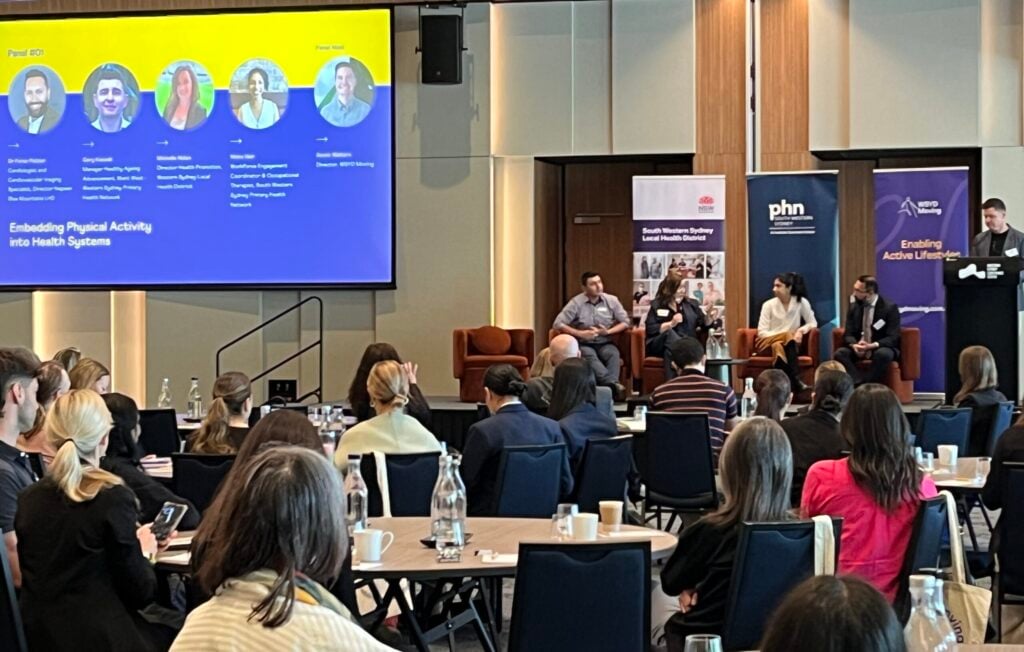
physicalDuring the panel discussion, Nisha gave HEAL as one example of a SWSPHN initiative which promoted physical activity saying there is capacity for the program to be scaled through joint collaboration.

“HEAL facilitates collaborative opportunities through providing templates for communication, options for the exercise components which can be adapted based on the group of participants and opportunities for health education,” she said.

“We have commissioned service providers within our region to run the HEAL program for our community, and we are hoping to support over 200 people within our region.

“Embedded within the program are opportunities for facilitators to collaborate with GPs and other relevant health providers involved in the care of the participants. We’re looking to explore different versions of HEAL for different population groups to expand the impact of the program.”

Penrith Deputy Mayor Garion Thain opened the event, which included an address by State Health Minister Ryan Park, and 40 speakers from health, local government, sport, academia and community sectors, covering Local Active Partnerships, systems leadership, community-led solutions and new opportunities for collaboration.  

When asked about building the capability of the health workforce to champion physical activity – particularly for those who may not see it as ‘their role’ – Nisha spoke about how building opportunities to showcase the impact of those roles could result in ‘lightbulb moments’.

“I was at a youth refugee expo a few weeks ago, where we had a push up competition to build awareness of the impact of physical activity,” she said.

“As language was a barrier with some of the interactions at the event, we saw the impact volunteer interpreters made with bridging that health literacy gap.

“Not only did having interpreters help with building that awareness of physical activity with participants, they saw attendees taking flyers not only for themselves but for their siblings and parents.

“I saw the lightbulb moment in the volunteers’ heads – that sense of contribution they felt in that moment.”

WSYD Moving is a health-promotion charity. The symposium marked the official launch of the WSYD Moving Systems Leadership Course, a first-of-its-kind program designed to build capacity and strengthen collaboration across sectors.

WSYD Moving Convenor David Burns said physical inactivity cost the Western Sydney region more than $1.5 billion every year.

“We can’t solve this alone — it requires all of us working together. The symposium is a key event to bring parts of the system together, build relationships, and help to systemise approaches that enable communities to reduce inequity in access to more active lifestyles.”

Find out more about HEAL

Find out more about WSYD Moving

07 May 2024

Village Connect is a unique child and family hub designed by Karitane in partnership with Sonder and Uniting to support parents living in South Western Sydney who are pregnant and/or have a child.

The hub brings together child and family health services, key workers and a wide range of resources to ensure parents get the help they need, when they need it.

It aims to improve the confidence and skills of parents in connecting with and raising their child through a range of support services including playgroups, parenting workshops and care navigation services.

Nurses, wellbeing experts, and psychologists also offer parents access to 24/7 confidential medical, safety and mental healthcare support via the Sonder app

Village Connect also offers multilingual support, including:

  • In-app chat: more than 240 languages
  • Phone or video: more than 300 languages via translation service
  • Full App translations: available in Mandarin, Bengali, Cantonese and Thai

Find out more about Village Connect
30 April 2024

Your patients can now access a new program which supports people who have experienced family, domestic or sexual violence to connect with services to assist with their long-term recovery.

Anglicare Sydney and CatholicCare Sydney began service delivery of the key mental health component of the SWSPHN-funded Supporting Recovery from Family, Domestic and Sexual Violence Program in April.

The program officially launched at the Casula Powerhouse in Liverpool on 1 May.

Services are initially being delivered from hubs based in the Campbelltown, Liverpool and Fairfield communities due to higher rates of family, domestic and sexual violence in those local government areas (LGAs).

However, services may be expanded across Bankstown, Camden, Wingecarribee and Wollondilly LGAs based on need and demand. 

The Supporting Recovery program includes access to:

  • a Local Care Team to help clients coordinate and manage their recovery journey, including connecting clients with a range of other services such as legal, financial and housing supports
  • trained psychologists, social workers and counsellors who specialise in providing trauma-informed and client-centred mental healthcare
  • holistic, culturally appropriate mental health services which are available at no cost for a period up to two years

Your patients do not need a doctor’s referral. They can access the service by calling 1300 316 554 or going online and completing a self-referral.

Find out more
16 November 2023

Eligible patients can now apply online for the Continence Aids Payment Scheme (CAPS).

CAPS is an Australian Government program which helps people over five years old who experience permanent and severe incontinence to cover some of the costs of buying continence products.

The new online application is available through the individual’s Medicare account on myGov or in the Express Plus Medicare mobile app.

Patients still have the option to use the existing CAPS application guidelines and application form, which can be downloaded or ordered from the Department of Health and Aged Care.

If someone else is applying on behalf of a patient, their representative must use the paper form.

Even if a patient applies online, they still need a registered health professional (such as a GP) to complete the health report section using the paper form.

The patient will then need to upload the report to their online application through their Medicare online account.

Please inform your eligible patients of the new online application process.

More information can be found at www.servicesaustralia.gov.au/caps and the department’s website.

20 September 2023

This week has been a timely reminder extreme heat can have a serious impact on people’s health.

Heatwaves and hot weather have killed more people in Australia than any other disaster.

Extreme heat can be dangerous for anyone, however it is particularly dangerous for those:

  • over the age of 75
  • babies and young children
  • overweight or obese
  • pregnant or breastfeeding
  • poor mobility
  • who are homeless
  • socially isolated, living alone
  • working in a hot environment
  • have a chronic illness (such as diabetes, heart disease, high blood pressure, cancer, mental illness)
  • have an acute illness (an infection with fever or gastroenteritis)
  • taking certain medications

Heat stroke is a life-threatening emergency.

It occurs when the body temperature rises about 40.5 degrees.

Immediate first aid is critical to lowering the body temperature as soon as possible.

The effect of heat on chronic conditions

Most heat-related morbidity and mortality is due to the exacerbation of chronic conditions.

Conditions which most commonly contribute to death during a heatwave include:

  • cardiac events
  • asthma or other respiratory illness
  • kidney disease
  • diabetes
  • nervous system diseases
  • cancer

Dehydration and subsequent medication toxicity may exacerbate:

  • altered mental state
  • kidney stones
  • cardiovascular impairment
  • falls

Heat and medication

Some medications can increase the risk of heat-related illness. Some can also be less effective when exposed to high temperatures.

The following medications can be impacted by heat. (This list should be used as a guide only)

Interference with sweating, caused by:

  • anticholinergics, for example tricyclic antidepressants and benztropine
  • beta blockers
  • antihistamines
  • phenothiazines
  • vasoconstrictors

Interference with thermoregulation, caused by:

  • antipsychotics or neuroleptics, for example risperidone, clozapine, olanzapine
  • serotoninergic agonists
  • stimulants, for example amphetamine, cocaine
  • thyroxin

Decreased thirst, caused by:

  • butyrophenone, for example haloperidol and droperidol
  • angiotensin-converting enzyme (ACE) inhibitors

Dehydration or electrolyte imbalance, caused by:

  • diuretics, especially loop diuretics
  • any drug causing diarrhoea or vomiting, for example colchicines, antibiotics, codeine
  • alcohol

Reduced renal function, caused by:

  • NSAIDS
  • sulphonamides
  • indinavir
  • cyclosporine

Aggravation of heat illness by worsening hypotension, caused by:

  • vasodilators, for example nitrates (GTN) and calcium channel blockers
  • anti-hypertensives

Levels of drug affected by dehydration (possible toxicity for drugs with a narrow therapeutic index), caused by:

  • digoxin
  • lithium
  • warfarin
  • antiepileptics
  • biguanides, for example metformin
  • statins
  • altered state of alertness, caused by any drugs which alter the state of alertness, for example alcohol, benzodiazepine and narcotics

Resources to help you prepare for heatwaves

At-risk community members can prepare for heatwaves and heatstroke using the resources below:

Heatstroke – Health Resource Directory

Preparing for a heatwave – Health Resource Directory

Healthcare providers can find more information at:

Beat the heat (nsw.gov.au)

14 September 2023

SWSPHN’s Disaster Management team will be sharing information about the importance of healthcare during a disaster or emergency, at the Wollondilly Emergency Services Expo on Saturday, 23 September.

The event will be held from 10am to 2pm at Victoria Park, Picton.

Representatives from the NSW Rural Fire Service, Fire & Rescue NSW, NSW SES, NSW Ambulance and the NSW Police Force will also attend the expo.

Our Disaster Management team will be holding a stall to provide community members with information about how to best prepare their health for a disaster.

They will also be distributing a flyer highlighting the five simple steps to follow to ensure your health and wellbeing can be prioritised during disaster.

The flyer, which provides practical advice about preparing your health for disaster as well as information about access to services, will also be available at:

  • Emergency Ready Day, Sunday, 24 September, 11am to 3pm, Koshigaya Park, Campbelltown
  • Community Links Wellbeing Festival of Fun, Sunday, 26 November, 10am to 2pm, Bargo Sports Ground

During an emergency, PHNs are the first points of contact on primary healthcare coordination and service availability, as part of the overall coordinated health response.

Health outcomes for our community can be greatly improved and enhanced when we prepare and respond to emergencies together.

07 August 2023

State-wide Referral Criteria (SRC) are clinical decision-support tools which give health professionals the referral criteria they need to refer their patients to public specialist outpatient services across NSW.

SRC helps people who need to see a health professional in a NSW public specialist outpatient service be referred and prioritised in a safe and timely way.

They support patients and the health professionals looking after them to make a referral and assist NSW public specialist outpatient services with screening and triaging these referrals.

Please visit the NSW Health website for more information.

27 June 2023

South Western Sydney Primary Health Network (SWSPHN) joined forces with Western Sydney University (WSU) and Wests Tigers at a recent Men’s Health Week (12 to 18 June) activation at Campbelltown Sports Stadium to shine a spotlight on men’s health.

The activation was part of the Centre for Male Health, which is a new initiative by WSU.

While the Tigers battled the Cronulla Sharks, SWSPHN and WSU staffed a Centre for Male Health stand, providing information and resources about men’s health to footy fans as well as a health check station for men.

SWSPHN staff handed out brochures about a range of services while WSU distributed bags with men’s health resources.

Men also were encouraged to reach out to their GP (or to find themselves a GP) for a full health check.

Research shows health promotion programs can assist with behaviour change, which facilitates positive choices about one’s own health.

Visit the Centre for Male Health website

Mens Health Week activation    

02 May 2023

Safer Families Centre of Research Excellence is offering a number of free educational opportunities for healthcare providers.

Motivational Interviewing Strategies to address domestic violence workshop

This online workshop, on Wednesday, 10 May, from 8.30am to 10am, aims to enhance your use of motivational interviewing strategies in consultations with people using or experiencing domestic violence.

Find out more / register

Pivoting to the perpetrator: How to engage with patients who use DFV

This online workshop, on Wednesday, 31 May, from 9am to 10.30am, aims to enhance your confidence to safely engage with people who use violence.

Find out more / register

Identifying and Responding to Child Abuse and Neglect e-learning module

This 90-minute e-learning module is free for GPs and primary care staff. It discusses the nature, prevalence and impact of child abuse and neglect, and outlines safe and appropriate response pathways for the children and their families, including when reporting is mandated. The module will assist you in identifying strategies to provide ongoing support to the child and family following initial first line response and illustrate key challenges in responding to child abuse and neglect within the practice environment.

Access the module