27 April 2021

Australia’s COVID-19 vaccine rollout has been amended following recent advice from vaccine experts about the AstraZeneca vaccine.

People in Phase 1a and Phase 1b are currently being vaccinated. Vaccinations will begin for people in Phase 2a in May, starting with all adults 50 years and over.

  • From 3 May 2021, people 50 years and over can receive the AstraZeneca vaccine at GP Respiratory Clinics and state vaccination clinics.
  • From 17 May 2021, people 50 years and over can receive the AstraZeneca vaccine at a participating general practice.

The Australian Government’s focus remains on vaccinating Australians in the phase 1a and 1b categories. However, if there are available doses of the AstraZeneca vaccine – and there are people aged 50 or over who would like to receive that vaccine – the Australian Government is fast-tracking the process to get them vaccinated.

The AstraZeneca vaccine is highly effective at preventing severe COVID-19 hospitalisations and deaths. The evidence indicates the risk of someone developing the side effect of Thrombosis with Thrombocytopenia Syndrome from the AstraZeneca vaccine, is very low.

To read an update on the vaccine rollout

24 March 2021

Updated 22 April 2021


Local GPs began vaccinating patients on Monday, 22 March as Phase 1b of the national COVID-19 vaccination program rolled out at general practices, respiratory clinics and Aboriginal health services across South Western Sydney.

Tharawal Aboriginal Corporation Chief Executive Officer, Darryl Wright, and Uncle Ivan Wellington were the first to be vaccinated at Tharawal Aboriginal Medical Services (AMS) in Airds.

Mr Wright said he felt only a “twitch” when the vaccine was administered.

“We have all had needles in our life for the prevention of diseases like Chickenpox and flu shots, some people are scared about it, but that needle didn’t hurt, it was just a twitch,” he said. “I would say to everyone, don’t be afraid, it’s not only for your own good but for your family.”


“I would say to everyone, don’t be afraid, it’s not only for your own good but for your family.”
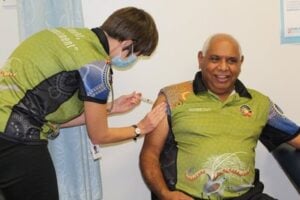
 

Darryl Wright


Dr Dong Hua, who is operating the GP-led respiratory clinics testing for COVID-19 at Campbelltown and Fairfield, said he was pleased to be one of the first respiratory clinics to administer the vaccine and encouraged all eligible community members to book an appointment.

“The vaccine is our best chance to fight the spread of COVID-19,” he said. “It will help to protect those who are vulnerable and help us to get on with our normal lives again.”


“The vaccine is our best chance to fight the spread of COVID-19.”

 

Dr Dong Hua
 

South Western Sydney Primary Health Network (SWSPHN) is supporting the region’s 187 general practices and four GP respiratory clinics, and Tharawal AMS, who are administering the AstraZeneca vaccine as part of Phase 1b.

The Phase 1b priority group includes:

  • Elderly adults aged 70 years and over
  • Healthcare workers not already addressed in Phase 1a of the vaccine rollout
  • Aboriginal and Torres Strait Islander people over 55
  • Adults with an underlying medical condition, including those with a disability
  • Critical and high-risk workers including defence, police, fire, emergency services and meat processing

SWSPHN Chief Executive Officer, Dr Keith McDonald PhD, said all eligible general practices who confirmed their participation were being progressively included in the rollout over a four-week period.

“I would encourage those who are in the priority groups to use the Vaccine Eligibility Checker on the HealthDirect website to confirm their eligibility and make a booking to be vaccinated,” he said.


Update:

Following advice from the Australian Technical Advisory Group on Immunisation on 8 April, the Pfizer vaccine is now preferred over the AstraZeneca vaccine for adults aged under 50 years.

This recommendation is based on the increasing risk of severe outcomes from COVID-19 in older adults (and therefore a higher benefit from vaccination) and a potentially increased risk of thrombosis with thrombocytopenia following AstraZeneca vaccine in those under 50 years.

AstraZeneca can be used in adults aged under 50 years where the benefits are likely to outweigh the risks for that person.

People who have had the first dose of the AstraZeneca vaccine without any serious adverse effects can be given the second dose, including adults under 50 years.

The Australian Government has ordered an extra 20 million doses of the Pfizer vaccine. It is anticipated that these extra 20 million doses will be available between October and December this year.


Mr Wright said there had been a strong uptake of the vaccination amongst the local Aboriginal and Torres Strait Islander communities.

“When we advertised it, and let people know that the vaccines were here for Elders 55 and up, within 10 minutes we had 80 people booked,” he said. “It’s about keeping healthy – we want to ensure that our Elders and those with chronic disease in particular, don’t get the coronavirus.”

Dr Hua was among the frontline health workers who has received the second dose of the Pfizer vaccine.

He encouraged anyone who is hesitant about getting the vaccine to talk to their GP, saying vaccines will be administered by a trained immunisation nurse or practitioner. “The vaccine has undergone vigorous testing, and there is good evidence it’s safe and effective,” he said.

Dr Eva Constantinidis, a GP at Tharawal AMS, received the AstraZeneca vaccine on 22 March.

She said wide-scale vaccination would play an integral part in moving forward from the COVID-19 pandemic by reducing the risk of people acquiring and transmitting the disease.

“The evidence shows it’s particularly important in reducing severe COVID and the need for people to be hospitalised.”


“The evidence shows it’s particularly important in reducing severe COVID and the need for people to be hospitalised.”


Dr Constantinidis said 80 patients had had the vaccination on the first day.

She said Aboriginal and Torres Strait Islander people over 55 and those with chronic conditions including diabetes, high blood pressure, obesity, respiratory disease, and conditions causing immunosuppression, were eligible to be vaccinated under Phase 1b of the vaccination rollout.

“Those who are unsure can phone or come in for a face-to-face consultation to discuss their eligibility.”

Vaccine Eligibility Checker
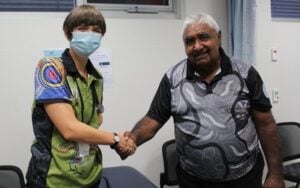
   

Dr Heather McKenzie and Uncle Ivan Wellington
 

16 March 2021

General practices assessing patients for their suitability to receive the COVID-19 vaccine can access 16 new COVID-19 related MBS items. The COVID-19 vaccine suitability assessment service is free to patients and the MBS items must be bulk billed. Patients are expected to have a face-to-face assessment before they get the first and second doses of the vaccine.

The phase 1B priority groups include:

  • people aged 70 or older
  • healthcare workers
  • Aboriginal and Torres Strait Islander people aged 55 or older
  • people with an underlying medical condition, including people with a disability
  • critical and high-risk workers, including police, defence, fire, emergency services and meat processing.

The new MBS items are:

  • First dose of COVID-19 vaccine – business hours – 93624-93627
  • First dose – after hours – 93634-93637
  • Second dose of COVID-19 vaccine – business hours – 93644-93647
  • Second dose – after hours – 93653-93656

To find more information

08 March 2021

More than 4,600 general practices – including almost 200 general practices in South Western Sydney – received their COVID-19 vaccine Onboarding Packs last week after being approved to participate in the Phase 1b vaccine rollout.

Over four weeks beginning the week of 22 March, all general practices who were deemed initially eligible to participate will be progressively included in the rollout.

This Onboarding Pack is intended to provide clear guidance on the operational and functional arrangements in place for the Australian COVID-19 Vaccine Roll-out Program.

As part of their Onboarding Pack, eligible general practices will have received a letter notifying them of which week they are scheduled to commence vaccinating and how many doses per week they will be allocated.

The allocations may be reviewed as vaccine availability increases and data on utilisation and demand across the system becomes available.

General practices will be supported by GP respiratory clinics – at Fairfield, Campbelltown, Picton and Mittagong – and Aboriginal Community Controlled Health Services who will also be providing vaccines in Phase 1b.

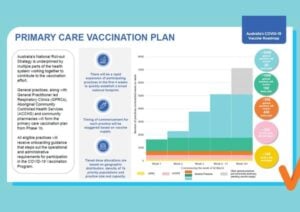
Please see below the 12-week Primary Care Vaccination Plan


COVID-19 vaccination training

In order to administer vaccines, each health professional involved in the administration of COVID-19 vaccines is required to:


Phase 1b Eligibility

Priority groups have been identified using public health, medical and epidemiological evidence, including expert advice from the Australian Technical Advisory Group on Immunisation (ATAGI). This includes people that would be at higher risk of serious illness if they contracted COVID-19, and those most likely to be exposed to it.

Practices should only book patients who meet the eligibility for each phase of the rollout.

Phase 1b priority population groups include:

  • people 70 years of age or older;
  • healthcare workers;
  • Aboriginal and Torres Strait Islander adults over 55 years;
  • Younger people with an underlying medical condition, including people with a disability; and
  • critical and high risk workers, including Australian Government officials about to be deployed overseas on official government business.

ATAGI has developed guidance documents to assist vaccine providers to make clinical decisions on who should receive the vaccine.  


Booking vaccination appointments

The COVID-19 Vaccination Information and Booking Service is based on the existing National Health Services Directory (NHSD), operated by Healthdirect Australia on behalf of the Department of Health. It will provide ‘one front door’ where people can check their eligibility and find out where to get a COVID-19 vaccine, with links to clinics offering vaccine appointments. All approved COVID-19 vaccination clinics must be listed on the NHSD to ensure timely and transparent access for consumers, and should accept bookings from all eligible people.


Practices who are not participating in the Phase 1b rollout

General practices which are not providing COVID-19 vaccinations should refer their patients to healthdirect to find their nearest vaccination site and to book their appointment.


Australian Immunisation Register

It is mandatory under the Australian Immunisation Register Act 2015 to report all COVID-vaccine encounters to the Australian Immunisation Register (AIR). COVID-19 vaccine encounters should be uploaded into AIR at the time of administration (including the patient’s individual Medicare reference number), or as soon as possible, to ensure consumer immunisation information is up to date. 


To find:

02 February 2021

The Australian Government has a strategy to deliver COVID-19 vaccines to everyone living in Australia as soon as they are available. 

A staged roll-out of the vaccine is expected to commence this month.

Healthcare professionals have an important role in discussing and delivering vaccination against COVID-19 with their patients. 

The Pfizer/BioNTech COVID-19 vaccine is likely to be available from early to mid-February this year. Doses of this vaccine will be available through 30 to 50 hubs at specific hospital sites across urban and rural Australia. 

Approval of the University of Oxford/AstraZeneca COVID-19 vaccine is anticipated for the coming months.

Both vaccines will progressively be distributed through an expanded number of sites, including general practice clinics, existing Commonwealth GP respiratory clinics, state-run vaccination clinics and pharmacies.

The vaccine rollout roadmap has determined the phases of vaccination for priority groups.


General practices expressions of interest for vaccine roll-out

Expressions of interest (EOI) from general practices to participate from Phase 1b of the national rollout strategy, planned to commence in March, close today (Wednesday, 3 February at 11.59pm). Respondents will be notified of the outcome ASAP.


COVID-19 vaccine training

The Australian College of Nursing has been appointed to lead the development of the mandatory training materials for COVID-19 immunisation providers. Healthcare professionals will not be able to administer any COVID-19 vaccines without having first completed the training modules.

Training for immunisation providers will include:

  • handling and storage
  • multi-dose vial (MDV) training
  • delivery mechanisms of the vaccine
  • administrative reporting including eligibility checking
  • safety and surveillance monitoring and reporting for adverse events following immunisation
  • communication.


COVID-19 and influenza vaccination requirements for aged care workers

The Australian Health Protection Principal Committee (AHPPC) strongly encourages COVID-19 vaccination. But at this time AHPPC does not recommend mandating COVID-19 vaccination for the aged care workforce. For more information on the AHPPC decision visit the Department of Health website

To learn more, visit the Department of Health’s COVID-19 vaccines website and subscribe to the COVID-19 Vaccines Update

01 February 2021

In November, SWSPHN distributed an email to general practices across South Western Sydney on behalf of Healthcare Complaints Commission and Northern Sydney Local Health District Public Health Unit advising of an investigation into a patient complaint about Medsound Diagnostic Imaging, Hornsby.

The investigation found that an unregistered person was performing ultrasound procedures and writing reports, and that there were unsatisfactory infection control procedures.

The period of concern is between 31 January 2017 and 20 November 2020.

The two identified risks to patients are the potential for misdiagnosis on imaging, and the potential for patient-to-patient spread of BBVs and other infections.

To read our 24 November 2020 alert

As a precaution, NSW Health has now written to all patients (about 2800 individuals) and their GPs recommending that people who have had certain procedures undergo screening for BBVs.

If your patient had any of the following procedures, please discuss screening for blood borne viruses (hepatitis B, hepatitis C and HIV):

• Transvaginal/transrectal ultrasounds

• Orbital/periorbital ultrasounds

• Ultrasounds of non-intact skin

• Procedures involving injections or surgical procedures

To read the most recent alert

12 January 2021

NSW Health has provided the following advice in relation to Residential Aged Care Facilities and Home Care Services.

As of 8 January, 2021:

Advice to residential aged care facilities
Advice to home care service providers


The key points include:

Until further notice all residential aged care facilities must:

Until further notice all residential aged care facilities in Northern Area of the Northern BeachesCity of WollongongCumberland City Council or the Canterbury Ward of Canterbury Bankstown Council:

  • must exclude all visitors, except those performing essential caring functions
  • should avoid residents leaving the facility unless it is essential (for example, a medical appointment) or for exercise
  • should ensure that residents are provided with appropriate PPE and infection control advice if they need to leave the facility.
22 December 2020

Given the recent COVID-19 outbreak on the Northern Beaches, the RACGP’s presentation to our most recent CPD webinar on infection prevention control was a timely reminder of the importance of remaining vigilant and referring patients with even the mildest symptoms for testing.

Chair of the NSW and ACT RACGP faculties, Charlotte Hespe, shared case studies to demonstrate the importance of ongoing vigilance and to explain why even one case matters in working towards zero transmission of COVID-19, at the webinar.

Associate Professor Hespe’s messages include:

  • When there is just one case that is not linked to a known cluster, it tells us that COVID-19 is still circulating in the community and that there are unrecognised chains of transmission.
  • Maintaining high rates of testing is critical for finding new cases early and stopping chains of transmission.

To download the presentation

12 December 2020

Senior Australians who would like information and support are encouraged to contact the Older Persons COVID-19 Support Line on 1800 171 866, Monday to Friday between 8.30am and 6pm (excluding public holidays). The Support Line has been extended until 30 June to ensure senior Australians get the services and assistance they need during COVID-19. 

The support service is a joint initiative of COTA Australia, Dementia Australia, National Seniors Australia and the Older Persons Advocacy Network. The expansion of the service will also include support from the Partners in Culturally Appropriate Care Alliance. 

In its first six months the service received more than 5,000 inbound calls and provided more than 29,000 outbound calls.

The top five reasons for calls included: 

  • wellbeing checks 
  • information about COVID-19 
  • advice to vulnerable people 
  • travel restrictions 
  • access to new, or queries about existing, home care services.