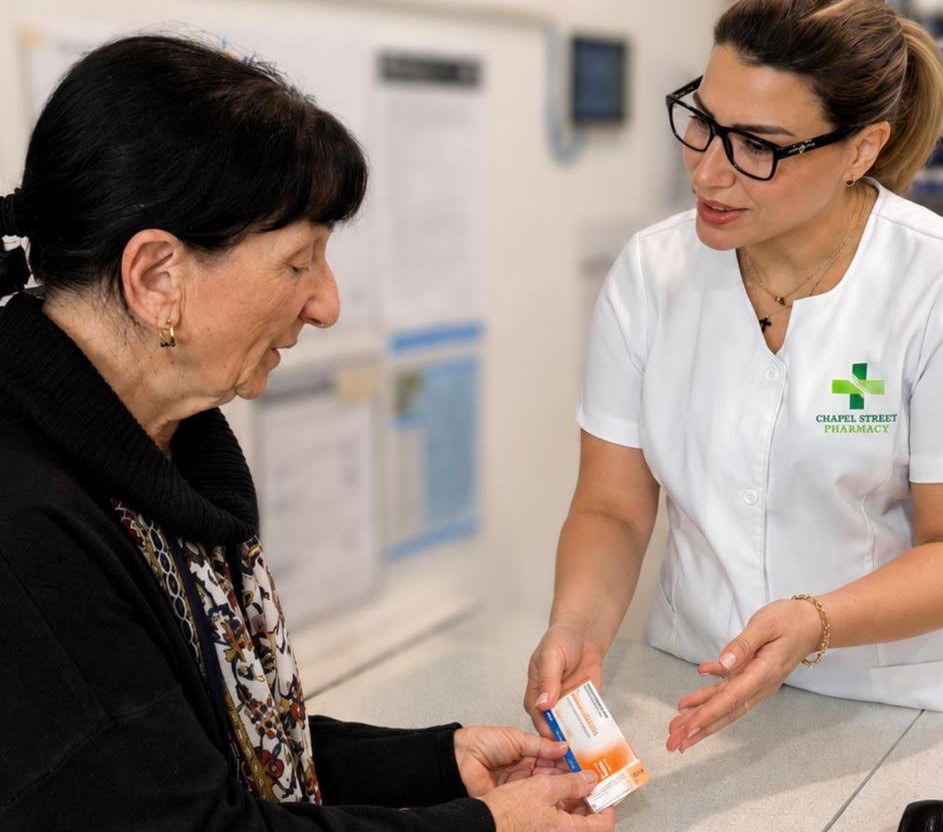
Our quarterly Spotlight on allied health feature, highlights the incredible work of providers across our community. This time we’re speaking with Rima Wehbi, a pharmacist and manager of the Chapel Street Pharmacy at Kingsgrove.
Background
Rima Wehbi is a pharmacist, accredited consultant pharmacist and manager of Chapel Street Pharmacy, a family-owned community pharmacy. Since 2014, the Chapel Street Pharmacy has supported the local community through accessible, person-centred care, including medication counselling, Home Medicines Reviews, vaccinations, dose administration aids and chronic disease support. Rima also works with the University of Sydney and is completing her Master of Philosophy (MPhil) in medication management, focusing on improving medicine safety and patient outcomes. She says her pharmacy is unique due to its strong community connection, clinical focus, research involvement and commitment to collaborative care.
What inspired you to become a pharmacist and keeps you motivated in your work today?
I come from a family with a strong healthcare background. Both of my parents are doctors, one of my brothers is a doctor and another is a pharmacist. Growing up, I saw the way my parents supported their patients and community, which inspired in me a deep passion for healthcare.
When I arrived in Australia, I worked in a community pharmacy as a pharmacy assistant and quickly fell in love with the profession. I saw how important pharmacists are in providing accessible care, practical medication advice and ongoing support which patients may not always have time to receive elsewhere.
What keeps me motivated today is the trust our community places in us. Every day, I have the opportunity to help people better understand their medicines, feel supported in their health journey and connect them with the right care when they need it.
What do you wish more people understood about the role of your profession in primary care?
It is important for clinicians, policymakers and the public to recognise pharmacists are not simply part of a retail environment; we are highly trained healthcare professionals and an essential part of primary care. Patients often come to us first because we are accessible, trusted and available without an appointment. We provide medication counselling, identify medicine-related problems, support adherence, monitor chronic conditions, deliver vaccinations and help patients navigate the health system.
Community pharmacy forms a strong backbone of primary care, especially at a time when general practice and hospital services are under increasing pressure. With the expansion of pharmacist scope of practice, including pharmacist prescribing supported by proper training, accreditation and clinical governance, pharmacists can contribute even more meaningfully to patient care.
Pharmacists should be better integrated into multidisciplinary teams alongside GPs, nurses, allied health professionals, hospitals and Primary Health Networks. This is not about replacing other healthcare professionals, it is about strengthening collaboration, improving referral pathways, reducing duplication, supporting earlier intervention and improving continuity of care for patients in the community.
Can you share an example of when working closely with another health professional improved patient outcomes?
Through my work as an accredited consultant pharmacist providing Home Medicines Reviews.
In this role, I work closely with GPs, nurses and other health professionals to identify medication-related problems and provide practical recommendations to improve patient safety.
For example, when reviewing older patients with multiple medicines, I may identify medicines which increase the risk of falls, confusion, sedation or poor adherence. By communicating these concerns to the GP and supporting the patient with counselling, dose administration aids or a simplified medication regimen, we can reduce medication burden and improve the patient’s confidence in managing their medicines.
This collaborative approach improves outcomes because each health professional contributes a different perspective. The GP understands the broader medical history, the pharmacist focuses on medication safety and adherence, and together we can create a more practical and person-centred care plan for the patient.
How can other providers best recognise when to refer to your service, and collaborate effectively with your team or profession?
Other providers can best recognise the need to refer to community pharmacy services when a patient is experiencing difficulty managing their medicines, has multiple medications, has recently been discharged from hospital, is starting a new high-risk medicine, has adherence concerns, or may benefit from a Home Medicines Review or dose administration aid.
Effective collaboration begins with recognising and trusting the pharmacist as part of the patient’s primary care team. Sometimes the simplest and most effective step is to pick up the phone, call the pharmacist, ask questions, share concerns and work together on the patient’s care plan.
GPs, nurses, allied health professionals and pharmacists can collaborate more effectively by sharing relevant clinical information, medication changes, patient concerns and follow-up plans. This helps avoid duplication, reduces medication errors and ensures the patient receives consistent advice from the whole care team.
Community pharmacists are well placed to support patients between medical appointments because we often see them regularly and can identify early warning signs, medication confusion or changes in health. Strong referral pathways between general practice, pharmacy and allied health would allow us to provide more timely, coordinated and person-centred care.
What do you enjoy most about working in South Western Sydney, and what would you say to allied health professionals considering working in this region?
It is the privilege of serving one of the most diverse, hardworking and community-focused regions in NSW. Every day, we care for patients from many cultural backgrounds, many with complex health needs, language barriers, caring responsibilities or limited access to timely healthcare. This makes the role of local health professionals incredibly important.
South Western Sydney is a region where trust matters. When patients know you, when they feel listened to, and when services work together, the impact on their health and confidence can be significant. Working here has shown me primary care is not only about treating conditions; it is about building relationships, improving access and supporting people in a way that respects their family, culture and circumstances.
To allied health professionals considering working in this region, I would say this is a place where your work will genuinely matter and will always be rewarded through the trust, appreciation and relationships you build with the community. There is strong community need, but also enormous opportunity to make a visible difference through collaboration, education and person-centred care.
What excites you most about joining SWSPHN’s Clinical Council?
What excites me most is the opportunity to contribute a community pharmacy perspective to important conversations about primary care in South Western Sydney. As a new member, and as a pharmacist joining the council, I see this as an opportunity to demonstrate the valuable role pharmacists can play in shaping practical, patient-centred solutions.
Pharmacists see patients regularly, often between GP appointments, and we understand many of the real-world challenges people face with medication safety, access to care, health literacy, chronic disease management and continuity of care.
I am excited to be part of a forum where different health professionals can share their experiences, identify gaps in care and bring new ideas forward. I believe community pharmacy has an important role in supporting a more connected primary care system, and I hope to contribute in a way which shows pharmacists can make a meaningful difference.
For me, joining the Clinical Council is also an opportunity to advocate for patients, strengthen collaboration between providers, and ensure the community voice is reflected in planning and decision-making.
What does a typical day in a life look like in your role. Is there some aspect about your daily role people may not expect?
A typical day in my role is very varied, and often unpredictable, which is one of the things I enjoy most about community pharmacy. Our day can range from dispensing and simple medication counselling to managing complex medication interactions, supporting confused or vulnerable patients, organising dose administration aids, providing vaccinations, and communicating with GPs or other health professionals.
At times, the role can also involve urgent situations which people may not expect, such as assisting with wound care, assessing deep cuts or injuries, identifying when escalation is needed, and even responding to emergency situations such as resuscitation or patients becoming acutely unwell in the pharmacy.
Alongside my pharmacy role, I am also involved in medication management research through the University of Sydney, which strengthens my focus on medicine safety, falls prevention, adherence and patient-centred care.
One aspect people may not expect is how clinical and relational the role really is. Community pharmacists do much more than dispense medicines. We often know our patients and families over many years, notice changes in their health or behaviour, identify medication risks early, and help connect them with the right care. At the same time, we manage the operational, regulatory and business responsibilities required to keep an accessible healthcare service running every day.
What’s one wellbeing tip or personal practice you’d like to share with your colleagues across primary care?
Take a moment to reconnect with the purpose behind the work. Primary care can be busy, demanding and emotionally draining, especially when we are supporting patients with complex needs. However, even small interactions can make a meaningful difference to someone’s health, confidence or sense of support.
Personally, I try to remind myself we cannot pour from an empty cup. Looking after our own wellbeing, taking short pauses when possible, asking for help, debriefing with colleagues and maintaining strong professional relationships are all important. When we support each other as healthcare professionals, we are better able to support our patients and community.