


This quarterly feature highlights the incredible work of allied health providers across our community. This time we’re speaking with Musthafa Mohammed, co-founder and Managing Director of Audience Hearing which services the Camden, Liverpool and Campbelltown local government areas.
Background
Audience Hearing is an independent, clinician-owned audiology practice with clinics at Liverpool, Leppington and Mount Annan. After years of medical and corporate hearing industry experience across India and Australia, co-founder and Managing Director Musthafa Mohammed and his colleagues chose to return to hands-on clinical work and build a practice grounded in genuine patient care. He splits his time between seeing patients and leading the business, staff and community partnerships. He says he’s driven by helping people reconnect with conversations and sounds they’ve been missing – guided by the practice’s values of care, curiosity and creativity, while helping people understand why hearing is worth celebrating.
Find out more
What drew you to your chosen profession and what continues to inspire you in your work today?
To be honest, it was an accident – not love at first sight, more like an arranged marriage. But the more involved I got, the more I fell for it. What still amazes me is how quickly we can change someone’s quality of life, sometimes in a single appointment.
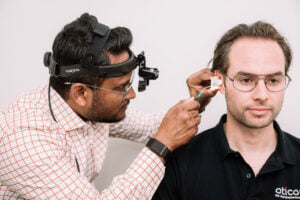
Ours is an unusual profession in that patients rarely walk in saying ‘I need to be treated’. More often they insist they’re fine and don’t need hearing aids, even when it’s plain to see they do. That tension is what keeps the work interesting, and it shows up everywhere: reminding a patient not to chase wax out with a cotton bud before we remove it properly with microsuction; picking up a child’s glue ear when there were no obvious symptoms at all, then making sure parents and teachers know what to watch for; telling a grandfather he’s genuinely missing his grandchild’s voice, not that the child is mumbling; helping someone so distressed by tinnitus finally get their life back.
Underneath all of it is the same instinct – to get to the bottom of what’s really going on for a patient, not just run the test they walked in asking for. That’s what inspires me, every single day.
What health conditions, concerns or challenges can your profession help with, and when should someone consider seeking support from you?
In broad terms, anything ear and hearing related. That can mean wax impaction, a blocked or muffled feeling, tinnitus or ringing, dizziness and balance issues or simply missing parts of conversations – really, if it involves the ear, it’s ours to help with.
It’s not just about diagnosis, though. Prevention is a big part of what we do too, whether that’s guiding people on proper aural hygiene or fitting custom or general hearing protection before damage happens. On the treatment side, we work with both kids and adults, using hearing aids, bone conduction devices and cochlear implant rehabilitation depending on what’s needed. And one thing people are often surprised to hear: tinnitus does have treatment and audiologists are actually the first point of care for it – it’s not something you just have to live with.
What is a common misconception about your profession, and what do you wish more people understood about the role you play in primary care?
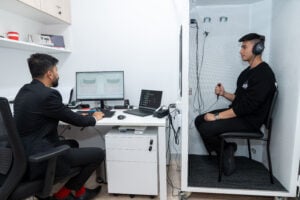
The biggest misconception is a hearing test simply tells you how much you can hear. In reality, it’s often the first place conditions like a cholesteatoma or an acoustic neuroma get picked up. A pure tone audiogram is only one piece of the puzzle – we run a whole battery of tests to pinpoint exactly where in the hearing and balance system a problem sits, then guide you to the right next step, whether that’s a GP, an ENT or audiological care like hearing aids, tinnitus therapy or cochlear implants.
What I wish more people understood is waiting until hearing loss is obvious is often waiting too long. It usually starts in the high frequencies, so the first thing to go is subtle clarity most people don’t consciously notice, and it can progress for years before anyone realises. Even ‘mild’ hearing loss is linked to a threefold increase in fall risk and is now considered the single biggest modifiable risk factor for dementia by the Lancet Commission, so my advice is simple: get a baseline hearing check in your 50s, then routinely after that, the same way you would with your eyes or blood pressure.
What do you enjoy most about working in South Western Sydney, and what would you say to healthcare professionals considering working in the region?
When Kevin Peris and I decided to start our own practice, South Western Sydney was a deliberate choice, not a default. It’s one of the fastest-growing regions in the country. Camden, where one of our clinics sits, is regularly ranked among Sydney’s fastest-growing council areas – and that growth brings a genuinely varied clientele: paediatric assessments, working-age adults and a large geriatric population, often within the same family. It’s also one of the most culturally diverse parts of Sydney, which keeps every day interesting and keeps us honest about communicating clearly across languages and backgrounds.
To any healthcare professional considering the region: come for the variety and the growth but stay for the relationships. This isn’t a transient population passing through a CBD clinic – it’s a community you get to know over years, which is exactly what makes independent, community-focused practice worthwhile here.
What does great multidisciplinary team care look like to you in South Western Sydney, and what needs to change to make this way of working more common across the region?
To me, multidisciplinary care means looking after a patient’s whole life and quality of life, not just the thing they walked in for. It’s a mindset more than a referral list: knowing that no single profession has all the answers and being just as ready to bring someone else in as you are to take a referral yourself. That works both at the start of a patient’s journey and at the end of it. The moment you’ve done everything within your own expertise and hit a wall is exactly when you should be looking around for who else might help, not the moment to stop.
In our own field, that looks like physiotherapists checking whether a patient’s persistent dizziness might be inner ear rather than musculoskeletal, and sending them to us for vestibular testing; or dentists, after years working close to a drill, getting their own hearing checked and us doing the same in reverse when a patient’s ear pain or tinnitus turns out to be TMJ related. The principle matters more than the example, though: real multidisciplinary care means every profession keeping the whole patient in view and knowing when to hand the baton on.
What needs to change is awareness. Hearing loss still carries a stigma of just getting old, so people avoid raising it – and as professionals, we shouldn’t buy into that either. More broadly, I’d love to see our local allied health and medical community meet regularly, at least monthly, to share what’s new in our fields. Hearing health would just be one of many things we all stay on top of, together.
Is there a success story or achievement about your work or organisation that you’re particularly proud of and would like to share?
The story I’m proudest of is a patient who came in for a routine hearing aid consultation – no symptoms, nothing he was worried about. Something told us to look a bit closer anyway and that’s when we found an advanced cholesteatoma he had no idea he was carrying. We referred him urgently, he went into surgery, and by every account, that surgery likely saved his life. He came in for hearing aids and left with a warning which may have saved him.
It’s stuck with me because it’s the clearest example of why the details matter in this job – you’re not just fitting devices, you’re the person who might catch the thing nobody came in looking for.
Beyond that one moment, I’m proud of what we’ve built as an organisation in under two years, three clinics across South Western Sydney and one on the South Coast, alongside caring for residents across three major aged care centres in the region. What means the most to me is even while running four clinic rooms, we’ve kept our promise to those aged care residents too – seeing them within a week of a request coming in, with the same standard of care we give patients who walk into our clinics.
Outside of work, what might people be surprised to learn about you, and what do you enjoy doing to switch off and recharge?
Outside of work, I’m an amateur DJ, I enjoy playing cricket, and I love cooking street food (always chasing that authentic version!) I also enjoy binge-watching series – though I try to avoid it, so it doesn’t take over my evenings. Beyond that, I have a real passion for professional coaching and public speaking.
If you’re an allied health provider in South Western Sydney and would like to be included in Spotlight, email alliedhealth@swsphn.com.au