


Our ageing population
Potentially preventable hospitalisation rates
How an ageing population affects providers
How GPACI can help your practice
Introducing POLAR Puffin
When QI and GPACI join forces
Walkthroughs and resources
Helpful tips for health professionals
Additional resources
“Every person living in a residential aged care home has the right to receive safe, timely, high-quality care.”
– Final Report, Royal Commission into Ages Care Quality and Safety (Royal Commission)
South Western Sydney and its ageing population
The World Health Organisation 2025 highlighted advances in social, economic and medical developments have resulted in longer life expectancies and lower mortality rates – ‘one of our most remarkable collective achievements’.
More than one million people reside in South Western Sydney, and it remains one of the fastest growing regions in NSW. Our rapid population growth is driven mostly by greenfield developments and urban intensification.
In response to our expanding community SWSPHN and the South Western Sydney Local Health District collaborated to create an in-depth health needs assessment. This in-depth analysis of the population prepares our community to be informed for future health planning and be able to successfully meet our region’s key health needs.
One of the key areas identified in this analysis was our rapidly growing and ageing population. The total population of people aged 65 years or older is expected to increase significantly between 2016 and 2031, from 127,000 to 221,000 (a total increase of 74 per cent). Additionally, those aged 85 years or older are expected to increase by 92 per cent – with an additional 14,660 people.
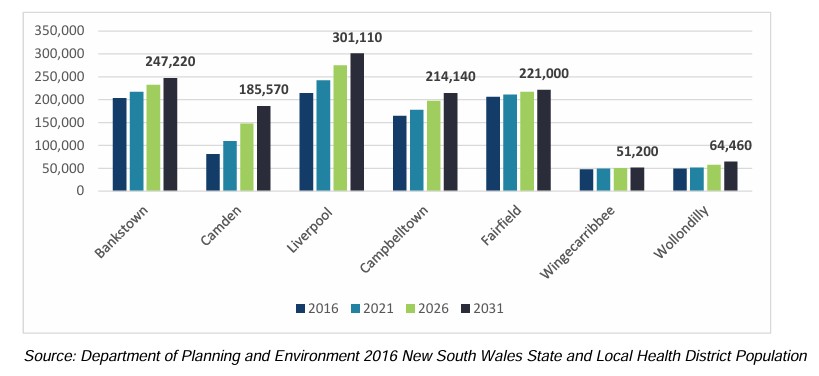
Figure 1 – Projected population growth in South Western Sydney by LGA, 2016-2031
South West Sydney – Our Health in depth
Current data predicts Camden and Liverpool local government areas (LGAs) are taking the lead in population growth rates. It is predicted by 2031 Camden will have the largest population growth by more than double, with increases from 81,000 to 186,000 people.
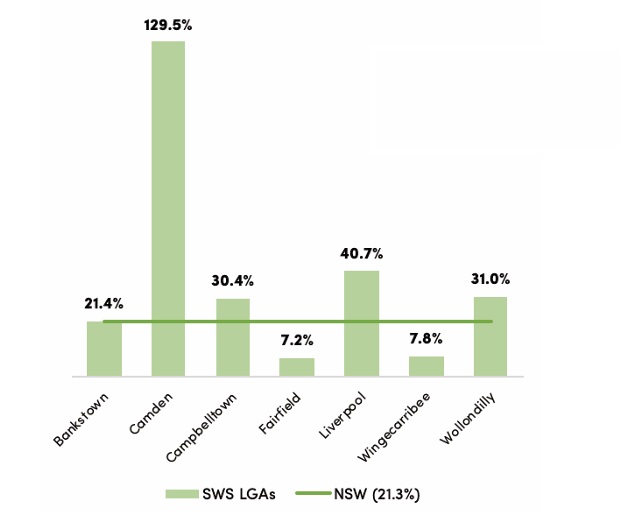
Figure 2 – Projected population growth (per cent) in South Western Sydney LGAs and NSW, 2016-2031
South West Sydney – Our Health in Brief
South Western Sydney has the highest potentially preventable hospitalisation rates in NSW
Potentially preventable hospitalisations (PPH) are determined by hospitalisations which may have been avoided with either preventative care or early disease management. This doesn’t mean the hospital admission wasn’t necessary at the time. It may have been prevented with the use of primary care services which were timely and appropriate.
Recent PPH data confirmed chronic, vaccine preventable and acute conditions were higher for South Western Sydney residents compared to the rest of the state, as seen in Figure 3. The most common reasons for PPH included but aren’t limited to; cellulitis, urinary tract infections, ear, nose and throat infections, and congestive heart failure.
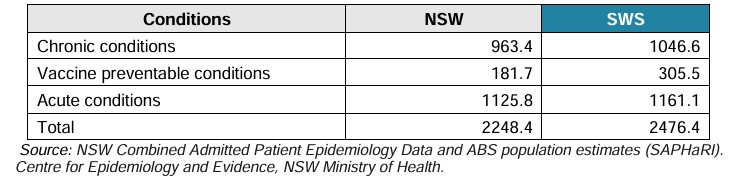
Figure 3 – Potentially preventable hospitalisations, rate per 100,000 population NSW and South Western Sydney 2016-17
How will an ageing population affect primary healthcare providers?
Primary healthcare providers play an essential role in caring for older people in the community, as general practices are often a patient’s first point of contact. Our primary healthcare providers’ contribution in early detection and treatment of chronic conditions is crucial in minimising the impact on both the healthcare systems and individual patients’ lives.
The Australian Institute of Health and Welfare recognised yearly GP service attendance rates increased from 3.8 to 6.2 visits per person in 2025.
Despite the expected demographic shift towards an ageing and rapidly growing population, the World Health Organisation 2024 raised the concern “care and support systems across the world are not yet prepared to meet the needs of older people”.
With an ageing population, chronic diseases and multiple comorbidities are likely to become more prevalent. Furthermore, the demand for permanent residential aged care and the number of people requiring this level of care is expected to almost double in 15 years from 5,947 to 10,894 people by 2031.
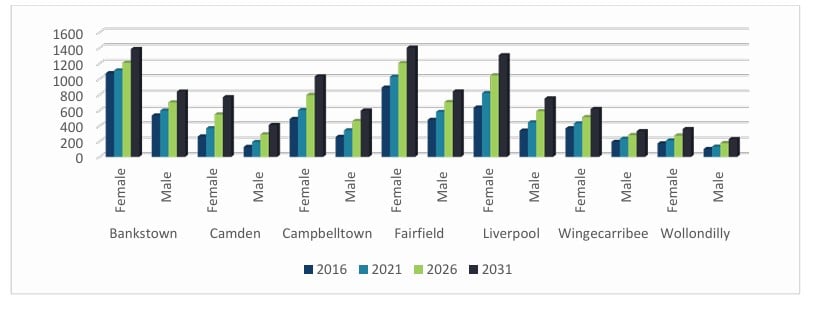 Figure 4 – Number of persons requiring or in residential aged care for South Western Sydney by LGAs and gender, 2016-2031
What is GPACI and how can my practice get involved?
The General Practice in Aged Care Incentive (GPACI) was introduced in July 2024. GPACI aims to support continuity of care and reduce avoidable hospitalisations for older people living in residential aged care homes (RACH), through proactive visits and chronic disease management.
The introduction of GPACI incentives was in response to the Royal Commission into Quality and Safety in Aged Care and Strengthening Medicare, both of which identified the need to shift our focus towards our rapidly growing and ageing population.
For more information on eligibility and servicing requirements for GPACI – please refer to the General Practice in Aged Care Incentive program guidelines.
Introducing POLAR Puffin: less GPACI administration, more time for what matters
The Early Insights from the General Practice in Aged Care Incentive reported more than $14.3 million was distributed to general practices and providers with a strong initial uptake in GPACI. However, a common barrier identified was the complex and administrative workload in monitoring service requirements for ongoing participation – it was often described as overly burdensome through GP and practice surveys.
To overcome the common barrier of a high administrative workload in GPACI, Western Victoria PHN and Outcome Health worked together to create a solution – a new POLAR report called Puffin.
Puffin has been tailored to be used by GPs and practices to assist with visualising and meeting their GPACI quarterly reporting requirements, as well as optimising time spent on patient care. The new Puffin report was trialled with a small group of general practices in Western Victoria, with positive feedback overall. Puffin was successful in reducing the amount of time spent tracking GPACI servicing requirements and reducing errors previously made in manual tracking.
Puffin is readily available at no extra cost to all current users of POLAR. It is currently integrated with Best Practice, Medical Director and Zed Med users.
If you want to know more about Puffin or are thinking about getting involved in GPACI, please contact your Practice Advancement Officer (PAO)/Practice Support Officer (PSO).
Lean more about Puffin
How can Quality Improvement and GPACI join forces?
Quality Improvement (QI) plays a pivotal role in driving practice-based decisions to make changes, based on practice specific demographics and needs. POLAR Puffin is a user-friendly data extraction and analysis tool which can be utilised to support both QI-based activities and meet GPACI quarterly servicing requirements.
Some ways POLAR Puffin can be incorporated into your practice’s QI activities include:
- identify GPACI-registered patients in PRODA and update Puffin patient list accordingly (when first using Puffin)
- identify GPACI-registered patients who have not yet met the quarterly requirements for eligible regular services
- identify GPACI-registered patients who have not yet met care planning requirements over the 12-month period
- identify GPACI-registered patients eligible for a vaccination (COVID, shingles, influenza)
- track improvements in GPACI service delivery each quarter – by using the Model for Improvement, compare baseline and current data
- collaborate with SWSPHN in quarterly QI meetings for a team-based QI approach and assistance in using POLAR Puffin or to further improve practice data and service delivery
Helpful resources for health professionals:
Puffin Introduction | Western Victoria PHN
GPACI: Patient Information Booklet
SWSPHN walkthroughs and resources
SWSPHN has various resources to assist your practice with QI activities and introducing the use of the new POLAR Puffin report within your practice. If you are unsure how to access POLAR or need help with initial use of Puffin, contact your Clinical and Quality Improvement (CQI) Officer or your PAO/PSO for more information.
Model for Improvement (MFI):
Model for Improvement Template
Model for Improvement Walkthrough
Sample MFI – GPACI Care Planning
Sample MFI – GPACI COVID Vaccine Eligibility
POLAR Puffin Walkthroughs:
POLAR Puffin Walkthrough – Patient Management
POLAR Puffin Walkthrough – Applying Filter
Helpful tips for health professionals participating in QI
Maintain accurate data in patient files – POLAR extracts data from the practice’s clinical information software. POLAR does not obtain data from AIR, My Health Record or PRODA.
Using POLAR Puffin for the first time?
When first using Puffin, it is recommended you extract an accurate list of GPACI-registered patients from PRODA
Using the GPACI-registered patient list from PRODA, update your Puffin patient list accordingly – adding/removing patients as appropriate
Private bookmark function
The private bookmark function in POLAR allows users to save searches created with specific filters for future reference.
References and additional resources
Introducing POLAR Puffin | South Western Sydney PHN
South West Sydney: Our Health in depth
South West Sydney: Our Health in brief
Final Report – Care, Dignity and Respect: Volume 1 | Royal Commission into Aged Care Quality and Safety
Strengthening Medicare | Department of Health, Disability and Ageing
Early Insights from the General Practice in Aged Care Incentive | Department of Health, Disability and Ageing
Ageing: Global population | World Health Organization
WHO calls for urgent transformation of care and support systems for older people | World Health Organization
General practice, allied health and other primary care services | Australian Institute of Health and Welfare
General Practice in Aged Care Incentive program guidelines | Department of Health, Disability and Ageing
If you wish to find out more POLAR Puffin or SWSPHN’s QIPC program, please email cqisupport@swsphn.com.au or visit our website Quality Improvement in Primary Care.