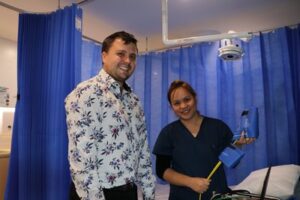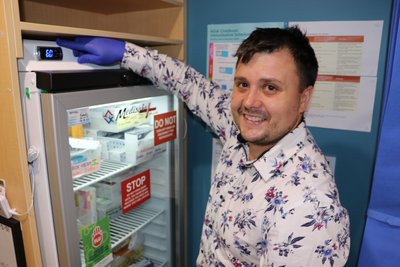
Kyle Gibbs is Director of Clinical Services at Sydney Dermatology Group and MyDoctors Ltd.
He has a Bachelor of Nursing (Honours), Bachelor’s degree, Registered Nursing and a Master’s degree in Management.
Two years ago, he gave a presentation at the Practice Nurses Association conference and has also spoken at the Australian College of Nursing.
Kyle has just completed his thesis on the barriers and facilitators of graduate nurses entering primary health care.
This year he is starting his PhD.
Learn more about Kyle.
How long have you been a practice nurse?
I’ve worked in primary care for approximately 11 years.
What got you into being a practice nurse, particularly in public health?
Originally, I thought it would be an easier way for me to study while doing my Masters; to work and study at the same time. When I completed my Masters, I was offered a job in management and have been managing medical centres ever since.
I love being a practice nurse because I get to look after all facets of life, birth, death and everything in between. I love the fact that I can prevent a lot of people from going to hospital or getting medical chronic conditions.
Working in South Western Sydney, particularly here in Macquarie Fields, can be very rewarding, there’s a lot of need within the area identifying and managing chronic illness. There’s a lot of patients who are asymptomatic, walking around, not knowing they have a condition. They need help to be educated on identifying the tests they need and to get those treatments and become healthy.
Give me a typical example of your workday
A lot of my day involves training new nurses in primary healthcare. It’s not uncommon for me to be teaching a nurse who has worked in a hospital for 30 or 40 years of their career and introducing them to general practice. I cover immunisations and culture, pain management, sterilisation, care planning, health assessments and other aspects that wouldn’t normally be undertaken in a hospital.
Primary care is a lot more involved than just completing a template on Best Practice or MedicalDirector. It is actually about knowing what questions to ask, listening carefully and finding preventative strategies to improve that patient’s health.
My role also includes boring stuff like business planning, writing policies and procedures, project management, going to meetings. We’ve just been through the EOI for the COVID-19 vaccine. We have to purchase more equipment and hire more staff, that usually falls to me as well. This morning I conducted a construction inspection for a new medical centre in Burwood.
Tell us about the role of primary care, how does your role complement the role of GPs and how you contribute to improving clinical outcomes.
I see my role as a nurse when I’m with patients. A lot of it is educating patients around navigating the health system and advising when they are eligible for free services or knowing that, because of their conditions, they should have certain tests or assessments yearly, three-monthly or six-monthly.
I often check the files doctors have put together of patients, ensuring there’s no gaps in their treatment, and then educating the patient about the gap and working with the doctor to fulfill that need.
I make sure my level of knowledge and understanding of medical conditions follows best practice guidelines, and then educate my colleagues, the GPs, about those guidelines to have the best outcomes for patients.
What is your biggest challenge as a PN and how do you work on this?
Nursing is growing quite rapidly in the primary healthcare setting. Even so, there are some nurses and GPs who are still somewhat traditional in the way they work and perceive their roles. Some nurses are hesitant to start learning and doing more as this area evolves, and some GPs are hesitant to let go of some tasks they’ve historically done. There are many tasks a nurse can do, leaving the doctor to handle more complex situations. I advocate for nurses to do more and to speak up more about the growing scope of their role within primary healthcare.
In nursing generally, general practice nurses may think of their role in a primary care setting is lower than being a nurse in a hospital setting; I would argue that’s not the case. In a hospital setting, a nurse will get very specialised in one facet of nursing. In contrast, a general practice nurse’s role may cover orthopaedic, renal, geriatric, and paediatric conditions, we have to have a generalised knowledge of a wide range of conditions. For example, knowing when a 30 and 40-year-old keeps breaking their bones, getting sprained ankles, or starts to have chest pains, they probably have high cholesterol. And if we get rid of that high cholesterol, they won’t end up as a 60-year-old who needs to be on beta blockers and have hypertension medication treatment, because we treated it early.
What do you like to do in your spare time?
I live on a small farm with lots of animals. I have cows, geese, dogs, fish and birds. This weekend I’m building a waterfall, last weekend I built a garden. I also play soccer and I’m studying to do my PhD. I’m a person that doesn’t like to be still. I think it’s is a nursing thing, a lot of nurses I know are about time management, doing the next thing and always planning.
Who are your role models in the industry?
Oh, I’ve got a few role models in the industry. Firstly, my mum who is a nurse. She became a nurse later in life. She decided to become a nurse after I finished my Bachelor degree and heard how much I loved it. She now works in drug and alcohol and mental health.
Another role model is Carrie Cordrey, who encouraged me to become a nurse manager. Carrie is now retired. Other nurses in my career who have pushed and inspired me are Julie Baker and Nicole Tibideau.