


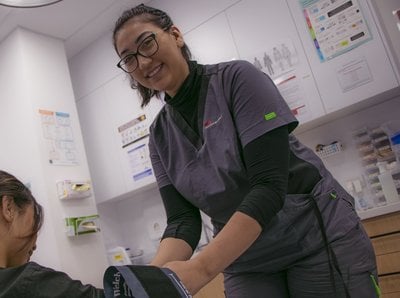
Aysu Kaya started her nursing career at Liverpool Hospital before moving to primary care, currently working at Doctors @ Liverpool. She has a Bachelor of Nursing and plans to do her Masters of Clinical Education next year. She is an authorised nurse immuniser and is trained in blood collection and ear syringing to name a few.
How long have you been a practice nurse and how long have you been working in Liverpool LGA?
I’ve been a nurse for about nine years, and a practice nurse approximately five or six years. I realised there was a lot of care needed for the people in the Liverpool LGA that are not aware they have health concerns, or even health issues, they can speak about. I feel that because I grew up in South Western Sydney, I know the people and how to approach them, hence why I choose to stay within this community.
When/why did you decide to pursue a career in nursing and specifically in primary care?
I decided to become a practice nurse because, more so than with hospital nursing, you get to know your patients a lot more and you are exposed to a lot more elements within a medical centre. As a hospital nurse, you typically just specialise in one field only and that is because you are generally assigned to one ward.
I wanted to pursue my career in primary care nursing because I wanted to do more for a patient. I love knowing I can take that extra step to help impact a patient’s life in a positive way and hopefully prevent them from going to hospital. Ultimately, general practice is there to prevent hospitals from being overburdened with preventable diseases, so if there was a way to help with that, I wanted to be a part of it.
Tell us about the role of nurses in primary care …
Well, this is a hard question to answer, what I do each day is so different. Working in a medical centre has now become instinctual for me that defining the role of a nurse in primary care is hard. It could mean managing someone’s chronic wounds, educating a patient about their health, completing health assessments that require you to sit down and listen, and then handling an emergency that has come through. And this is just to point out a few of the things, it is always a different day.
As a practice nurse, I see myself as part of a team in someone’s health care. So, I like to think that working alongside the GP can help support and assist them when they are trying to get a patient to self-manage their own health. That could mean educating myself and my colleagues with health updates, such as immunisation changes or simply learning about health programs that can be available for patients. I feel that if a doctor misses a health issue or concern, they also have confidence in me to see an opportunity to jump in and provide education or to simply update the patient’s health record.
What do you love about nursing/what do you find most fulfilling about your role?
Knowing I’ve made an impact on someone’s life. That’s the most fulfilling part of my role. I love that I can be giving reassurance to parents about immunisations and its benefits, or simply providing guidance to a diabetic patient on their dietary needs or leg care. I like knowing I have made a patient think coming to a medical centre is not something to be dreaded and can be helpful.
What is your biggest challenge as a PN and how do you overcome this?
I think that would mostly be language barriers. Liverpool has such a wide variety of languages. So, trying to discuss strategies or getting a patient to understand ways to prevent health issues can be difficult. Thankfully with the team we have here, we cover a whole bunch of languages between us which sometimes can help with finding health information to provide to patients.
I think another big challenge is some patients just don’t see the need for nurses in medical centres. Patients that have only been cared for by just a doctor, to then getting introduced to a nurse seems to upset them or think that the doctor doesn’t care anymore. This is a challenge I am slowly seeing, especially with patients that are elderly or traditional in thinking that the doctor is the only one that can discuss health with them.
Tell me about your ideal work day…
If I could do a bit of everything, I would be happy. I’m a simple nurse, but also, I love wounds! I know that can sound really odd, but there it is. So, if I can have patients coming to the centre looking for help with managing their wounds regardless of it being chronic or acute, I would love it. There is something about knowing that each wound has different characteristics and it can require different methods of managing to see a healed wound makes it so worth being a nurse.
What do you like to do in your spare time?
I read a lot and I mean a LOT. I’m a bookworm and I love fantasy and the occasional romance. I also like spending time with my family and friends especially with my niece and nephews. So having time to wind down and relax is needed.
Do you have any role models and why?
My mother, she was a care worker who helped care for patients with disabilities and aged care patients. I strive to be like her and she is someone that takes patient care seriously and because I practiced on her constantly with everything, I’ve learnt to always see through a patient’s perspective. For example, with immunisations, when I was learning and tried various techniques she would say “That’s going to hurt the patient, don’t do it that way”. And I would change it to make sure what she told me would help make the experience positive for a patient. I also had a second year facilitator at Campbelltown Hospital who made a positive impression of the type of nurse I wanted to be.