28 April 2026

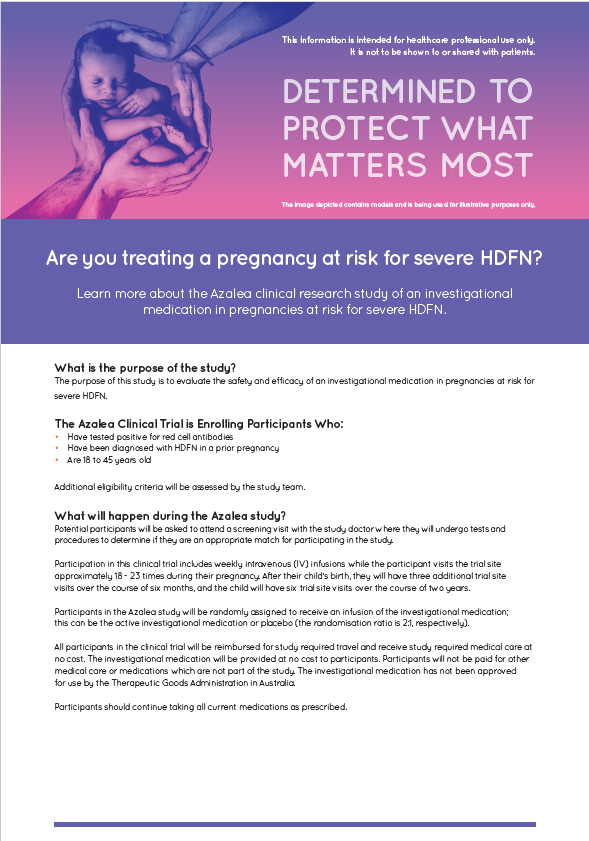
Do you have a patient who is eligible to take part in a phase three study for pregnancies at risk for severe Haemolytic Disease of the Foetus and Newborn (HDFN).

This rare and potentially life-threatening condition can occur when the blood types of the mother and foetus are incompatible.

Azalea’s clinical trial is designed to evaluate the efficacy of an investigational product in pregnancies at risk for severe HDFN. It is currently open for recruitment at Liverpool Hospital.

Participation criteria and further information can be found on clinicaltrials.gov.

Additional eligibility criteria will be assessed by the study team.

For more information, you can contact:

Learn more


This article appeared in Practice Pulse on Wednesday, 29 April 2026. If you are a GP, practice nurse or practice manager in South Western Sydney and do not get the weekly Practice Pulse email, speak to your Practice Support Officer.

08 July 2024

Women with diabetes who have glucose levels outside target ranges and become pregnant are at increased risk of pregnancy related complications and poor birth outcomes.

Having support from a GP to plan and manage the pregnancies of women with diabetes can reduce complications for both the mother and baby.

South Western Sydney PHN (SWSPHN) is hosting a webinar during National Diabetes Week, 14 to 21 July, which emphasises the importance of having routine conversations with patients about managing their diabetes before becoming pregnant.

Head of the Campbelltown Hospital Endocrinology Department, Professor David Simmons, will present the Diabetes Contraception and Pre-pregnancy Program (DCAPP) webinar on Thursday, 18 July, from 7pm.

What is DCAPP?

DCAPP has been designed to develop a more integrated approach to supporting women of childbearing age with type 1 and type 2 diabetes.

SWSPHN is working in partnership with Western Sydney University and South Western Sydney Local Health District to implement the program in our region.

For women with pre-existing diabetes, understanding and managing the risks of unplanned pregnancies, undertaking pre-pregnancy planning and maintaining glycaemic level target ranges before and throughout pregnancy can significantly increase the likelihood of having a healthy baby.

Similar programs implemented elsewhere have reduced the rates of congenital malformations, miscarriage and stillbirths by up to 70 per cent.

DCAPP aims to open up early conversations between GPs and their patients about the seriousness and potential complications of becoming pregnant if the patients’ diabetes is not well-managed.

It provides GPs with guidance on managing these patients, including about referring patients with diabetes who are planning pregnancy to one of the diabetes pre-pregnancy clinics across our region. For patients who are not planning pregnancy, GPs are encouraged to discuss the importance of contraception with your patients with diabetes.

How are patients benefiting from DCAPP?

Mother of two, Rachel Hicks (pictured), was diagnosed with type 1 diabetes when she was five.

She said encouragement and support from her treating team at Macarthur Diabetes Service at Campbelltown Hospital, and Professor David Simmons introducing the Diabetes Contraception and Pre-pregnancy Program (DCAPP) at Campbelltown, made all the difference when she decided to start trying for a family.

Her team included a diabetes educator, an endocrinologist and a GP, who worked collaboratively to improve her blood glucose management and put plans in place to prepare for extra low blood sugar levels, and ensure she had access to the most appropriate devices like an insulin pump and a continuous glucose monitor.

“Going through my first pregnancy there was so much more information to take on about what I needed to do for myself, for my baby, for my family during that time. It was good to have a little bit of pressure relieved with access to a glucose monitor and getting more data on what was happening with my diabetes.”

How can diabetes care be more accessible?

Mrs Hicks is also undertaking PhD research examining lived experiences of diabetes and pregnancy, including working with DCAPP to look at peer support models.

She said her research had highlighted how there couldn’t be a one-size fits all approach to providing accessible care to, and engaging with vulnerable communities across South Western Sydney, including people from culturally linguistically and diverse (CALD) backgrounds.

“We’ve seen with diabetes programs delivered at Campbelltown Hospital for example, where our treating teams going out into the communities deliver some services in spaces which are more suitable and for those communities.

“And we saw hybrid models of care throughout the pandemic as well – a mixed delivery of services which has been beneficial, especially for women with diabetes who are concerned about how medicalised their pregnancy is going to be.

“If there’s any options for making care more accessible or equitable, like the option of the hybrid model of care, that would be most beneficial.”

Support for your practice

SWSPHN will run a POLAR report for interested practices in our region, to identify patients diagnosed with diabetes who are of childbearing age. The report will help develop a recall list, enabling you to engage those patients in discussions about pre-pregnancy planning and contraception. Our diabetes co-ordinator Alyssa Horgan is available to visit practices to assist in setting up a recall process.

For bookings or enquiries, contact Alyssa via email at alyssa.horgan@swsphn.com.au or phone 4632 3088.

Webinar details

The Diabetes Contraception and Pre-pregnancy Program webinar will:

  • educate GPs on potential maternal and neonatal outcomes if a woman’s diabetes is not controlled before pregnancy
  • which medications should be stopped, substituted or introduced before pregnancy
  • why they should refer patients to a diabetes pre-pregnancy planning clinic

It has been RACGP-approved for 1.5 Educational Activities hours.

Visit the SWSPHN website to register.

Additional resources

Download the flyer for ways to support your at-risk patients

Visit HealthPathways for pre-pregnancy planning for type 1 and type 2 diabetes pathways

Visit SWSPHN’s website to find diabetes resources for GPs

Visit Diabetes Australia for information about National Diabetes Week

05 March 2024

Healthcare providers are being called on to stay up-to-date on infectious syphilis, amid a significant rise in syphilis diagnoses in Australia.

In the past decade, rates of syphilis diagnoses in Australia have tripled, according to a recent report by the Kirby Institute.

The rate of syphilis has increased six-fold among women, while congenital syphilis cases rose 68 per cent.

Australia’s Chief Medical Officer, Professor Paul Kelly, said we’re seeing the re-emergence of congenital syphilis, when the infection is transmitted during pregnancy.

“This can have devastating health consequences for newborn babies, including death,” he said.

“Congenital syphilis is also entirely preventable. We must ensure everyone is tested for syphilis during pregnancy. All pregnant people should be tested at least once, and in many cases more.”

Read more

Healthcare providers are urged to:

28 February 2024

Healthcare providers are being called on to stay up-to-date on infectious syphilis, amid a significant rise in syphilis diagnoses in Australia.

In the past decade, rates of syphilis diagnoses in Australia have tripled, according to a recent report by the Kirby Institute.

The rate of syphilis has increased six-fold among women, while congenital syphilis cases rose 68 per cent.

Australia’s Chief Medical Officer, Professor Paul Kelly, said we’re seeing the re-emergence of congenital syphilis, when the infection is transmitted during pregnancy.

“This can have devastating health consequences for newborn babies, including death,” he said.

“Congenital syphilis is also entirely preventable. We must ensure everyone is tested for syphilis during pregnancy. All pregnant people should be tested at least once, and in many cases more.”

Read more or watch the video below

Healthcare providers are urged to:

27 November 2023

NSW Health has introduced a second universal antenatal syphilis screen at 26 to 28 weeks gestation and additional screening for women at high-risk of syphilis in pregnancy.

This is in response to concerning increases in maternal and congenital syphilis diagnosed in NSW. 

Syphilis in pregnancy is associated with preterm birth, low birth weight, congenital anomalies, fetal loss or stillbirth, and neonatal death.

Congenital syphilis is a preventable disease.

Additionally, GPs who engage with pregnant women are encouraged to screen opportunistically regardless of gestation where a pregnant woman has had limited or no antenatal care.  

You can find advice and referral information at NSW Sexual Health Clinics and the NSW Sexual Health Infolink.

NSW Sexual Health Infolink is available during business hours on 1800 451 624.

GPs will be offered active assistance with case management from their local sexual health clinic after the notification is referred to them in specific cases. 
 
An online training has been developed NSW Introduction to Syphilis for Midwives and Clinicians Providing Antenatal Care to assist GPs identify priority populations for antenatal syphilis testing, learn about syphilis care and management including more complex clinical scenarios, and contact tracing after a syphilis diagnosis. 

More information can be found via the policy directive Syphilis in Pregnancy and Newborns.

The policy directive establishes the minimum requirements for NSW Health services and outlines the roles and responsibilities of clinicians and NSW Health staff when screening and managing syphilis in pregnancy and managing neonates at risk of congenital syphilis.  

10 August 2023

The ForWhen mental health support line connects new and expecting parents with services which can help them understand what they’re feeling, and provide guidance and support throughout their perinatal journey, from conception up until 12 months old.

You can refer, or your patients can self-refer by calling 1300 242 322 or using the Contact Us page on the ForWhen website.

Download ForWhen Information Guide
23 March 2023

Amid a worrying spike in syphilis cases, the Australasian Society for HIV, Viral Hepatitis and Sexual Health Medicine (ASHM) has launched an online Syphilis Interactive Tool to guide clinicians through testing and treating syphilis.

The decision-making tool is free and available online, with primary practices encouraged to use the tool in their clinical care. The tool incorporates pathways for diagnosis and treatment in pregnant women, a priority population group of growing concern.

ASHM’s Syphilis Interactive Tool complements existing resources, including the on-demand training module, Syphilis Outbreak Training.

ASHM is encouraging primary care professionals to help combat Australia’s increase in syphilis cases by integrating the Syphilis Interactive Tool into their clinical practice. 

Find out more
06 December 2022

SWSPHN joined South Western Sydney Local Health District (SWSLHD) for the recent official launch of the First 2000 Days initiative, a strategy aimed at giving all children 0 to five-years the best start in life.

Our Chief Executive Officer, Dr Keith McDonald PhD, Director of Planning and Performance, Amy Prince, and other PHN staff attended the gathering at Western Sydney University’s Macarthur Clinical School in Campbelltown.

The First 2000 Days strategy aims to:

  • Improve care and access to care at general practice and hospitals
  • Continue to improve GP knowledge through relevant CPD opportunities
  • Improve maternal health by:
    • Identifying women with gestational diabetes and/or preeclampsia
    • Reducing smoking in women and alcohol consumption
    • Improving obesity rates in children and education
  • Improve immunisation rates
  • Work with women to reduce domestic violence

Dr Nicole Hall, a GP from Wattle Grove Family Medical Practice and co-chair of the SWSPHN/ SWSLHD Antenatal Shared Care (ANSC) Operations Group, spoke on behalf of SWSPHN.

There are currently 370 ANSC-recognised providers within the region, working across 445 medical practices delivering care in multiple languages. 

Dr Hall emphasised the importance of GP-care from as early as pre-conception and conception, antenatal and postnatal care, continuing through to childhood and all other stages of life.

Dr Hall highlighted points including:

  • GPs are at the heart of every referral 
  • GPs are the primary immunisers for pregnant women and children within the first 2000 days 
  • SWSPHN encourages GPs to record height/weight through our Quality Improvement in Primary Care program 
  • SWSPHN supports GPs and practice nurses in providing quality paediatric care via: 
  • CPD events for paediatric conditions 
  • Ongoing CPD in relation to ANSC throughout the year 
  • SWSPHN, in partnership with SWSLHD, provides clinical guidance and referral information via HealthPathways
  • SWSPHN provides information to the community on common developmental and paediatric conditions, as well as local services via Heath Resource Directory. This is provided in four languages and audio formats 

SWSPHN has been implementing the First 2000 Days strategies since 2019 but COVID-19 delayed the official launch of the initiative.


This article appeared in Practice Pulse on Wednesday, 7 December 2022. If you are a GP, practice nurse or practice manager in South Western Sydney and do not get the weekly Practice Pulse email, speak to your Practice Support Officer.

28 January 2022

Before pregnancy


Influenza (flu)

Flu in pregnancy can be serious with an increased risk of premature labour and low birth weight. Flu vaccination during pregnancy is safe and effective and is strongly recommended for all pregnant women. Flu vaccine is free for pregnant women and also provides protection for babies in the womb and up to six months after birth.


Whooping cough (pertussis)

Whooping cough is an infection which causes serious illness, and in some cases death, in babies who are too young to be vaccinated. The whooping cough vaccine protects mothers and their newborn from infection and is recommended before pregnancy or in the last three months of pregnancy if the patient has not had the vaccine in the last five years.
 

MeaslesMumps and Rubella

If a patient catches measles, mumps or rubella during pregnancy she could have a miscarriage, premature delivery or their baby could be born with serious birth defects. If patients are not yet protected, they should be vaccinated. It is important women do not become pregnant for 28 days after vaccination.
 

Chickenpox (Varicella)

Chickenpox can cause severe birth defects if caught during pregnancy. If patients are not yet protected, they should be vaccinated. It is important women do not become pregnant for 28 days after vaccination.
 

Hepatitis B

All pregnant women are tested for hepatitis B infection, as it can pass to their baby during birth. If an expectant mother has the disease, they should be seen by a specialist and their baby will need to be treated with a medication called immunoglobulin and receive hepatitis B vaccine immediately after birth.


Following birth

It is safe for new mothers to receive routine vaccinations immediately following birth, even if they are breast feeding. Patients should have the whooping cough vaccine if they have not received it in the last five years or the MMR vaccine if they are not immune to measles or rubella.

A baby’s first vaccination, hepatitis B, is recommended just after birth. The next scheduled vaccinations are due when babies is six to eight weeks old.

19 May 2021

The Early Pregnancy Assessment Services (EPAS) across the South Western Sydney Local Health District will undergo changes from June 2021.

EPAS is a low-risk outpatient facility for women experiencing vaginal bleeding or pregnancy related complications prior to 20 weeks gestation.

Criteria to attend EPAS is as follows:

  • be under 20 weeks pregnant, and
  • have abdominal pain or vaginal bleeding, and
  • experiencing only mild to moderate symptoms

or

  • failed pregnancy has been confirmed by ultrasound

In all cases, the patient must be assessed as being clinically stable. Women who are not hemodynamically well should be sent directly to the Emergency Department.

EPAS Services are offered at the following facilities across the Local Health District:

Bankstown Hospital

Tuesday and Thursday – morning only (by appointment)

Liverpool Hospital

Monday to Sunday – 8am to 2.30pm (by appointment)

Campbelltown Hospital

Monday to Friday – 8am to 3pm (by appointment)

Women from the Fairfield area can be referred to Liverpool EPAS, and Women from Bowral can be referred to Campbelltown EPAS.

  • Further information regarding the contact numbers for these services and information to include for referral to the EPAS service can be found at HealthPathways.