06 April 2023
One in seven women in NSW will develop breast cancer in their lifetime.
Key risk factors for developing breast cancer are being female and getting older – 75 per cent of women diagnosed with breast cancer are over 50.
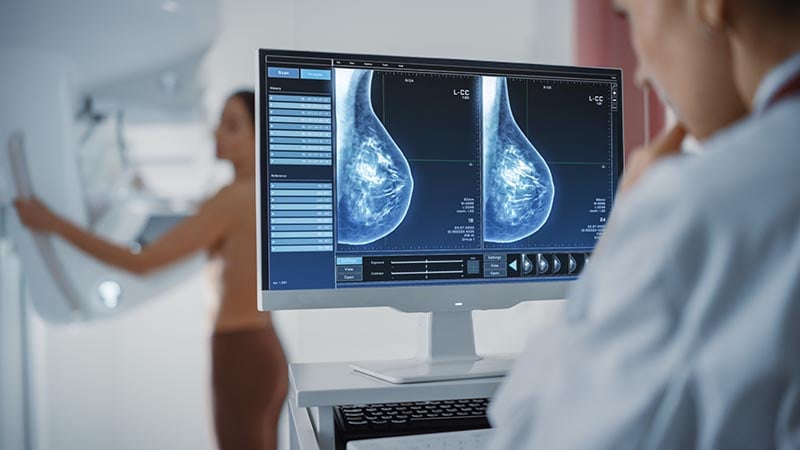
BreastScreen NSW provides free screening mammograms for women between the ages of 50 and 74 at mobile and permanent clinics across our region.
Find out more about breast cancer screening in South Western Sydney
Download these flyers to find out more:
Breast screening and you
South Western Sydney service schedule
17 February 2023

Updates have been made to the National Cancer Screening Register.
The updates include:
- A patient’s address can now be updated directly by their GP or practice nurse through the National Cancer Screening Register (NCSR) Healthcare Portal.
- National Bowel Cancer Screening Kits can now be ordered in bulk to your practice and distributed directly to patients during consultation through the Alternative access to kits model. Single kits are still able to be ordered directly to a patient’s home. All orders are made via the NCSR healthcare portal.
National Cancer Screening Register Healthcare Provider Portal
The NCSR has released a Healthcare Provider Portal which is able to integrate with clinical information systems to enable providers (GPs, nurses and other specialists) to access and submit bowel and cervical screening data electronically in a self-service fashion.
The portal eliminates the need for healthcare providers to contact the National Register via fax, paper and phone, while also making it easier for healthcare providers to submit information.
You can use the National Register in real-time to:
- order your patient a National Bowel Cancer Screening Program Test Kit (to their home)
- bulk order National Bowel Cancer Screening Program Kits directly to your practice
- check patient screening histories
- receive reminders for patients overdue for screening or follow-up
- check and update patient details
- manage patient program participation
- submit information about your patient, such as colonoscopy or colposcopy information
- nominate other people to assist your patient, including another doctor or a personal representative
The Healthcare Provider Portal tab will link you directly with:
- User Guide
- Quick Start Guide
- Step by step, walk-through videos for set-up, logging-in and registration, patient searches, ordering and reporting
Technical support is available to assist with accessing the portal and integrating your clinical software. Call 1800 627 701 (Call back options are available).
Find out more about the Healthcare Provider Portal
08 February 2023
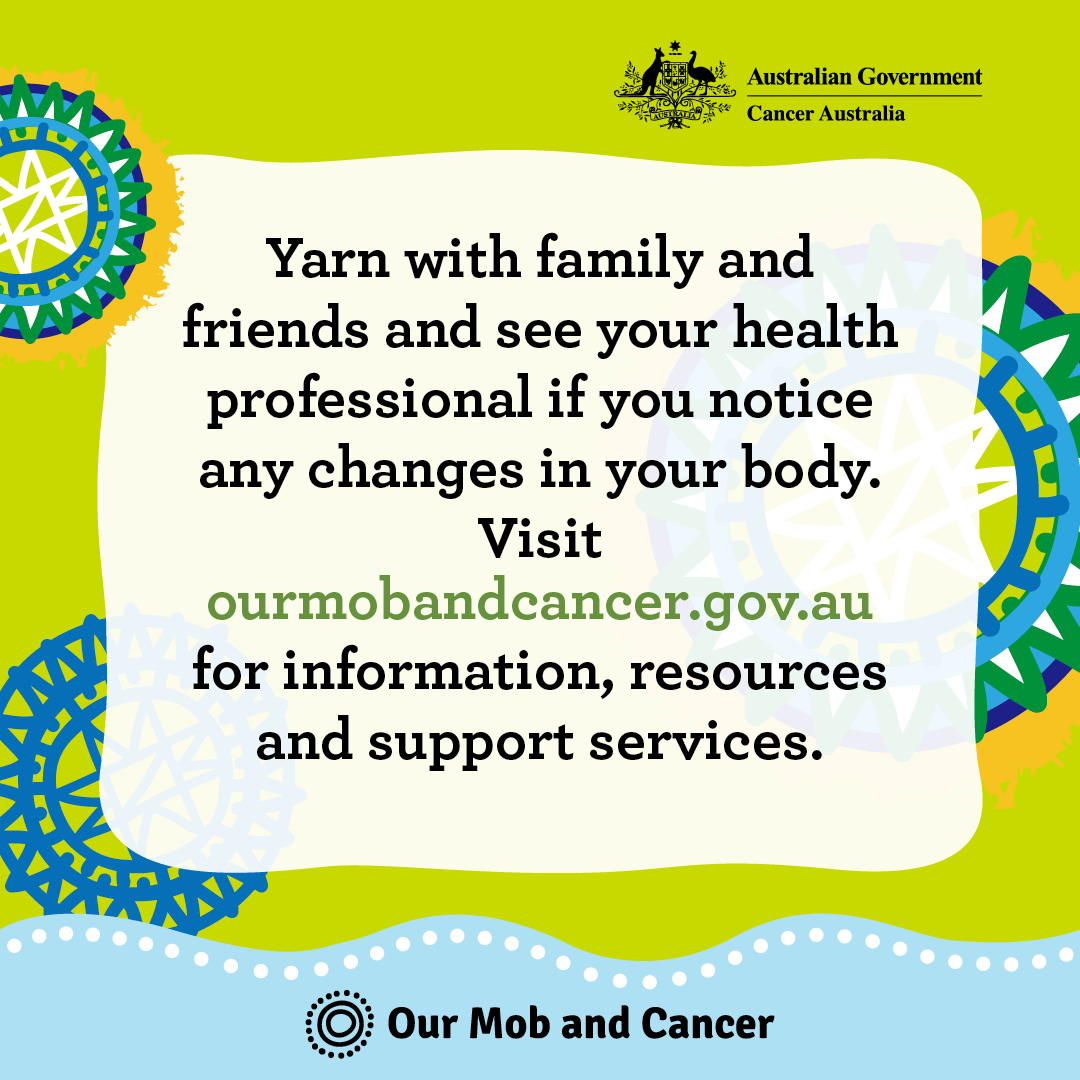
New community resources are now available to support Aboriginal and Torres Strait Islander people affected by cancer, their families, communities and health professionals.
Aboriginal and Torres Strait Islander people are at higher risk of being diagnosed with and impacted by cancer. That’s why it’s important to know what to do about cancer, where to get help and support services.
Our Mob and Cancer is a Cancer Australia website providing critical information about the impact of cancer, ways to protect against cancer, types of cancer, diagnosis, treatment and living with cancer, how cancer spreads and where to get help and support.
18 January 2023
SWSPHN has developed a fact sheet to provide general practices with an update on changes to cancer screening recommendations for Aboriginal and Torres Strait Islander people.
Changes include:
National Cancer Screening Register (NCSR)
The NCSR has released a Healthcare Provider Portal which provides a self-service alternative for healthcare providers to access and submit screening data for the bowel and cervical screening programs.
Cervical cancer screening
Self-collection is now available to all people with a cervix.
Bowel cancer screening
Bowel cancer screening kits can now be ordered in bulk to your practice and distributed directly to patients during consultations.
Breast cancer screening
The BreastScreen NSW PUTUWA Project is supporting Aboriginal women to access mammograms from age 40 (previously it was age 50).
National Cancer Screening Register (NCSR)
The NCSR has released a Healthcare Provider Portal which provides a self-service alternative for healthcare providers to access and submit screening data for the bowel and cervical screening programs.
The portal can be integrated into clinical information systems enabling GPs and practice nurses to access and submit data electronically.
It eliminates the need for healthcare providers to contact the National Register via fax, paper and phone, and makes it easier for healthcare providers to submit information.
You can use the National Register in real-time to:
- order your patient a National Bowel Cancer Screening Program Test Kit (to their home)
- bulk order National Bowel Cancer Screening Program kits directly to your practice
- check patient screening histories
- receive reminders for patients overdue for screening or follow-up
- check and update patient details
- manage patient program participation
- submit information about your patient, such as colonoscopy or colposcopy information
- nominate other people to assist your patient, including another doctor or a personal representative
Register now
16 January 2023

Did you know you have a choice when it comes to cervical screening?
ACON has launched a new campaign called Own It which aims to empower young women and people with a cervix aged 25 to 35 years to make their Cervical Screening Test their ‘own’, by choosing how to screen.
The campaign is based on the experiences of real people who have overcome barriers to cervical screening by choosing how their Cervical Screening Test is done.
Their choices include self-collection, bringing a friend, inserting the speculum themselves, finding a doctor they can trust, talking to others and educating themselves to address misinformation.
What is cervical cancer?
Cervical cancer is the growth of abnormal cells in the lining of the cervix, the lowest part of the uterus or womb. Most cervical cancers are caused by the human papillomavirus (HPV).
What is the Cervical Screening Test?
The Cervical Screening Test is how we screen for cervical cell changes so they can be monitored or treated to prevent cancer from developing. It’s for anyone with a cervix who has ever been sexually active – regardless of gender identity, sexuality or sexual history.
Who should have a Cervical Screening Test?
If you have a cervix and are aged 25 to 74, you should have a Cervical Screening Test every five years.
More cervical screening options
Everybody attending for a Cervical Screening Test can choose if they would like their clinician to collect their sample or if they would like to collect their own sample. This is called self-collection. Self-collection involves a vaginal / front hole swab. The collection device looks like a long cotton bud.
How do I know when I’m due for my next test?
The National Cancer Screening Register sends invitation letters to start screening when you turn 25 and reminders when your next test is due. The register collects your info from Medicare, so if your name does not match your Medicare card, you can change it in the National Cancer Screening Register by calling them on 1800 627 701.
Find out more about cervical screening and preventing cervical cancer
21 December 2022
Practices are invited to prepare for a new cervical screening campaign by ACON called ‘Own It’ in January 2023.
The campaign aims to empower young women and people with a cervix aged 25 to 35 years to make their Cervical Screening Test their own, by choosing how to screen.
The campaign is based on the experiences of real people who have made choices about how their Cervical Screening Test is done, to overcome barriers.
Their choices include self-collection, bringing a friend, inserting the speculum themselves, finding a doctor they could trust, talking to others and educating themselves to address misinformation.
For people who are eligible for a Cervical Screening Test, GPs should offer the choice of human papillomavirus (HPV) testing by either:
- self-collected vaginal sample using a simple swab (unless a co-test is indicated)
- clinician-collected sample from the cervix using a speculum and a soft brush
Eligible people include anyone with a cervix aged 25 to 74, who has ever had any sexual contact.
GPs must order and oversee both options.
Both are accurate and safe ways to collect a sample for a Cervical Screening Test.
Please give your patients clear information about the pros and cons of both sample collection options, including possible follow up requirements. This supports the patient in making an informed decision.
19 December 2022
Doctors, did you know you can refer a patient directly to the Leukaemia Foundation for assistance with a range of support services and blood cancer advice?
Access the referral form
The Leukaemia Foundation can provide the following assistance to people diagnosed with a blood cancer:
14 December 2022

The Cancer Institute NSW has launched a new campaign to encourage younger people, aged 18 to 24 years in NSW, to protect their skin from UV radiation.
This group is particularly at risk as they are less likely to protect their skin from the sun than the general population.
The campaign’s key messages are:
- Melanoma is the most common cancer among young Australians
- If you could see UV radiation, you would protect your skin
- Be prepared before you go outdoors
- Protect your skin in five simple ways: Slip, Slop, Slap, Seek, and Slide
The campaign demonstrates the scale and danger of UV rays by depicting them as illuminated ‘Arrows’ hurtling down from above, transforming it into a tangible and ever-present threat.
Protect yourself from skin cancer:
Find out more
13 December 2022

ACON is launching a new cervical screening campaign called Own It in January 2023. The campaign aims to empower young women and people with a cervix aged 25 to 35 years to make their Cervical Screening Test their own, by choosing how to screen.
The campaign is based on the experiences of real people who have made choices about how their Cervical Screening Test is done, to overcome barriers.
Their choices include self-collection, bringing a friend, inserting the speculum themselves, finding a doctor they can trust, talking to others and educating themselves to address misinformation.
For people who are eligible for a Cervical Screening Test, GPs should offer the choice of human papillomavirus (HPV) testing by either:
- self-collected vaginal sample using a simple swab (unless a co-test is indicated)
- clinician-collected sample from the cervix using a speculum and a soft brush
Eligible people include anyone with a cervix aged 25 to 74, who has ever had any sexual contact.
GPs must order and oversee both options. Both are accurate and safe ways to collect a sample for a Cervical Screening Test.
NSW Cancer Institute: information for healthcare providers
Please give your patients clear information about the pros and cons of both sample collection options, including possible follow up requirements. This supports the patient in making an informed decision.
NSW Cancer Institute: key messages for healthcare providers
The Own It campaign will launch on Monday, 16 January and run throughout February.
If you’d like to order campaign posters (A3 or A4) for your practice or service email canwe@acon.org.au.
21 November 2022
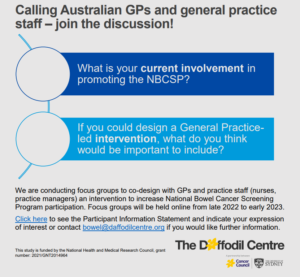 The Daffodil Centre – a partnership between Cancer Council NSW and the University of Sydney – is inviting GPs and practice staff to take part in a new study which aims to co-design a general practice-led intervention to increase National Bowel Cancer Screening Program (NBCSP) participation. Eligible participants are GPs and practice staff who work within practices with a minimum of two GPs and use electronic patient records. The study involves participating in a 60 to 90-minute online focus group. Results from this research will aid in understanding GP and practice staff perspectives about optimal intervention components, and potential barriers and enablers which may impact intervention components.
Learn more
This article appeared in Practice Pulse on Wednesday, 23 November 2022. If you are a GP, practice nurse or practice manager in South Western Sydney and do not get the weekly Practice Pulse email, speak to your Practice Support Officer.


