


Rising concerns in childhood vaccinate rates
Why are vaccination coverage rates declining?
How does misinformation impact vaccination rates?
Role of primary healthcare providers in improving vaccination rates
How can Quality Improvement (QI) support your practice?
How to identify missed childhood vaccinations using POLAR
SWSPHN walkthroughs and resources
Helpful tips for health professionals participating in QI
“We all need to be reminded vaccine-preventable viruses or bacteria can and do cause serious illness and even death, and they haven’t gone away”
– Dr Matthew Gray
Rising concerns in childhood vaccination rates
Previously, Australia maintained high success rates of vaccination coverage for children.
However, the National Centre for Immunisation Research and Surveillance (NCIRS) identified there are rising concerns and continual declines in childhood vaccination rates since the COVID-19 pandemic.
Recent data showed current childhood vaccination rates are in fact lower than they were pre-pandemic, highlighting the importance of identifying barriers to vaccine access and acceptance.
Vaccinations are the most simple and effective way of protecting yourself and your community against vaccine-preventable diseases.
Immunisation programs prevent approximately 2.5 million deaths every year world-wide, according to the Australian Government.
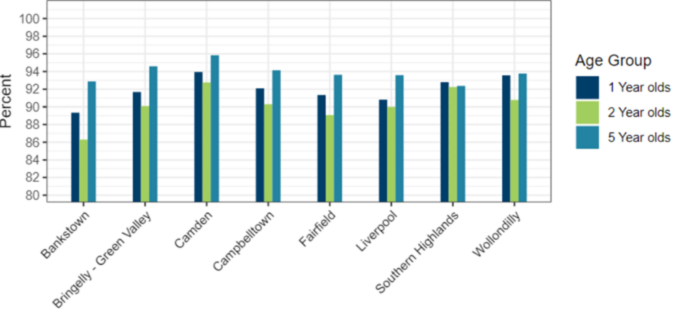
Recent data showed vaccination rates were lower for two-year-olds than those aged one and five years.
The Department of Health, Disability and Ageing identified that across highly populated suburbs (Statistical Area – Level 3 criteria) in South Western Sydney (SWS), Bankstown had the lowest vaccination coverage for children aged one year (89.3 per cent), two years (86.3 per cent) and five years (92.9 per cent).
Source: SWSPHN 2025-2028 Health Needs Assessment
Why are vaccination coverage rates declining?
In 2019, the World Health Organisation (WHO) placed vaccine hesitancy in the top 10 threats to global health.
The National Vaccination Insights Project 2025 performed a recent study to identify childhood vaccination barriers for Australian parents which included:
- poor access to immunisation services
- low confidence in vaccination efficacy
- misinformation based on myths surrounding vaccination coverage and its importance
- mistrust in healthcare professionals providing information
- social influences
| Vaccination barrier | Parents with unvaccinated children (%) | Parents with partially vaccinated children (%) | Parents with up-to-date children (%) | All parents (%) |
|---|---|---|---|---|
| Do not intend to give child all recommended vaccines | 48.8 | 10.8 | 4.8 | 5.7 |
| Do not believe vaccines are safe for child | 47.9 | 17.7 | 4.8 | 6 |
| Would not feel guilty if did not vaccinate child and child got a VPD | 46.7 | 16.0 | 7.1 | 8.1 |
| Do not believe vaccinating child helps protect others in the community | 39.7 | 14.0 | 3.9 | 4.9 |
| Do not believe vaccines are effective for preventing diseases | 39.8 | 14.3 | 4.4 | 5.3 |
| Vaccinating on time is not my responsibility | 12.8 | 10.4 | 3.9 | 4.3 |
| Feel distressed when thinking about vaccinating child | 65.4 | 55.4 | 60.3 | 60.2 |
| Do not trust information received about vaccines from child’s doctor or nurse | 43.7 | 16.8 | 5.4 | 6.4 |
| People close do not support vaccination | 21.8 | 11.5 | 5.5 | 6 |
| Child’s doctor or nurse cannot answer questions about vaccination | 20.2 | 10.8 | 4.4 | 4.9 |
| Do not prioritise child’s vaccination appointment over other things | 47.6 | 23.9 | 6.9 | 8.2 |
| Not easy to travel to child’s vaccination appointment | 12.1 | 8.9 | 4.9 | 5.2 |
| Cannot afford costs associated with vaccinating child | 16.5 | 20.5 | 10.4 | 11 |
| Not easy to get an appointment when child’s vaccination is due | 14.2 | 24.8 | 8.5 | 9.3 |
| Cannot discuss vaccination in preferred language with child’s doctor or nurse | 10.5 | 11.0 | 6.2 | 6.5 |
|
|
Access | Practical barrier |
|
|
Acceptance | Thinking-feeling barrier |
|
|
Acceptance | Social influence barrier |
Source: Childhood vaccination barriers in Australia and strategies to address them, October 2025
How does misinformation impact vaccination rates?
The term herd immunity refers to slowing or stopping the transmission of a disease within a community as a result of high levels of vaccination coverage.
A common myth about herd immunity is, if most of the community is vaccinated, an unvaccinated person will be protected by everyone else.
The danger in this misconception is if more people in the community adopt this belief, vaccination rates will continue to decline.
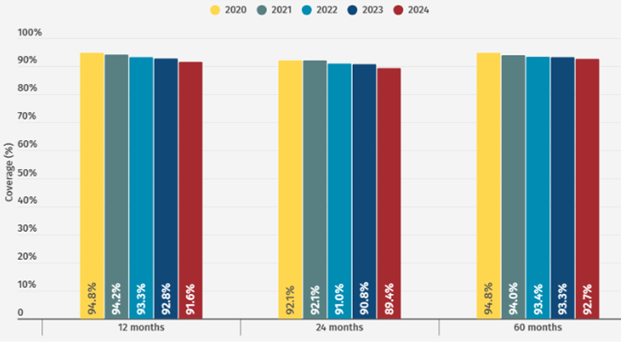
Australian immunisation coverage rates for five-year-olds stood at 95 per cent in 2020 but have since declined to 93.27 per cent in 2025.
The Australian Government has established 95 per cent as the minimum immunisation rate required to achieve herd immunity for many vaccine-preventable diseases.
The overall decrease of vaccination rates in the community poses a risk for outbreaks of previously eliminated vaccine-preventable diseases in Australia.
Vaccinations prevent deaths, serious illness and minimise transmission rates.
Source: Annual Global Immunisation Coverage Report 2024 – Summary | NCIRS
There is no singular solution or approach for vaccine hesitancy as the magnitude of negative beliefs, myths and mistrust must be addressed individually for each patient and/or parent.
SWSPHN has recently launched an Immunisation Hero campaign to support general practices in promoting immunisation uptake and boosting vaccination awareness within the community.
For more information or resources, please visit our website: Immunisation Hero
Role of primary healthcare providers in improving vaccination rates
Primary healthcare providers play a crucial role in increasing vaccination coverage, as they are the key providers in administering vaccinations and re-shaping public opinions through education.
Primary healthcare providers could:
- improve their own confidence in providing information on immunisations to their community
- promote vaccination in the community through displaying educational posters, brochures and/or pamphlets in their practice to become a local immunisation hero!
- allow time for discussions surrounding vaccinations and addressing individual concerns
- participate in quality improvement activities to increase vaccination coverage within the community
- utilise effective recall and reminder procedures within the practice
- maintain up-to-date patient files
Helpful resources for health professionals:
How to talk about vaccines | WHO
Trusted immunisation resources for general practice | SWSPHN
CPD events calendar for primary healthcare in South Western Sydney | SWSPHN
How can QI support your practice?
Quality Improvement plays a pivotal role in driving practice-based decisions to make changes, based on current evidence.
POLAR is a user-friendly data extraction and analysis tool which can be used to support QI-based activities in your practice.
Ways POLAR can assist with QI:
- create a patient list within POLAR that identifies patients eligible for a specific immunisation – you can tailor your report to meet practice needs or a specific demographic
- utilise the extracted patient list to audit patient files and identify any gaps in clinical data
- utilise Walrus alongside your clinical information software system to further identify missing data within the practice. For more information on Walrus, refer to the POLAR Walrus Tool Guide
track improvements in practice data quarterly in conjunction with Models for Improvement to compare baseline and current data - collaborate with SWSPHN in quarterly QI meetings for a team-based QI approach and assistance in using POLAR or how to further improve practice data
How to identify missed childhood vaccinations using POLAR
Due to a national decrease in childhood vaccination coverage, SWSPHN has created a POLAR walkthrough to help practices identify potentially missed childhood vaccinations.
Specific filters applied can be tailored to your practice and demographic needs.
POLAR Walkthrough – Childhood Vaccination Eligibility
SWSPHN walkthroughs and resources
SWSPHN has various resources to assist your practice with QI activities.
If you are unsure how to access POLAR or need help obtaining data, contact your CQI officer or your PAO/PSO for more information.
Model for Improvement Template
POLAR Walkthrough – Adult Prevenar 13 Eligibility
POLAR Walkthrough – Shingrix Vaccine Eligibility
Helpful tips for health professionals participating in QI
Maintain accurate data in patient files, POLAR extracts data from the practice’s clinical information software.
POLAR does not obtain data from AIR, My Health Record or PRODA.
If immunisations were administered elsewhere, update the patient file to reflect this in conjunction with the patient’s AIR immunisation history.
SWSPHN has created a sample, editable Model for Improvement (MFI) to help practices implement processes to regularly update immunisation history using AIR:
Sample MFI – Maintain Accurate Immunisation Records
Clinical information software walkthroughs to utilise AIR to maintain up to date patient records:
MedicalDirector Walkthrough – Update Immunisation History via AIR
Best Practice Walkthrough – Update Immunisation History via AIR
Private bookmark function:
The private bookmark function in POLAR allows users to save searches created with specific filters for future reference.
POLAR Walkthrough – How to create a private bookmark
References/resources
Immunisation programs | NSW Health
About immunisation | Department of Health, Disability and Ageing
If you wish to find out more about vaccinations in POLAR or SWSPHN’s QIPC program, please email cqisupport@swsphn.com.au or visit our website Quality Improvement in Primary Care.