


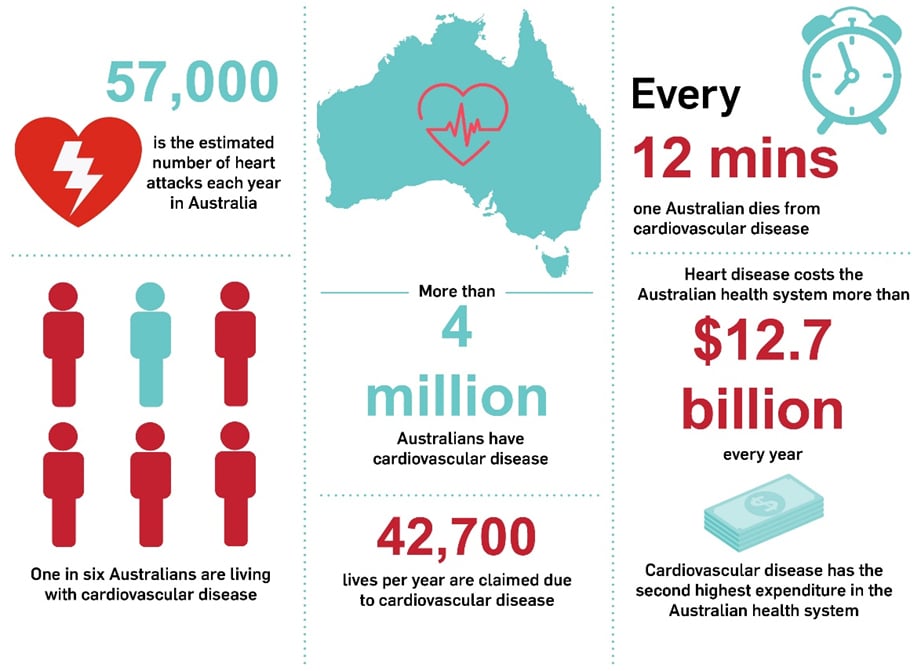
Cardiovascular disease (CVD) is one of the major health concerns in Australia; it remains the key cause of death and morbidity nationwide. According to the Heart Research Institute, CVD is contributing to more than 1.2 million hospitalisations each year and leads to long-term complications.
Source: Heart Research Institute, 2024.
Primary prevention in general practice plays a significant role in early identification and management of modifiable CVD risk factors such as blood pressure, cholesterol and smoking.
The National Preventive Health Strategy 2021-2030 and the RACGP Guidelines strongly recommend the use of absolute CVD risk assessments in the primary healthcare setting, which is also embedded as one of the 10 PIP QI measures.
National Preventive Health Strategy 2021-2030
RACGP Guidelines
10 PIP QI measures
Understanding and addressing modifiable cardiovascular risk factors
Many of the risk factors contributing to CVD are modifiable, meaning they can be influenced through lifestyle changes, medical intervention or both. Addressing these factors not only reduces the risk of CVD but contributes to improved outcomes in diabetes, kidney disease and mental health.
Key modifiable risk factors for CVD:
- tobacco smoking
- obesity (BMI)
- physical inactivity
- hypertension
- hyperlipidaemia
- unhealthy diet
- excessive alcohol consumption
- diabetes and impaired glucose regulation
- psychosocial stress
Among these, body mass index (BMI) and smoking status are particularly significant, as they directly contribute to the calculation of an individual’s absolute CVD risk.
Recording BMI is essential in identifying overweight and obesity, both of which are associated with increased blood pressure, adverse lipid profiles, insulin resistance and ultimately a higher risk of cardiovascular events. According to the Australian Bureau of Statistics, adults with elevated waist circumference have a five per cent higher risk of developing CVD.
Smoking remains one of the highly significant independent risk factors for cardiovascular disease. Current smokers are estimated to have three times the cardiovascular mortality risk compared to non-smokers.
Despite this, documentation remains suboptimal. The AIHW’s 2021–22 Practice Incentive Program – Quality Improvement (PIP QI) report revealed only 49.8 per cent of eligible patients aged 45 to 74 years (without known CVD) had sufficient data recorded to calculate an absolute CVD risk score. In South Western Sydney, POLAR data shows only 43 per cent of eligible patients have a documented CVD risk score.
Further data from AIHW (2014) highlights:
- Only 22.7 per cent of patients aged 15 years and older had a recorded BMI
- Only 64.7 per cent had a recorded smoking status within the previous 12 months
These figures demonstrate clear opportunities for improvement in routine risk assessment and documentation.
AIHW 2021–22 Practice Incentive Program – Quality Improvement (PIP QI) report
How your practice can contribute
As a key part of the primary care system, general practice teams can play a pivotal role in CVD prevention by using tools such as POLAR to identify patients with incomplete risk factor data.
To ensure accurate CVD risk calculation:
- BMI (height and weight) should be updated annually, as per PIP QI Measures 2023-24
- smoking status, including confirming known non-smokers, should be reviewed at least annually, and updated immediately if a patient’s smoking behaviour changes
Accurate and up-to-date documentation:
- enables the calculation of absolute CVD risk
- facilitates the delivery of brief lifestyle interventions
- supports timely referral to appropriate services such as smoking cessation programs or the HEAL (Healthy Eating Activity and Lifestyle) program
Australian CVD risk calculator
HEAL (Healthy Eating Activity and Lifestyle)
How POLAR can support better CVD risk assessment
POLAR offers practical tools to enhance CVD risk assessment workflows:
- identify patients eligible for CVD risk assessment
- use Walrus or filters in reports to identify missing data (e.g. BP, cholesterol, smoking status)
- track improvements over time with baseline comparisons and quarterly monitoring
- collaborate with PHN staff via quarterly Model for improvement (MFI) sessions for a team-based QI approach
- collaborate with PHN team to apply a private bookmark for streamlined and quick access to relevant POLAR reports.
Visit POLAR Knowledge Base to learn about Walrus
Download the QIPC Model for improvement template
Download the Private Bookmark POLAR Walkthrough for instructions
There are a couple of reports which could assist practices in improving CVD risk data:
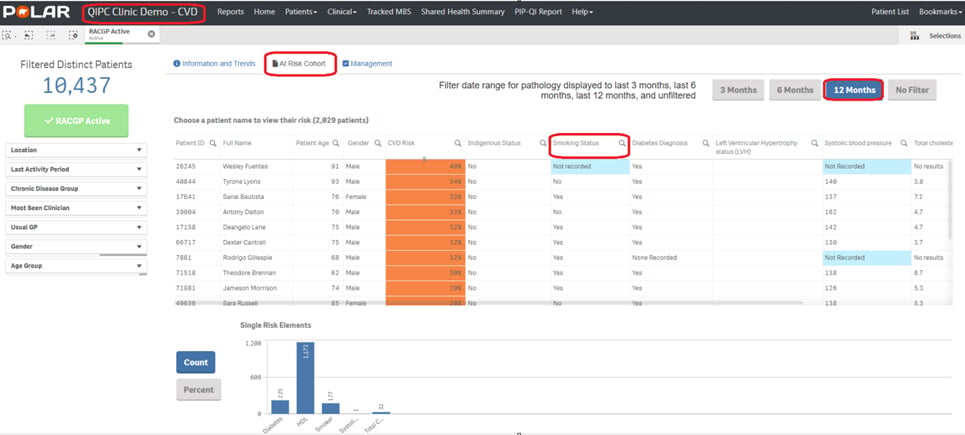
QIPC Clinic report – CVD module (At Risk cohort)
The CVD module in the report helps visualise patients’ risk documentation status for a certain time period and opportunities for improvement.
PIP QI report
This report supports practices to meet and track progress against PIP QI measures, such as CVD risk factors.

MBS items relevant to CVD risk – Heart Health Check
| MBS Item | Description | Eligibility | Frequency | Fee & rebate |
|---|---|---|---|---|
| 699 | Heart Health Check by a GP: ≥ 20 minute consultation including history, BP, cholesterol, risk plan | Patients aged ≥ 45 years, or ≥ 30 years for First Nations people | Once per patient every 12 months | ~$84.90 (GP, pre 2019); updated to $80.10 ↓, full rebate (Health.gov.au, Heart Foundation) |
| 177 | Heart Health Check by a non-specialist medical practitioner (other than a GP) | Same as Item 699 broadens eligibility to non-GP practitioners in primary care settings | Same rule as above | Lower fee (~$64.10), full rebate (Heart Foundation) |
Notes:
Items can be claimed once per patient in a 12-month period and cannot be claimed if the patient has had other health assessments (e.g. items 701, 703, 705, 707, or 715) in that time.
Heart Foundation, NPS Australia
From 1 July 2023, the previous restriction preventing co-claiming with a First Nations health assessment has been removed, supporting more flexible care for First Nations patients.
MBS Online
How our PHN can assist you
- access to targeted training on CVD risk assessment and POLAR usage
- organise quarterly MFI meetings and six-week check-ins for Tier 3 practices
- offer Heart Health toolkit with step-by-step POLAR walkthroughs and editable sample MFIs
- assist practices to identify data gaps and track progress in CVD risk management using POLAR
Private bookmark
The Private Bookmark Function in POLAR allows the user to save searches of specific patient cohorts by creating a bookmark. The user can create these bookmarks by clicking the tab at the top right-hand corner of the page.
Useful resources
AIHW – Burden of CVD in Australia
Heart Foundation – Heart Health Checks
CVD Check Tool
CVD Guidelines for Health Professionals
NPS MedicineWise – Absolute CVD Risk in Practice
Relevant newsletter: How practices tackle cardiovascular disease using POLAR
If you wish to find out more about CVD in POLAR or SWSPHN’s QIPC program, please email cqisupport@swsphn.com.au or go to Quality Improvement in Primary Care.